

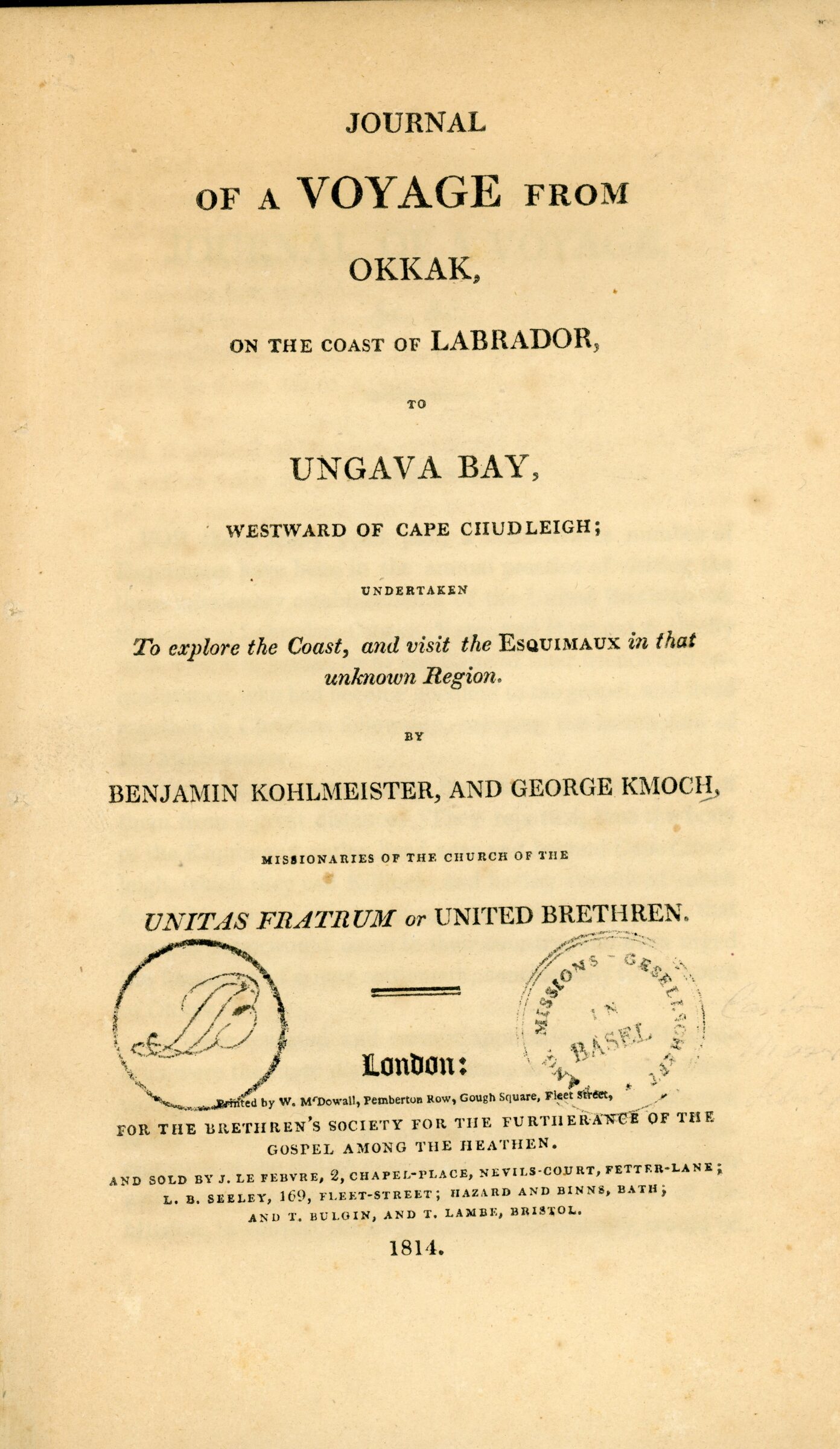
The title page of Kohlmeister and Kmoch’s account of their journey from the Moravian mission at Okkak, Labrador, to Ungava Bay, published in 1814. (Image from the Kenn Harper Collection)
The Inuit-guided Moravian expedition to Ungava, Part 2
In the last instalment, I set the stage for the Moravian missionaries Benjamin Kohlmeister and George Kmoch to enter Ungava Bay, guided by an accomplished Ungava trader, Uttakiyok, who met them on the Atlantic coast near the tip of the Labrador peninsula.
Uttakiyok guided them safely through the dangerous channel at Killinek. Once through, the missionaries saw Ungava for the first time.
“It seemed as if we were transported to a new world,” they wrote.
Compared with the high mountains on the Labrador coast, often with cliffs dropping precipitously into the sea, the Ungava coast was low, “with gently sloping hills, the sea being full of small islands, abounding in sea-fowl.”
On this new coast, the missionaries met Inuit from Saglek on the Labrador coast, more proof that there was considerable Inuit traffic between Ungava and the Atlantic coast. Those Inuit were en route to a summer camp and most, said the missionaries, were “quite ignorant heathen, who had never before seen a European.”
The missionaries commented on the traffic between the two bodies of water: “Some of the Ungava people have come to Okkak, and carry on a trade between their countrymen and that place. They are a kind of middle men, bring fox and bearskin, and exchange them for European goods. These they carry back, and sell at a very advanced price in the Ungava country. They spend two years on such a trading voyage.”
Soon they came to the estuary of a great river at Kangiqsualujjuaq and spent five days exploring the area. It was reported to have plentiful game year-round, as well as wood, fresh water and a good harbour — an excellent location for a future mission, thought the Moravians.

They conducted a ceremony there, claiming the area for Britain and naming the river George River in honour of the king.
They erected cairns on two hills and affixed a plaque made of board to one, explaining in their writings, “We have, on this day, raised this sign, in the name of our king, George III, the great monarch of all these territories, in testimony of our having explored it, and made choice of it, in case we or our brethren should think proper to settle here. To which we called upon all present to bear witness.”
They then continued on in Jonathan’s boat to another river with a wide estuary known as Koksoak [Kuujjuaq]. Again they met Inuit who had never before seen Qallunaat. These Inuit reported being fearful of another race, the Innu, who lived inland and were reported as being unfriendly to Inuit.
About 38 kilometres up that river, which they named South River, they located another good site for a future mission.
“A fine slope extends for about half an English mile, bounded on each extremity by a hill, on each of which we erected high signals,” they wrote.
“The land is even and dry. juniper, currants, and other berries, grow here in abundance, and rivulets run out of the wood at a distance of a few hundred paces from each other.”
They conducted a ceremony similar to what they had done at George River and named the place Unity’s Bay.
There Kohlmeister met an old man named Netsiak who asked him, “Are you Benjamin? I have never seen you with my eyes but at Eivektok [another location in Ungava] have heard your name often mentioned.”
Kohlmeister was so well known to Inuit after almost two decades on the Labrador coast, that his name was known even in Ungava Bay.
One wonders what the actual words used by old Netsiak were. Only a German and English version of this conversation survives. In Nunavut a century and a half later, the biblical name Benjamin was well-known to Inuit and had been adopted by many in the form “Pijamini” or “Pijjamini.”
This may have been the form used in Ungava in 1811.
The missionary report states, “We could not help remarking the difference between these Esquimaux and their countrymen living on the same coasts with our settlements [i.e. the Labrador coast]. The former are very poor, and miserably equipped, whereas the latter, by their intercourse with us and other Europeans, have acquired many conveniences, and are, by barter, well provided with what they want.”
Kohlmeister convened a large assembly of Inuit at or near Unity’s Bay and explained the Moravians’ interest in potentially opening a mission in the area.
Old Netsiak told him, “I am indeed old, but if you come to live here, I will certainly remove hither also, and live with you and be converted.”
Many others expressed a similar wish.
It was now September and winter was rapidly approaching. Neither Jonathan nor the missionaries wanted to risk being stranded in Ungava during a winter for which they were unprepared. They retraced their route of earlier in the season and reached Okkak on Oct. 4.
Fortuitously, the mission ship was there and Kmoch took immediate passage to England with his journal and extracts from Kohlmeister’s diary to report to the Society for the Furtherance of the Gospel. The report by the two missionaries would be published by the Society in 1814.
The stage had been set for the Moravian church to establish the first Christian mission in Ungava Bay. In the next instalment, I will explain what happened next.
Taissumani is an occasional column that recalls events of historical interest. Kenn Harper is a historian and writer who lived in the Arctic for over 50 years. He is the author of Give Me Winter, Give Me Dogs: Knud Rasmussen and the Fifth Thule Expedition, and Thou Shalt Do No Murder, among other books. Feedback? Send your comments and questions to kennharper@hotmail.com.
Intresting story .
Interesting story, the inuit in Nain, Nunatsiavut still carry the last name Kohlmeister.
An observation, I see is that in the past (the early 1800s) the word heathen was often used to justify and buttress the European view of superiority. The want and need to invade and exploit lands and peoples in addition to spreading Christianity, on reflection, is the fact. I am not painting everything black but… Tassumani is a great addition to NN.
Funny thing , these people used to torture and burn their country men during the hey days of the ” spanish inquistion ” in the name of god.
Religion is poison
very interesting how ungava was first discovered by European on an eskimos boat. I thought kangiqsualujjuaq was discovered from inland through George river from Labrador by Europeans.
wonder how did the first contact went with the locals of George river.
thanks kenn.