


Two Arctic sealift ships stuck in Persian Gulf as Iran blocks Strait of Hormuz
Crews are safe as Transport Desgagnés works on contingency plans
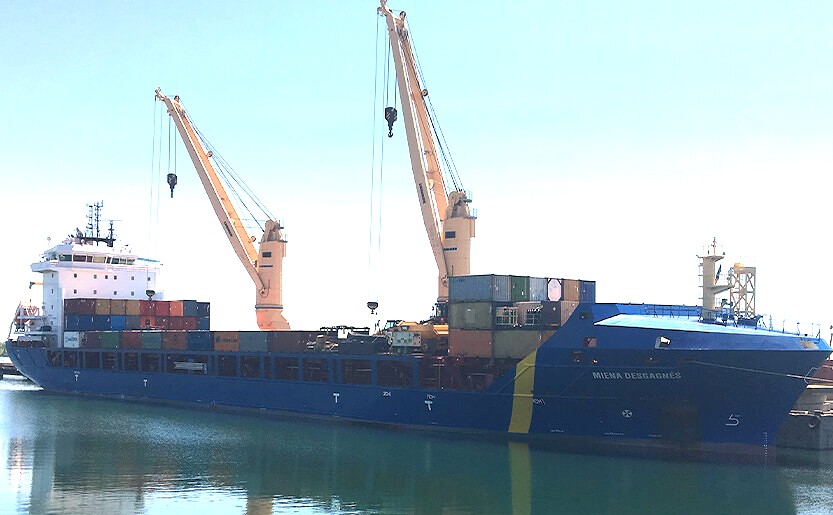
Two Transport Desgagnés sealift ships are stranded in the Persian Gulf, says company president and general manager David Rivest. The Miena Desgagnés, seen here, is the larger of the two trapped vessels. (Photo courtesy of Transport Desgagnés)
Updated on Wednesday, March 18, 2026 at 11:20 a.m. ET.
Two ships that handle annual sealift resupply for Nunavut and Nunavik are stuck in the Persian Gulf as Iran continues its blockade of the Strait of Hormuz.
The Miena Desgagnés and Rosaire A. Desgagnés arrived in the gulf only a few days prior to the United States and Israel’s Feb. 28 surprise attack on Iran. The attack led to an immediate blockade of the 34-kilometre strait that connects the Persian Gulf to the Arabian Sea and points beyond.
Both vessels “are currently in safe anchorage in the Persian Gulf,” said David Rivest, president and general manager of Desgagnés Transarctik Inc.
“Our crews are safe, the ships, as of today, are fully supplied — provisions on board are fully stocked.”
If required, they can easily be restocked, he said.
As of Tuesday, marine traffic data indicates the Miena Desgagnés is located near a port in the city of Al Jubail, on the eastern coast of Saudi Arabia. The Rosaire A. Desgagnés appeared to be more than 200 kilometres east of its sister ship, in international waters of the gulf.
The company is communicating with the ships’ crews more than once a day, Rivest said.
“There are hundreds of ships in the area and we are waiting for the appropriate conditions and instructions to depart the region safely,” he added.
Rivest acknowledged, however, “there is tension in the area, which is abnormal. Our priority right now is focused on ensuring [crew members] are safe.”
Each vessel has a complement of between 15 and 20 crew members.
According to the United Nations’ International Maritime Organization, approximately 3,200 vessels are confined west of the Strait of Hormuz with around 20,000 seafarers affected.
The Strait of Hormuz is a vital shipping route for oil and its closure has led to rising oil prices worldwide.

The Transport Desgagnés vessels trapped in the Persian Gulf carry general cargo.
While the world’s focus has been on oil tankers, the Middle East is also a major exporter of fertilizer. At the same time, the region is highly dependent on imports of food including wheat, fresh vegetables and fruit, according to the World Bank.
One of the Transport Desgagnés ships trapped in the Persian Gulf is tasked with resupplying Nunavut communities in the summer months and the other resupplies mining operations. Ships’ sealift responsibilities shift from season to season, Rivest said.
There has not been a disruption of the shipping company’s business operations so far, but the Transport Desgagnés team is working on contingencies for the upcoming sealift in case things change.
“At this point, it is difficult to do hypothetical scenarios in terms of how long and what the impact could be” on Arctic sealift operations, Rivest said.

The company operates a fleet of 23 ships that operate across the world during the winter months.
Correction: This article has been updated from its originally published version to correctly identify the name of the company that David Rivest is president and general manager of Desgagnés Transarctik Inc.
Let’s hope that Donnie J’s little Epstein distraction is done in time for this year’s sealift in our Canadian Arctic.
I was watching CNN last week and Trump said that , the US has won the war , refuel and get across the pond for , the summer sealift.
Could just airlift the ship back to yellowknife in one of those buffalo cargo planes
Lets hope their dilemma would not be a reason for Nunavut sealift increase this coming summer 2026.
Sealifts almost not needed, stores can hardly use them, not for food since everything has bbf dates.
If store managers were smart they would figure out the support offices and NWC mark up there own freight to hide it from the communities and staff. Genius.
We are too ready and too easily swayed into believing the news as reported by the corporate owned sources as the gospel truth. Money wealth largely determines what the press releases. It was clearly known that Iran was not building a nuclear weapon as was falsely reported as the reason for the onset of the conflict. They were building a power plant.