

‘What do you need?’: Inuk panel speaker discusses working with Inuit communities
Southern companies working in North often make mistake of telling communities what they can do for them, says Joshua Kilabuk Stribbell
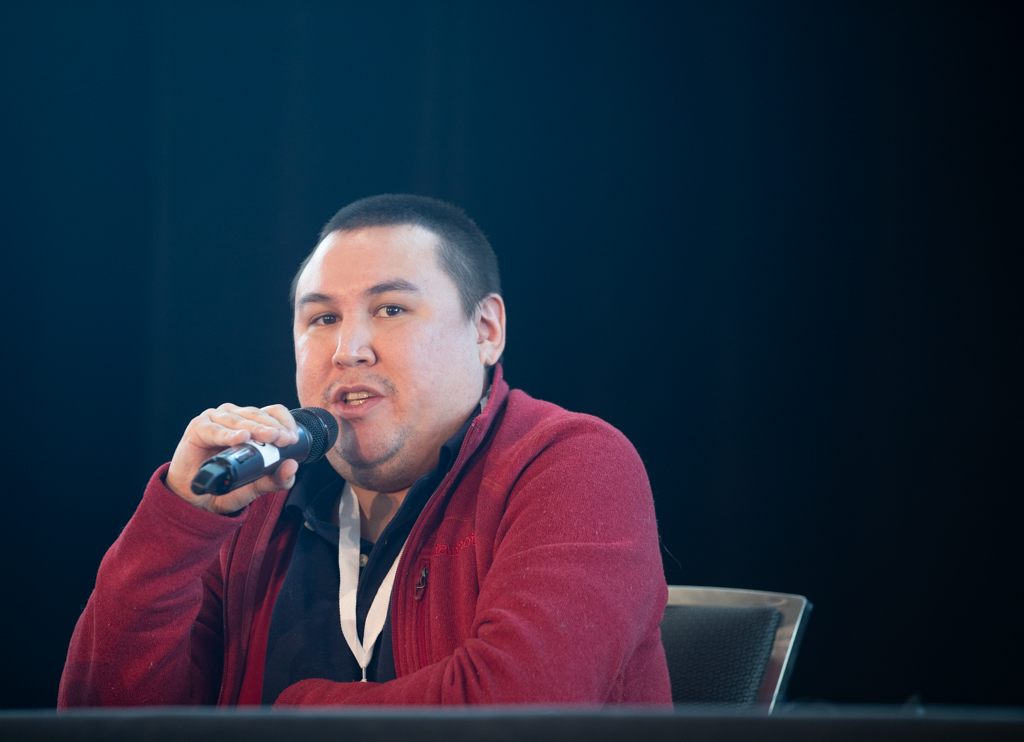
It’s important to avoid a top-down approach when working with northern communities, says Joshua Kilabuk Stribell of Ampere. (Photo by Jorge Antunes)
A representative of a technology company working closely with a regional Inuit association says the most important thing to ask when consulting with a community is, “What do you need?”
Don’t tell them what they can do, said Joshua Kilabuk Stribbell, head of strategic partnerships for Ampere.
“A big part of that is also two-way learning,” he said.
“So it’s not just about designing or looking at a project in two different ways. It’s also understanding that there are two ways of learning together.”
Kilabuk Stribbell spoke Wednesday at the Aqsarniit Trade Show and Conference in Ottawa during a session that addressed using digital resources to create opportunities for Inuit employment and skills development.
Also on the panel were Kent Driscoll, Ampere’s communications director, Kris Mullaly of Qikiqtani Inuit Association and Abbie Hodder of Women in Resource Development.
Kilabuk Stribbell, who is Inuk, noted an important part of the work Ampere does to connect with Inuit communities is the incorporation of what he called two-eyed seeing and two-way learning.

Two-eyed seeing involves viewing the world through both an Indigenous lens and a western lens and combining them into one greater perspective.
Two-way learning promotes a reciprocal relationship between teaching and learning, while giving equal value to community knowledge in decision making.
Ampere — which until late last year was known as the Pinnguaq Association — has been working closely with the Qikiqtani Inuit Association to develop technology-based educational programming for hamlets across the region.
Ampere is a non-profit organization with a mandate to work beside rural, remote, Indigenous communities to support the development of STEAM education.
STEAM stands for science, technology, engineering, arts and math.
“Our partners are equals, ‘nothing about us without us’ is a guiding principle,” Kilabuk Stribbell said.

The four-day Aqsarniit trade show wrapped up Thursday at Rogers Centre Ottawa.
“Women in Resource Development”. To go along with…
Qulliit Nunavut Status of Women Council
Pauktuutit Inuit Women of Canada
Amautiit Nunavut Inuit Women’s Association
Saturviit Inuit Women’s Association
AnânauKatiget Tumingit Regional Inuit Women’s Association
Native Women’s Association of Canada
The Department for Women and Gender Equality
Status of Women Canada
Women’s Initiative Grants
The Women Entrepreneurship Fund
Women’s Enterprise Organizations of Canada
The Fund for Gender Equality
Communities For Gender Equality
The Canadian Association for Girls In Science
The Women’s Art Association of Canada
Women Entrepreneurship Strategy
Women Business Enterprises Canada Council
Canadian Women’s Foundation
National Association of Women and the Law
Canadian Federation of University Women
Business Professional Women of Canada
The Canadian Association of Women in Construction
Federation of Medical Women of Canada
Every time you turn around there’s a new one funded by taxpayer dollars. Good thing we’re trying for equality, this oppression is painful.