


What will Nunavut look like by the end of the century?
Scientists predict Nunavut could exceed 10 C for much of the winter by 2100
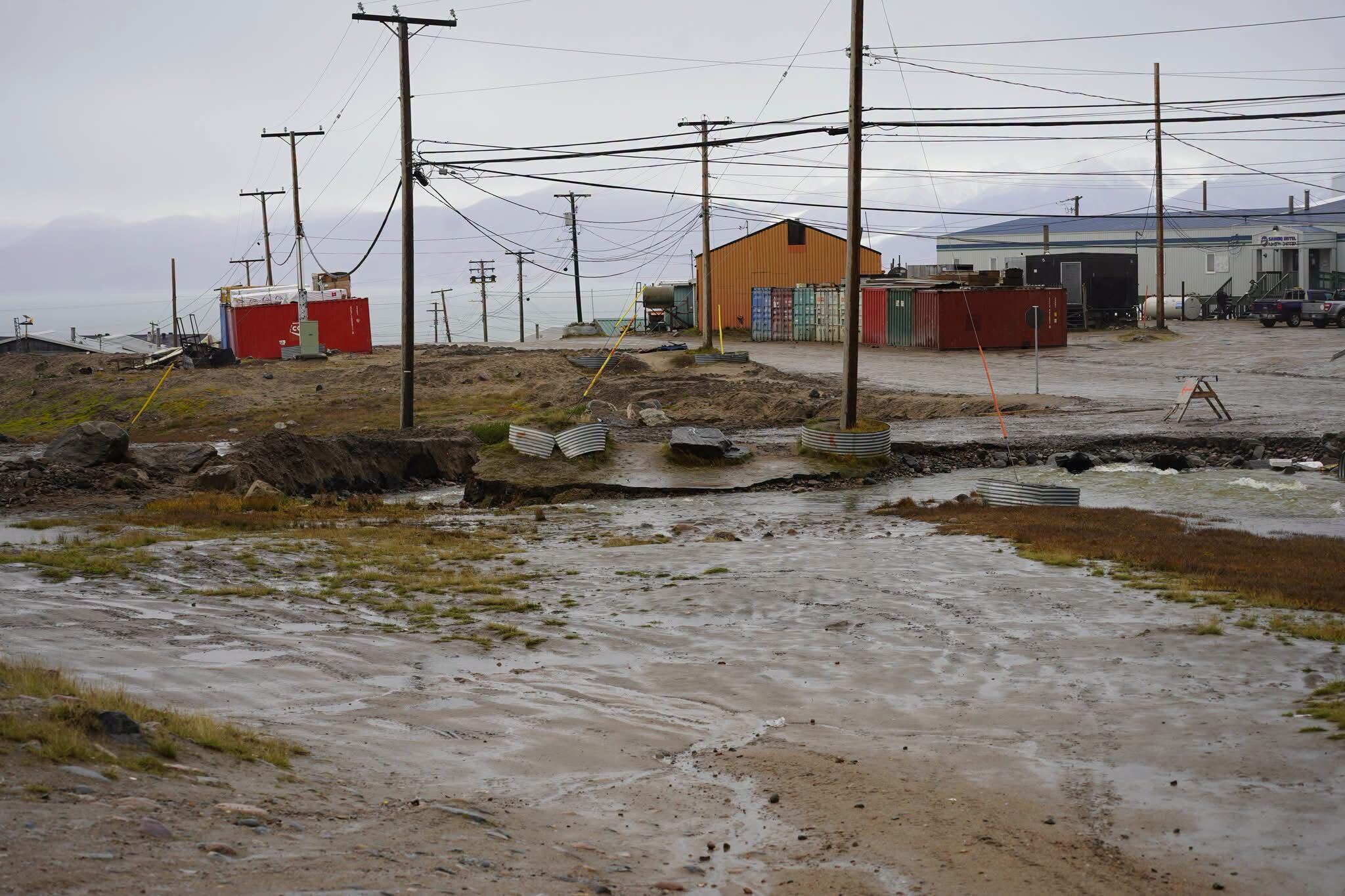
Heavy rains flood Pond Inlet on Sept. 5, leading to washed out roads and bridges. (Photo courtesy of Andrew Tagak)
By the end of this century, there’s an even chance that winter temperatures will exceed 10 C across much of
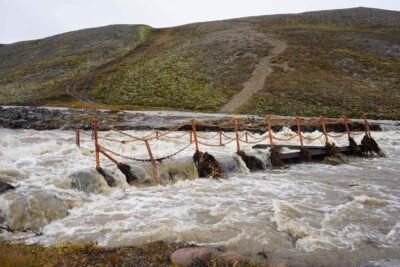
Heavy rains wash out a bridge in Pond Inlet on Sept. 5. (Photo courtesy of Andrew Tagak)
Nunavut, and that glaciers in western Canada could lose more than 75 per cent of their ice, say scientists behind a new climate change forecast, Canada’s Changing Climate.
That report, released in September by climate scientists with Environment and Climate Change Canada and other academics, predicts what Canada’s Arctic might look like if average global temperatures exceed pre-industrial levels by 1.5 C.
That’s the threshold most nations committed, under the 2015 Paris Agreement, to avoid crossing in order to prevent the most severe and irreversible impacts of climate change.
It also considers what could happen if average temperatures rise to 4 C above pre-industrial levels.
The planet is expected to exceed the 1.5 C threshold in the next few years, according to a United Nations Environment Programme report on climate change also released in September. The Arctic has already warmed three times faster than the global average since 1970, according to the federal Environment Department.

Many climate scientists agree some impacts, like sea-level changes, glacier melt, and permafrost thaw, will be irreversible. The oceans are projected to lose sea ice as well, but this loss may be temporary if temperatures stabilize. These changes will alter ecosystems and habitats in significant ways.
Sea ice reflects far more heat than the ocean does, for instance.
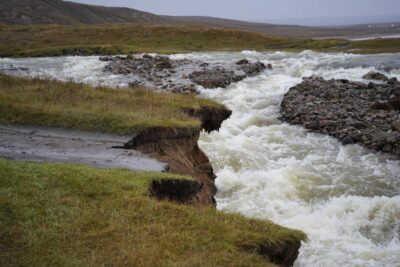
A road once used by ATVs in Pond Inlet on Sept. 5, 2026, is damaged following coastal erosion. (Photo courtesy of Andrew Tagak)
“You see ice- and snow-covered surfaces replaced by dark water that’s now absorbing more heat,” said Gregory W. Thiemann, associate dean of the Faculty of Environmental and Urban Change at York University.
Permafrost also operates as a carbon sink. When it thaws, it releases greenhouse gases like carbon dioxide and methane into the atmosphere, contributing to an increase in global greenhouse gas emissions. The northern permafrost region, which covers Canada, Alaska, Siberia, and Greenland, contains up to three times the amount of carbon currently in the atmosphere, which is why even small releases drastically influence global emissions, a 2025 study in the journal Science highlights.
Permafrost thaw also causes the ground itself to sink. This causes landslides and coastal erosion, threatening homes, roads and other critical infrastructure.

The damage could be “catastrophic,” said Daniel Fortier, a University of Montreal geography professor who studies permafrost, climate change and adaptation in the North.
“The High Arctic is reacting very strongly,” he said, adding permafrost thaw will persist at a rapid pace for some time before the ground begins to stabilize once again.
“Images we see of landslides and gullies forming and things like that, it’s true, it’s happening, but it’s not going to stay like that for 30 years,” he added. “It’s a short-term response.”
Cameron DeLong, director of the Government of Nunavut’s Climate Change Secretariat, described permafrost thaw as the most pressing issue communities are facing.
“We’re seeing the impact of that on a variety of fronts,” he said, adding his office works with builders to ensure they can access the right information about how to plan projects with climate resilience in mind.
Thermosyphon systems, which measure underground temperatures, have been integrated into many buildings in Nunavut, including the new airport terminal in Rankin Inlet, according to Nunavut’s Transportation and Infrastructure Department. These systems, like the one at the Iqaluit Airport, can also be used to remove heat from below to stop thawing.
DeLong said the GN’s adaptation and mitigation priorities include expanding maps of permafrost and climate hazards, which is currently happening in Iqaluit; staying up to date on coastal erosion; emergency planning to assess how well communities are prepared for major weather events like flooding; and updating infrastructure like culverts to reduce the chances of heavy rain causing flooding.
Heavy rain in Pond Inlet last month caused damage to roads and culverts throughout the hamlet.
Resident Andrew Tagak said the flooding was unlike anything he had seen before.
“This year was definitely different,” said Tagak, who is 37 and has lived in Pond Inlet his whole life.
The loss of sea ice from rising temperatures is also impossible to ignore, says Koonoo Tattinuee, president of the Kivalliq Inuit Association.
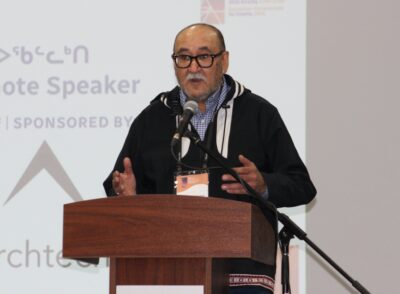
Kivalliq Inuit Association president Koonoo Tattuinee addresses a crowd at the Kivalliq Trade Show in Rankin Inlet on Sept. 22. (Photo by Corey Larocque)
“The Arctic shipping season is getting longer and our waters are changing,” he told a crowd gathered at the Kivalliq Trade Show last month in Rankin Inlet. “The change is not just about the shipping lanes — it affects the animals we harvest, the food security of our families in the future, and the safety of our communities.”
Sea ice coverage in the Arctic and Antarctic reached a new all-time low for the third consecutive year in February 2025, according to the Copernicus Climate Change Service, at eight per cent below average in the Arctic and 26 per cent below average in the Antarctic.
Analysis by the Canadian Climate Institute shows that Canada is far off track to meet its climate targets for 2030 and 2050, the year the government has committed to net-zero emissions. But that doesn’t mean some of the worst impacts can’t still be avoided through collective action, said H. Damon Matthews, a climate scientist and professor at Concordia University among the authors of the Canada’s Changing Climate Report.
“The future is not pre-determined,” Matthews wrote in a recent op-ed in The Conversation. “Increased and sustained climate action can still stabilize global and Canadian temperatures in the second half of this century if we are able to fully decarbonize the global economy and achieve net-zero emissions.”
The GN has set a goal of reducing the territory’s heavy reliance on diesel fuel, and offers subsidies to support Inuit-led renewable energy projects. The program helped finance a solar project in Naujaat, which became operational last month and which now supplies 30 per cent of the community’s electricity.
The territory also offers $5,000 grants to cabin owners who want to install solar panels.
Feel like this article started with a lot of fear mongering and I don’t disagree that the change is very concerning for everything from animals to people to infrastructure, etc., but if the Arctic is 10C for the majority of winter what does that mean for the rest of the world.
Wouldn’t that imply that much of the world would then be completely unhabitable in which case we are in far, far greater troubles than a warm winter!
Now because obviously 10c for the majority of winter makes legitimately zero sense I went and looked. It’s there’s a chance winter temps on average RISE 10c from their average not is 10C for much of winter.
How cute. Chicken little the sky is falling, with an over-the-top climate fear Arctic twist, a month before the United Nations COP 31 is held this coming November 2026. With pre-COP 31 in October. Some forecast COP 31 will be a flop no matter how much climate change fear-hype is pumped out. People have wised up and don’t fall for it any more other than the green cargo cultists. And the bottomless buckets of money for any project in the name of “climate change” have or are drying up.
In the 80’s and early 90’s it was pretty common for the ocean around Iqaluit to be frozen enough to travel on by mid November. Now we’re still seeing large vessels around Iqaluit right up until December and there’s not much travel on the ice until January. That’s not sky is falling rhetoric, it’s real personal observation.
Climate change doesn’t care about whether we argue about if its happening or if its effects will be minor or hugely significant on humanity. It’s sad to me that people choose to equate ignoring the change that is already happening with wising up.