


Wind farm nixed from proposed Meliadine mine extension
Public hearings for Agnico Eagle’s Meliadine mine extension took place last month in Rankin Inlet
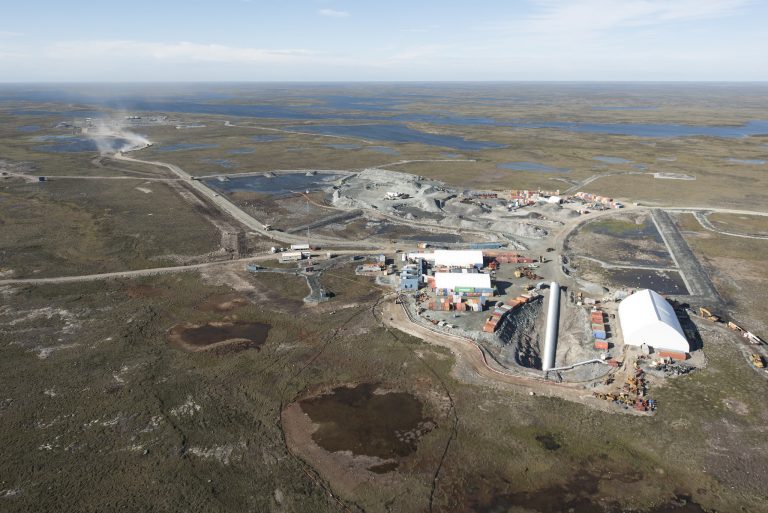
Agnico Eagle Ltd.’s proposal for an extension of Meliadine mine will be assessed by the Nunavut Impact Review Board. But Agnico Eagle’s plans to include a wind farm in the proposal have been excluded. (File photo)
A proposed wind-farm plan for Meliadine gold mine has been scrapped from Agnico Eagle’s proposed extension plans for the mine, as a result of a decision by the Nunavut Impact Review Board.
The Nunavut Impact Review Board held a public hearing on the proposed Meliadine extension in Rankin Inlet from Sept. 12 to Sept. 20. The board assesses the economic and social impact of proposed development projects in Nunavut and makes recommendations to the federal minister of northern affairs about whether projects should be allowed to proceed.
Agnico Eagle submitted a proposal April 14 to the review board to add an extension to its open-pit mine, 25 kilometres north of Rankin Inlet.
The company’s plan called for underground mining in three open-pit areas of the mine, the creation of a pathway between two underground mines, the installation of 11 wind turbines, and the option to build an airstrip near the mine.
In its proposal, Agnico Eagle said the extension would extend the lifespan of the mine, which is scheduled to end in 2032, by 11 years to 2043.
During the public hearing, community members from the Kivalliq Region, northern Manitoba and northern Saskatchewan expressed opposition to the wind farm, according to the review board’s statement.
Initially, Agnico Eagle wanted to build the wind farm next to the mine.
That proposal changed to a location yet to be determined, which was chosen in consultation with the Kivalliq Inuit Association.
The review board concluded in a decision posted to its public registry on Tuesday that Agnico Eagle’s updated wind-farm proposal does not provide enough information on the wind farm’s proposed relocation to properly assess potential environmental or socio-economic effects.
As a result, the review board has excluded wind farm from its overall assessment.
The board now has until Nov. 17 to release a report and recommendations to the Northern Affairs Minister Daniel Vandal.
The review board noted that Agnico Eagle can make a separate proposal for its wind farm in the future, when it has all the necessary information for an assessment to be carried out.
Agnico Eagle spokesperson Casey Paradis St-Onge told Nunatsiaq News that Agnico Eagle will take the time it needs to review the recent correspondence from the review board.
“We remain committed to responsible mining, and we believe that renewable energy solutions, such as wind power, are essential to reducing greenhouse gas emission in Nunavut and achieving a low or zero carbon future,” Paradis St-Onge said.
The Kivalliq Inuit Association did not respond to a request for a comment.
I guess N.I.R.B. would rather use fossil fuels and then cry about global warming after and complain that there are no more animals to “KILL KII,KILL!!” and then blame Agnico for ….. y’know.
Would love to hear the “socio-economic impacts” of a wind farm.
I cannot believe northern Manitoba, and Northern Sask, opposed the wind farm what is wrong with our leadership in Nunavut to let this happen, every river in Northern Manitoba is damed, and Northern sask, has 6 uranium mines, and not once was anybody in Nunavut asked to attend one of their meetings, and express any opinion, this is just plain stupidly, to let this happen, where are our leaders wake up
Even green projects have potential for negative effects that should be considered. A wind farm would create jobs to assemble, install, maintain, service, etc., Will they be locally-sourced jobs like those of the fuel truck drivers that will no longer be needed for the site, fuel contracts for local suppliers, etc. Consider all angles to make an informed decision and build the best project possible.
Training programs are offered to Inuit at every turn they can take. The mines consistently fly into our community to help people write resumes and apply for work with all training paid for so that they can take over these jobs. They keep trying to hand these things over to Inuit, but it takes dedication and commitment to sustain these things long term. Those two components can’t and never will come from the mining companies, or the government. Federal or local.
I was at the public hearing. Throughout the review over more than a year Agnico refused to listen to everyone who told them that the location of the wind farm needed to change, then only in their closing comments at the hearing did they say they’d heard the concerns and would pick another location with KIA… but that N.I.R.B should go ahead and give them approval for the wind farm now anyway thanks very much. I think the N.I.R.B. got this totally right, there is support for a wind farm but the location is important or it could interfere with calving caribou, so it needs to be assessed before it is approved. I don’t think anyone is against wind power or alternative energy, Agnico is trying to have their cake and eat it too, building in the cheapest spot for them regardless of what’s best for caribou and the community.
Amazing how every square inch of land anyone wants to develop for any purpose at all, especially mining, is the exact same place caribou calve. How crazy is that?
I still maintain that the Inuit Associations should consider building caribou farms as some countries do with reindeer.
Full-time employment for those who want it.
Then, you can have your cake (caribou) and eat it too.
Already done for cattle, sheep, swine, turkeys, and chicken.
Already done with Reindeer too. The Sami people of Lapland have been farming Caribou for many generations. Let’s actually use this land to feed the people. If country food is so important let’s create large protected areas to farm the caribou instead of hunting their swindling herds until there is nothing left.
You can’t do that because that would tank the price of caribou being illegally sold on Facebook. This would be devastating to the economy because farming is hard.