


Youth lead Iqaluit march for truth and reconciliation
Event encourages the next generation of Inuit leaders on national day honouring residential school survivors and victims

Hope Akeeagok, nine, left, and Arnariinaq Mike, eight, carry orange flags at the head of the march to honour the National Day for Truth and Reconciliation in Iqaluit on Tuesday. (Photo by Daron Letts)

Hope led the march in Iqaluit on Tuesday afternoon on the National Day for Truth and Reconciliation.
Specifically, that’s nine-year-old Hope Akeeagok who walked with her friend Arnariinaq Mike, eight, at the head of the crowd of about 400 people. Each girl carried an orange flag commemorating residential school survivors and honouring those who never returned home.
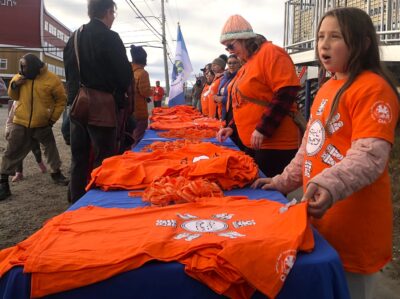
Nana Williamson Bathory, 10, hands out orange T-shirts from the Qikiqtani Inuit Association at the start of Tuesday’s march for the National Day for Truth and Reconciliation. (Photo by Daron Letts)
“It was a little bit heavy,” Akeeagok said of the flag, after the march.
Despite 37 km/hour winds, both girls carried their furiously flapping flags the full length of the parade route, which stretched from the Four Corners intersection about a half-kilometre to Iqaluit Square in front of the Elders Qammaq.
Akeeagok’s perseverance is emblematic of the path toward healing and prosperity that needs to continue, said former Nunavut MP Jack Anawak, a residential school survivor.
“What we have to do is pass on our knowledge to the youth and for them to take up the flag,” he said.
“They have much more oomph than us, and I think that I have better confidence that they’ll come through for us.”
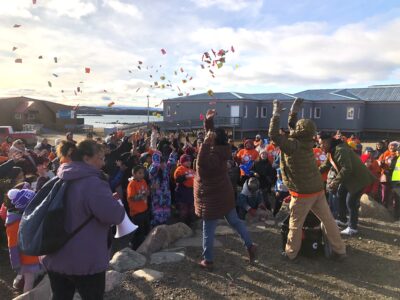
Organizers with the Qikiqtani Inuit Association hurl candy during a parlak in Iqaluit for the National Day for Truth and Reconciliation. Close to 400 people turned out for the event, many of them children. (Photo by Daron Letts)
This year marks the 10th anniversary of the release of the Truth and Reconciliation Commission of Canada’s final report that documented the stories of survivors and made 94 recommendations for actions to address reconciliation with Indigenous Peoples.
“The stark truth about the residential school system and the stories bravely shared by survivors in the report’s six volumes sparked a national awakening,” said Gov. Gen. Mary Simon, in a statement.
“I encourage all Canadians to renew their commitment to reconciliation.”
The national day offers an opportunity for the young generation of Inuit to learn about the struggles of their grandparents, said Paul Quassa, a residential school survivor who went on to serve as Nunavut’s fourth premier.
“It’s very important for this generation to know where they came from,” he said.
“Inuit from time immemorial survived in the harshest climates, survived the hardest trauma, and so did we. And sure enough, this will teach our younger generation you can survive anything as long as you put your mind to it and keep standing up.”
Organizers with Qikiqtani Inuit Association cut the event short by speeding up some of the speeches to give the crowd a break from the wind.
A parlak, or candy toss, capped off the event to the delight of the many children in attendance.
For anyone struggling on this day, the Nunavut Kamatsiaqtut Help Line offers telephone support at 1-800-265-3333.

The National Indian Residential School Crisis Line can be reached at 1-866-925-4419.
Truth: most north American “1st nations” used to fight each other in terrible, violent and gruesome wars and only progressed to hunter gatherer.
Reconciliation: after European contact everything changed. infant mortality dropped, lifespan increased, standard of living rose. Sanitation. Health and medicine. Education. Roads. Food security. Public safety. Peace.
We are way better off now than before European contact. This brief little blurb barely scratches the surface of how bad, cruel and brutish life was before that. There’s a reason there’s no written record, tribes slaughtered each other relentlessly.
This is my perspective as a “1st nation” historian.