

Inuit staff scarce at Nunavut youth rep office
“We want a more representative workforce to help serve our population”
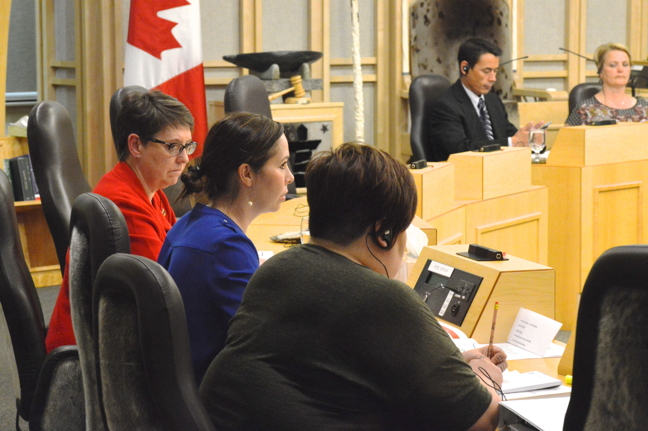
Appearing before the Standing Committee on Public Accounts, Independent Officers and Other Entities Sept. 15, Shelly McNeil-Mulak, Nunavut’s representative for children and youth tells MLAs that staffing, and particularly beneficiary hiring, has been a challenge for her small office. (PHOTO BY STEVE DUCHARME)
The office of Nunavut’s Representative of Children and Youth is understaffed and struggling to fill positions with Inuktitut-speaking beneficiaries.
Child and youth representative Sherry McNeil-Mulak appeared before the Standing Committee on Public Accounts, Independent Officers and Other Entities, nearly one year after her Iqaluit office opened to the public, in a televised hearing at Nunavut’s legislature, Sept. 15.
“We fully recognize that this is an issue for our office,” she told MLAs in the standing committee.
Only two beneficiaries currently work at the representative’s office and only one of them is fluent in Inuktitut.
That employee, a frontline worker who routes all inquiries among the office’s staff, is responsible for all Inuktitut correspondence, as well as any translation and interpretation as required, McNeil-Mulak said.
“We recognize that it’s not ideal, but at times we need to rely on [contracted] interpreters to help support our work,” she said.
According to employment figures given to the standing committee, the Child and Youth Representative office has seven positions filled out of a possible nine, but has never had more than three beneficiaries on the payroll at any point in the office’s three-year existence.
Tununiq MLA Joe Enook asked McNeil-Mulak how her office plans to improve those statistics to serve clients that are predominantly Inuit.
“The children and youth of Nunavut, the majority of them are Nunavut beneficiaries and we tend to think that the majority of clients that you will be receiving are Inuit,” he said.
McNeil-Mulak responded that her office cancelled job ads and retooled advertising to cull more beneficiary applicants, which netted one additional Inuit employee last year.
Another position, currently occupied by a non-beneficiary, was set up as a term position when a qualified beneficiary could not be hired.
McNeil-Mulak said her office is now in the final stages of hiring a beneficiary intern to train into that position as an indefinite employee.

“We want a more representative workforce to help serve our population well,” she said.
McNeil-Mulak added that her office is still in the process of developing its services and completed nearly 200 tasks prior to opening in September 2015.
The office is also continuing to develop a case database for clients, as well as a “systemic investigations” database, which will analyze government policy and services, and a team charged with analyzing critical injury or death cases involving youth.
So far, McNeil-Mulak said her office has identified 24 systemic issues stemming from files handled so far but is awaiting the completion of the internal database to prioritize the issues.
Netsilik MLA Emiliano Qirngnuq asked how the Representative for Children and Youth office can serve all of Nunavut when all it’s staff are currently based out of Iqaluit.

“We are Iqaluit-based and we recognize that presents some challenges, because we have responsibilities for the entire territory,” McNeil-Mulak said.
“I think now that we’re open, one of the challenges is just the sheer volume of work for a small office that has to be done, so we fully acknowledge that.”
Office staff have completed visits to 11 communities so far, McNeil-Mulak said, and have assigned regional files to the office’s three advocacy specialists.
McNeil-Mulak added that the office plans to visit Nunavut’s remaining communities during the current fiscal year.
“While there are some universal issues affecting children and youth in Nunavut there are some very distinct issues depending on the community,” she said.
When asked if the office has any future plans to assign dedicated advocates to work in communities outside Nunavut, McNeil-Mulak didn’t offer a conclusive answer.
“It’s hard to say at this point in time,” she said. “When we go to communities, community leaders ask us the same question.
“But as a new office that’s trying to establish ourselves in Iqaluit first, it’s not something, at this point in time, that we’ve thoroughly explored.”
MLAs at the standing committee session will draft their review of McNeil-Mulak’s appearance in the coming weeks, ahead of the fall sitting of the Nunavut legislature, set to begin Oct. 19.
(0) Comments