

Hydro Quebec: our dams have no impact on early Hudson Bay freeze-up
But researchers study connection between freshwater release and sea ice

This Hydro-Québec map shows its hydroelectric complex at La Grande Rivière, just south of Nunavik’s Hudson Bay coast. (IMAGE COURTESY OF HYDRO-QUEBEC)
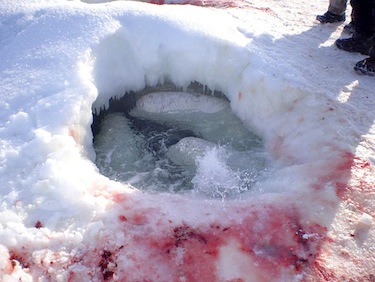
This photo shows some of the 70 belugas which were trapped in the ice near Sanikiluaq in February 2013. (FILE PHOTO)
Hydro-Québec says its hydroelectric projects in northern Quebec have no impact on sea ice in Hudson Bay.
The Quebec power corporation made the public statement Aug. 3 in response to a story that recently appeared in the French-language daily newspaper Le Devoir.
The story written by a journalist who visited the Nunavik community of Umiujaq earlier this year, highlighted the signs of a changing climate, as witnessed by Inuit living along the Hudson Bay coast.
Among the changes noted by local communities: a drop in the water’s salinity, which has led to an abrupt freeze-up along the coastline and with it, the entrapment of species like eider ducks and beluga and killer whales.

Marine researchers have suggested there could be a connection between those early freeze-ups and the plumes of freshwater sent into Hudson Bay by Hydro-Québec’s huge dams.
But the power corporation says that Grande Rivière, where its dams are located, flows into James Bay and not into Hudson Bay, which lies about 100 kilometres farther north.
“Moreover, the hydroelectric developments of the La Grande complex do not interrupt the natural flow but modulate it depending on the seasons,” Hydro-Québec said in an Aug. 3 release.
The corporation, which is an agency of the provincial government, said it’s undertaken a number of studies on its La Grande water complex discharge.
The studies have revealed that in winter, the zone of influences around its dams is limited to a maximum distance of 60 kilometres around the Grande Rivière estuary.
In other seasons, that zone is no greater than 30 km, Hydro-Québec said, and never reaches as far north as Hudson Bay.

Allegations to the contrary have no scientific basis, Hydro-Québec said, and are more likely due to climate variations.
But the concerns noted in the Le Devoir article are not new; for years, marine researcher Joel Heath has pushed for research into the connection between freshwater plumes sent into Hudson Bay from Hydro-Québec’s dams and the quick freezing of sea ice.
In February 2013, more than 70 belugas remained trapped in two six-foot-wide breathing holes in the sea ice about 96 km south of Sanikiluaq.
That entrapment, during the coldest part of the winter, corresponded “to the peak demand at Hydro-Québec,” said Heath, who studies the eider duck population around Sanikiluaq.
Now, a team of researchers have embarked on a four-year, $9.14 million research project to look at the impact of fresh water in Hudson Bay.

Since 2012, Hydro-Québec scientists have kept in touch with Heath to share the results of its studies, the power corporation said.
Hydro-Québec said Aug. 3 that is “active in the fight against climate change,” with 99 per cent of the energy it produces coming from renewable resources.
(0) Comments