

Inuit innovation on display at exhibition of rare Kinngait drawings
‘Worlds on Paper: Drawings from Kinngait’ at McMichael gallery in Ontario until Aug. 24

Pudlo Pudlat’s untitled 1985–86 drawing, made with coloured pencil and felt-tip pen, appears in the Imaginary Cities section of “Worlds on Paper: Drawings from Kinngait,” which is on view at the McMichael Canadian Art Collection in Kleinburg, Ont., until Aug. 24. (Photo courtesy of McMichael Canadian Art Collection)

Nearly 90,000 Inuit drawings long held in storage at the McMichael Canadian Art Collection in Kleinburg, Ont., are now being shown to the public, many for the first time.
A four-year digitization project led to the major new exhibition curated by Emily Henderson, an Inuk curator and anthropologist.
The archive, encompassing work created between 1959 and 1990, was largely unseen outside of Kinngait where the drawings were produced.
Henderson said the McMichael holds the artworks in trust. They remain the property of the West Baffin Eskimo Cooperative, with the agreement that they would be digitized.
Photographer Ed Burtynsky developed a machine in 2023 capable of capturing high-resolution digital images rapidly, which sped up a process that had been ongoing since 2019. The result was a fully digitized archive of the roughly 90,000 works by December 2023.
Just 200 were selected for display in the current exhibition, titled Worlds on Paper: Drawings from Kinngait. It opened March 8 and runs until Aug. 24.
Henderson said she had just over a year to curate the show, and even less time to select the drawings to be displayed. As the process evolved, themes emerged.
The final show is divided into four main sections: early graphite works from the 1960s; depictions of domestic and interpersonal life; art exploring Christianization and trade; and landscapes both real and imagined.
The early graphite section includes a focus on artist Kenojuak Ashevak, including her two 1950s sealskin bags with bovine leather sewn on top, one of which depicts women harvesting.
“That’s not imagery we associate with Kinngait,” said Henderson. Her theory is that the bag may have been crafted by Ashevak when she lived down south for two years receiving medical treatment in Quebec City.
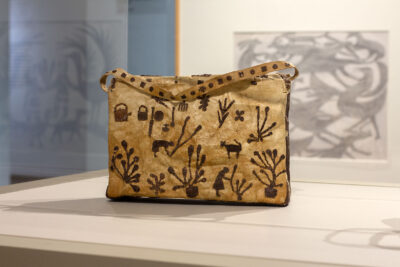
A 1950s sealskin bag by renowned Kinngait artist Kenojuak Ashevak, featuring bovine leather details, is part of Worlds on Paper, an exhibition at the McMichael Canadian Art Collection in Kleinburg, Ont. The show runs until Aug. 24 and features 200 works selected from a newly digitized archive of 90,000 Inuit drawings. (Photo courtesy of McMichael Canadian Art Collection)
The final room focuses on landscapes, both literal and futuristic, including works by Kimmirut artist Kingmeata Etidlooie.
“She’s drawing her community, but there’s a little bit of a twist to it,” said Henderson.

“These pictures of fantastical architectural works — high-rises, or fantastic kinds of new buildings — on what appears to be an Arctic landscape, are artists adding their own vision about what the Arctic could look like in their own imagination or plausible futures.”
A feature on machinery and innovation showcases Inuit as the “fantastic innovators” they are, said Henderson, such as the 1980s work by Pudlo Pudlat depicting airplanes and helicopters, or snowmobiles drawn by Kananginak Pootoogook.
“A lot of the work that was coming out of the North during this time focuses on wildlife or traditional hunting, shamanic scenes,” Henderson said.
“But there was all this other kind of technology, engineering, and innovation that Inuit have been producing since time immemorial that don’t show up quite as frequently when they hit the market.”
A smaller secondary show titled Dreaming Forward showcases work made after 1990.

The entire archive, hosted permanently on a website called Iningat Ilagiit — Inuktitut for ‘A place for family’— was designed for Inuit and non-Inuit audiences.
“When Inuit come through, I hope that you could see aspects that are recognizable from daily life,” said Henderson.
For non-Inuit viewers, she hopes to broaden perceptions.
“There’s a very narrow, a little bit romanticized vision of Inukness that sometimes makes its way into popular culture. Being able to see this collection from Inuit artists directly that deal with so many other aspects of their lived experience is really important.”
Curating the exhibition was a “curator’s dream,” she said.
“It’s humbling, because there is a huge sense of responsibility as I’m Inuk, but this is not my community,” said Henderson, who is Greenlandic Inuit and based in Guelph, Ont.
“Trying to steward other people’s stories in as sensitive a way as possible was extremely important to me.”
(0) Comments