


Aua’s Homily – Qujannamiik
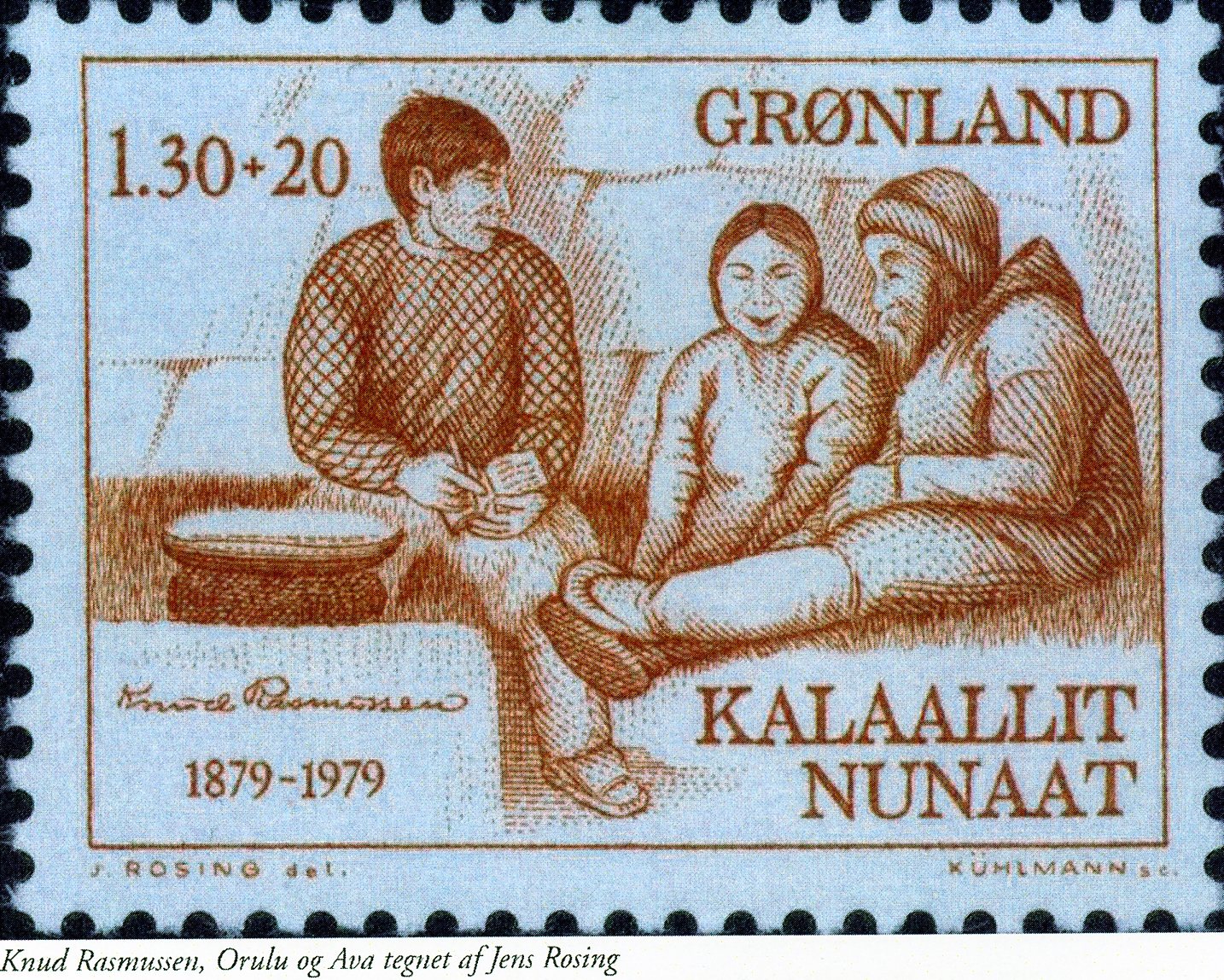
The shaman Aua and his wife Urulu appear with Knud Rasmussen on a Greenlandic postage stamp in 1979. (Photo courtesy of Kenn Harper collection)
On the Fifth Thule Expedition, the Danish-Greenlandic explorer and adventurer Knud Rasmussen had the good fortune to meet Aua, a renowned shaman of the Iglulingmiut Inuit.
Rasmussen met Aua early in the expedition, in 1922, and spent time with him before leaving for Baker Lake and the inland Inuit in the interior of the Kivalliq region.
His time with the shaman was productive and he learned much about ancient Inuit customs and beliefs. However, he felt Aua was not telling him the whole story, that he was holding back out of fear of offending his helping spirits.
“A faithful spirit conjuror,” wrote Rasmussen, “cannot disclose the secrets of his life without weakening his relationship to the supernatural.”
And so the old shaman, although helpful and co-operative, showed a certain reticence.
Following his trip to inland Kivalliq, Rasmussen returned to his headquarters at Danish Island near Repulse Bay in the early autumn. He wanted to spend more time with Aua before leaving on his great sled journey across the top of North America to Alaska.
But when he visited the shaman again, he realized immediately that something had changed. While Rasmussen had been away, Aua had converted to Christianity. This was not because of the arrival of any missionaries — it would be many more years before the first Christian missionary would visit the area.

Instead, it was because an Inuk named Umik had arrived from Pond Inlet bringing a version of Christianity that he had learned from another Inuk there.
Rasmussen had little to say about the conversion of the Iglulingmiut and Aivilingmiut to Christianity, but his colleague Therkel Mathiassen wrote that the adherents to the new religion were expected to abstain from work on Sundays, gather periodically in Umik’s snowhouse, and sing hymns which he had taught them.
“What is more,” he wrote, “the hunters were to bring their booty to him and he would distribute it.”
When Rasmussen heard of Aua’s conversion, he worried this might cause the old man to refuse to discuss the old beliefs. But it was the opposite that happened.
“To my great joy, he answered that this would not be the case,” Rasmussen wrote. “He explained that he indeed had sent away his helping spirits, as he had no more use for them, but that this was the reason why he could now tell all the secrets, which had been too sacred for him to communicate in the past.”
The old man was very forthcoming, and Rasmussen learned much from him that he had not heard before.

Although Rasmussen wrote little about Aua’s new beliefs — he was preoccupied with the old beliefs and traditions — he did write about a sermon Aua preached in his snowhouse while Rasmussen was there. The audience was Aua’s extended family and perhaps a few friends.
This sermon was very much like a homily a Christian minister might preach to his congregation today, taking a Bible passage as the point of departure and expounding on it.
In the case of Aua, he focused on the one word “qujannamiik,” meaning “thank you.”
His message was that a person must give thanks for everything he or she encounters in life, whether good or bad. Tolerance, mercy and helpfulness should be paramount in people’s lives. Believers must freely confess their faith without worrying that other people might not share their beliefs. A believer must face life’s destiny calmly, and no annoyances should lead them to anger.
Even if meat caches were plundered by foxes, wolves or bears, his message went, in our speech we must still show thankfulness because all animals fear hunger in the same way that we do, except that they do not have man’s wisdom that enables them to invent special weapons to help them in the struggle for food.

Therefore, we should not be angry that they seek to satisfy their hunger, even though their actions may be to our detriment. And what applies to animals applies even more to humans.
As soon as you hear that people in a camp are in need, he said, you must help them to the full extent of your ability. If you follow these commandments, you in turn will receive help throughout your own life, including protection against dangers and success in the hunt, and no power in the world will be able to threaten you with misfortune.
This was probably the first Christian sermon given by an Inuk in Canada and written down in the historical record. It must have been a powerful message to those in Aua’s camp.
You will scour the English-language publications of the Fifth Thule Expedition records in vain in search of this vignette. It appears only in Rasmussen’s popular Danish-language account of the expedition, “Fra Grønland til Stillehavet” — “From Greenland to the Pacific Ocean.”
Taissumani is an occasional column that recalls events of historical interest. Kenn Harper is a historian and writer who lived in the Arctic for over 50 years. He is the author of Give Me Winter, Give Me Dogs: Knud Rasmussen and the Fifth Thule Expedition, and Thou Shalt Do No Murder, among other books. Feedback? Send your comments and questions to kennharper@hotmail.com.
First page of the Bible gives man dominance:
Genesis 1:26 “And God said, Let us make man in our image, after our likeness: and let them have dominion over the fish of the sea, and over the fowl of the air, and over the cattle, and over all the earth, and over every creeping thing that creepeth upon the earth.”
Thank you for the story. I understand the movie by Zacharias Kunuk and Norman Cohn, ‘Journals of Knud Rasmussen’ better now, contextualizing the adaptation from shamanism to Christianity. The principles continue to live within us, passed to each generation as living commandments. It does not matter if there is one vignette surviving; all of us carry the teachings in our hearts. My grandfather Awa did not like to speak of shamanism, born after Aua’s passing, and therefor influenced by the missionaries. But he was brought up by his father Uyarak who would have instilled in him Aua’s way of living; to respect all animals and human beings – that none of us are above others, and equally entitled to breathe in this short life on earth; to be thankful for animals that we catch, for giving up theirs to sustain us. If we are disrespectful and ungrateful, it will come back and haunt us either in this earthlife, in the afterlife thereafter or in the next generation of our lineage. My grandfather gently scolded me to respect flies and mosquitos even. I never once observed him act out in anger, even if his dog messed up his camping sites. It takes incredible mental and psychological strength not to act out in anger, even if the opportunities present themselves daily. One must learn to elevate beyond the limitations of emotions, which requires being guided by our inner spirits to always choose the right path towards a harmonious life. It was easy for Aua to convert, because the principles of being guided towards the good life also existed in Christianity, to always strive for the goodness of humanity and quell the ‘evilness’ inherent in all of us, to achieve harmonious relations that would benefit oneself and of others. Willingness to adapt and adopt other cultures meant collective evolution. Inuit knew we had always evolved from our prehistoric roots in Asian-Siberia and Pacific Aborigines. It therefore is futile to stick to old ways and can only bring sickness from stagnation of evolution. Both of my maternal and paternal grandparents were always extremely grateful to leave behind a very harsh way of life and embrace the goodness of new cultures. I have a sense Aua didn’t want to offend his previous spirits, as they guided him immensely for the goodness of life, and to adopt new ones might have felt like a rejection to them. But in reality, all of us have merged our old spiritual beliefs to make our own version of Inuit Christianity. It is no longer an old British or Roman form of religion, where ‘evil’ persons are heavily penalized, shamed and condemned for life and the afterlife. But rather a continuation of fostering the best of our inner selves towards kindness of all other living beings. Thank you for the articles, I learn of my ancestors through your research of our history.
Thank you for your perceptive comments.