


‘Our homes come plug-and-play’: 9 modular homes arrive in Cambridge Bay
Pre-fabricated homes have been purchased for public housing by Nunavut Housing Corp.
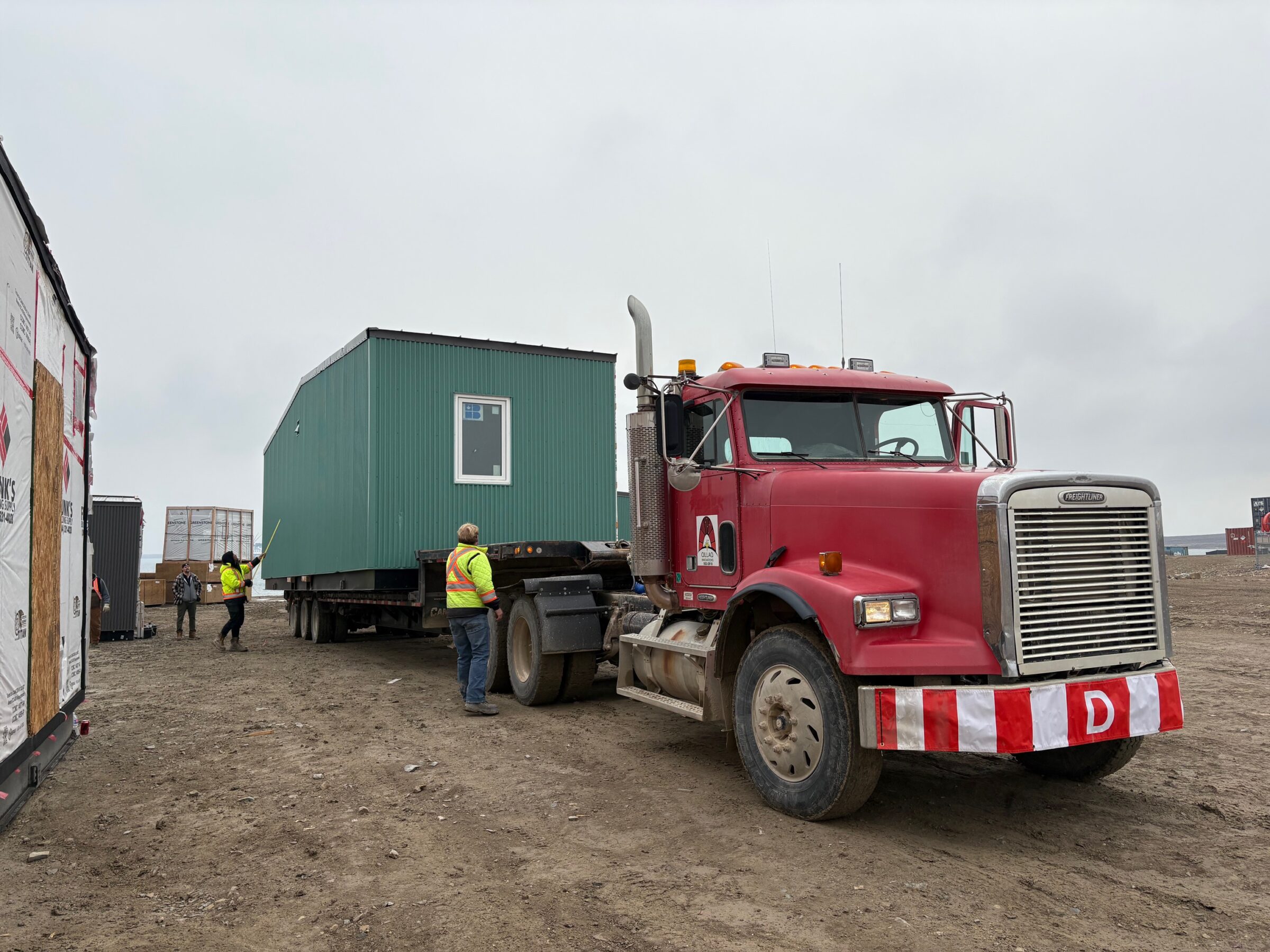
A crew from Arctic Modular Homes transports the first of 22 modular pods through the streets of Cambridge Bay on Sept. 3. The pods, which will be assembled into nine new homes — four four-bedroom units and five two-bedroom units — are part of a project expected to be completed within nine weeks for the Nunavut Housing Corp. (Photo courtesy of Amanda Doiron)


A kitchen in one of Arctic Modular Homes units in Cambridge Bay, is installed and ready for use. The modular home arrives complete with appliances, cabinets, and fixtures, reducing on-site construction time. (Photo courtesy of Amanda Doiron)
Close to two dozen “modular puzzle pieces” were transported through the streets of Cambridge Bay last week, each one to be assembled into nine new homes in the community.
It was the largest delivery yet for builder Arctic Modular Homes, said co-founders Amanda Doiron and her husband Stuart Rostant.
Four four-bedroom houses and five two-bedroom homes — assembled from 22 prefabricated “pods” — are being installed for Nunavut Housing Corp. and will be managed locally as public housing.
Doiron and Rostant are architects who have lived in Cambridge Bay for 15 years. They launched the company in 2023 after years of testing northern construction methods through their parent firm, CHOU Consulting & Development Inc.
“For us, going from an on-site builder to a modular builder, it became pretty clear that the risk, the time, the cost we were dealing with every single year just didn’t seem feasible,” said Doiron.
By building units in their factory down south in Winkler, Man., Arctic Modular Homes eliminates the northern risks caused by short building seasons and extreme weather, she said. The pods arrive in Nunavut fully drywalled, painted, floored and furnished.
“Our homes come plug-and-play,” Rostant said.
“When you walk into one of our modular units, you’ll see a fully furnished kitchen, blinds installed. It’s all there.”
Doiron said modular construction also reduces the amount of waste sent to landfills in the North because there is no leftover construction material.
The homes are built with insulated panels designed to be two to four times more energy-efficient than conventional stick-frame construction, Rostant said.
The construction material is also mould resistant.
No matter how efficient the process is, though, the company still faces challenges.

Once the housing units leave the factory in Manitoba, it takes two to three days to truck them to Quebec, followed by 10 to 12 days at sea before they reach Cambridge Bay.
The barges don’t usually arrive until late August or early September. That leaves just a narrow window to install the homes before winter sets in.
Cash flow is another challenge.
The pods for 2026 assembly are being built in advance at the Arctic Modular Homes factory, which means much of the construction cost must be covered long before the homes are sold or shipped, Rostant said.
“It’s very difficult for us to build homes without getting paid,” he said. “Finding partners like [Nunavut Housing Corp.] is very important for us.”

In 2021, the couple sold their first modular homes for about $460,000, fully furnished. Since then, construction and shipping costs have risen by 50 to 60 per cent, they said.
“For us, if we can sell homes where the mortgage is no more than $500,000 — say, a four-bedroom for $500,000 and a two-bedroom for $300,000 to $350,000 — that would be fantastic,” said Doiron.
The two-bedroom models on the Arctic Modular Home website are advertised at 1,008 square feet, which comes out to $347 per square foot at the $350,000 price point.
Doiron said she couldn’t give a total cost to Nunavut Housing Corp. for each home, including shipping and construction costs, because that work is not done yet.
Nunatsiaq News reached out to Nunavut Housing Corp. to ask about costs for these homes, but has not received a response.
Arctic Modular Homes is currently working with an eight- to 12-person crew aiming to complete the nine homes for Cambridge Bay in nine weeks.
For now, the company is focused on building in Cambridge Bay but hopes it can expand to other communities in the future.
Rostant said the modular approach won’t solve Nunavut’s housing crisis on its own, but it is helping to fill a critical gap.
“We’re just a small piece of a large puzzle,” he said. “If we want to bring all these homes up north, Nunavut doesn’t have the capacity to actually build them all from the ground up. Modular has a part to play.”
Stuart and Amanda are doing great work! Great people indeed.
So, my question is – where are all the materials to build and furnish these homes coming from? Where is the material produced/manufactured? Are we supporting China? Trump? Or are we supporting Canada, by purchasing home-made materials?
Building the homes in Manitoba, then shipping to Quebec, then shipping to Cam. Bay. Seems convoluted. Why not truck them to Tuk then barge them to Cambridge Bay. There must be some barges available in the Beaufort Area. Just saying.
Take a look at a map. Winkler Manitoba to Montreal is about 2300 km if you stay in Canada the whole way.
Winkler to the start of the Dempster Highway near Dawson City is 3800 km, then about 740 km up the Dempster to Inuvik, then another 138 km to Tuk, giving a total driving distance of about 4,678 km. So, twice as far to drive, which is much more than twice the time to travel, as the Dempster isn’t exactly a paved four-lane (or even two-lane) highway.
Then, of course, there are no barges in the west any more that come from Tuk.