


In search of the ‘best’ water, I end up above the Arctic Circle
Why many Nunavummiut swear by their local sources
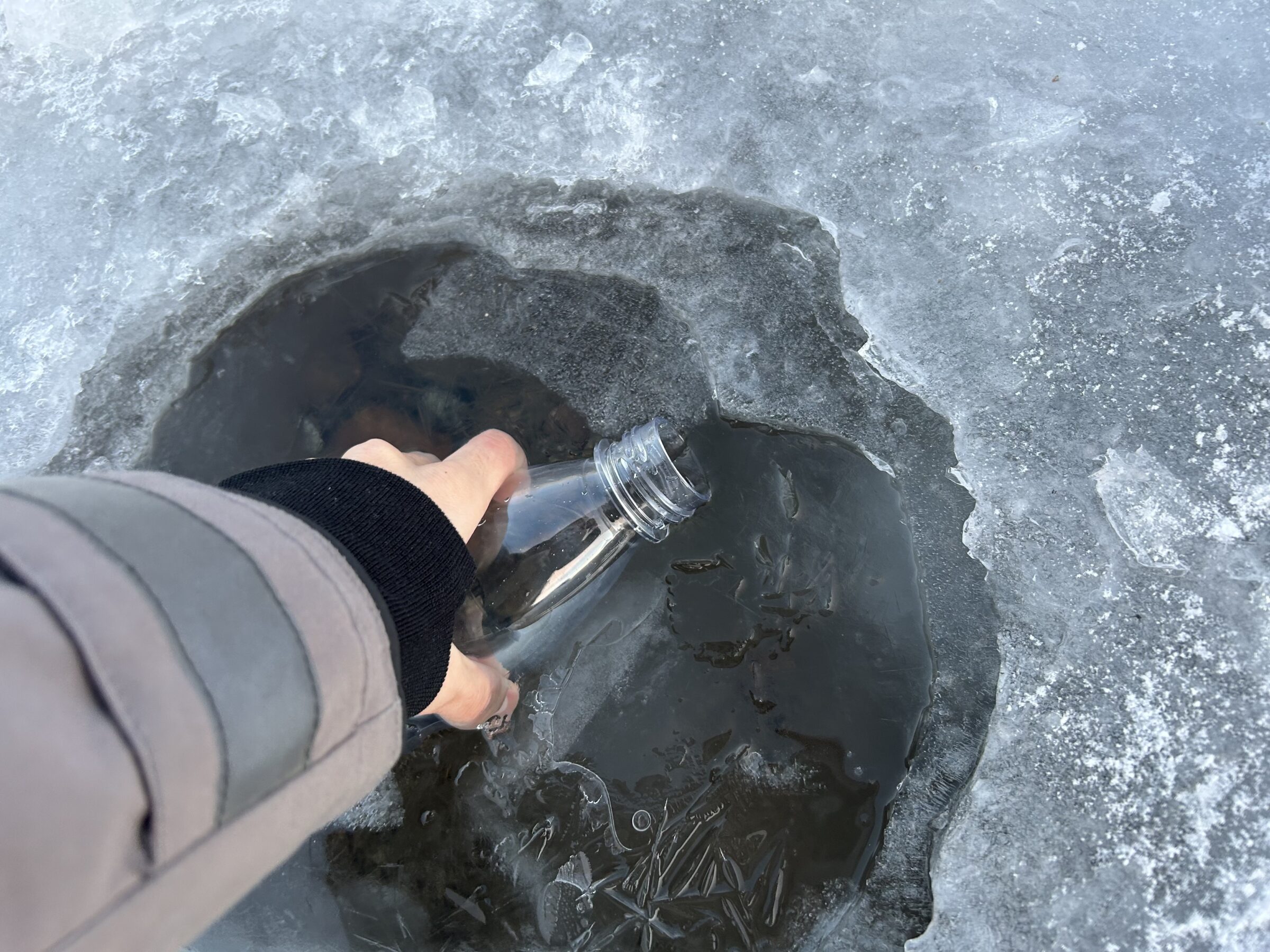
Qikiqtarjuaq hotel owner Johnny Kooneeliusie calls the fresh water he collects just outside his hamlet “the best in the world.” (Photo by Arty Sarkisian)

Johnny Kooneeliusie held up a bottle of freshly collected water to the sun like a sommelier would a glass of high-end wine.

Three litres of fresh Qikiqtarjuaq water stand next to an icy spring outside of the hamlet. (Photo by Arty Sarkisian)
“Look how clear this is,” he said.
It was Nov. 1, and we were standing next to a small hole in the ice covering a spring of water going down a hill about two kilometres outside Qikiqtarjuaq.
“Cheers!” he said, and we both took a sip. I swallowed a few small pieces of ice.
“No chlorine, no nothing. It’s the best water in the world,” he told me, as I tried to hold back a cough.
I agreed. The same way I would agree with a sommelier telling a me a wine is “fresh and earthy.”
I have tried water many times that people tout is the “best in the world.”
I drank from Lake Päijänne just outside Helsinki, Finland. I drove hours through Armenian mountains with two or three five-litre bottles to collect water from a spring in the remote village of Karenis — five times.
Water in Canada is generally clean, according to Health Canada. Even though glacial water has minimal risk of contamination, it’s generally recommended to filter all water from natural sources. Many Nunavummiut know their local water sources, though, and are comfortable with the risk of drinking it untreated.
And when I was in Kugluktuk earlier this fall, I drank a couple of handfuls straight from the Coppermine River.
“Don’t you just feel so fresh and alive?” said a local friend who stood next to me in a pouring rain, making sure I didn’t fall into the river.
I was soaking wet, kneeling on a plastic barge, scooping water from a river in Kugluktuk. So yeah, I felt fresh.

If for me drinking river or lake water is a fun adventure, for many Inuit it’s a daily exercise.
On our way to the icy spring, Kooneeliusie and I saw a couple of people on ATVs driving back to the community with big buckets filled with water.
In Kugluktuk, one family embarked on a boat trip up the Coppermine River to get fresh water further away from town.
Kooneeliusie said a lot of people don’t like the water from the treatment plants and they have their reasons.
So far in 2025, there have been roughly 103 notices from the Government of Nunavut or the City of Iqaluit relating to boil water advisories. Shortly after I left Qikiqtarjuaq, an advisory was issued in the community and it’s ongoing still.

During the Iqaluit water crisis in 2021, when the city’s water system was contaminated by fuel, some Iqalummiut chose to collect water straight from Sylvia Grinnell River.
A 2024 Nunatsiaq News report on water in Nunavut found 17 of 25 Nunavut water treatment plants had health or safety deficiencies, while three of those plants faced public health orders to fix the problems.
But I wasn’t thinking of any of that as I stood on a frozen hill close to Qikiqtarjuaq.
I collected three litres of water, most of which flew back home with me to Iqaluit.
Was Qikiqtarjuaq water really the best I have ever had? Could I honestly tell the difference between water in Qikiqtarjuaq, Kugluktuk, Helsinki, Karenis, or my own tap in Iqaluit?
Probably not.
But being 100 kilometres above the Arctic Circle, going to a frozen hill outside of town and dipping a hand into freezing water just to get a bit of hydration — there is something weirdly cool about that.
I asked Kooneeliusie whether he thought that too — whether Qikiqtarjuaq water is the best in the world because you have to make an effort to try it.
He laughed.
“Just drink your water,” he answered as he drove us back.
It’s important to point out that encouraging the use of untreated water is genuinely dangerous!
Even the clearest-looking natural sources in Nunavut — rivers, springs, lakes — can contain bacteria, parasites, or contaminants that aren’t visible but can cause serious illness. Under Canadian drinking water standards, most of the water sources described here would fall under a boil water advisory if they were tested.
Many Nunavummiut choose traditional water sources because of cultural preference and deep local knowledge, and that deserves respect. But from a public health standpoint, untreated water is never a guaranteed safe option. Boil water advisories are not overly cautious — they exist because the risks are real.
Highlighting the appeal of natural water is fine, but it should always come with a clear message: drinking untreated water carries significant health risks, and suggesting otherwise can put people in harm’s way!
Do you need extra bubble wrap?
Down south yes , not up north , i go camping a lot and drink from fresh suppy anywhere.
Kooneeliusie showed me a fresh water spring
near Qiqirtarjuaq on a return trip to Padloping in February 1976.
Air temperature 35 below but the spring was running.
Clear, pure and so refreshing! It also made the best tea1
Umiliviniq
Sounds like a certain EHO has their panties in a twist. The Canadian Drinking Water Standards are enforced in Nunavut, but written for the South where these bacteria, parasites, and contamination thrive. Nunavut water is pure, healthy and plentiful when taken from protected sources with knowledge.
The fact that the majority of water plants in Nunavut fail is because the people are holding the treatment standards used in the industrial and agriculture areas in the South to the pristine waters up here.
Fo’ Real?
What are the long term implications from improperly chlorinated water that’s not correctly tested at the plant or that undergoes “in truck” chlorination then happily makes its way into drinking water, baby formula and all the rest?
I find it amusing , to see inuks buying bottled water at our local store , to me , it like buying can of fresh air . i get my water from the lake and ice in the winter , makes for a great cup of tea.
The best water I’ve had was from a river by a bridge north Baker Lake, this isn’t the meadowbank road it’s another road I don’t know the name of the bridge or river.
Thelon river