


Nuclear in Nunavut — The story of Russia’s floating reactor
Part 2 | Moving power plants by sea could be easiest route to North, say experts
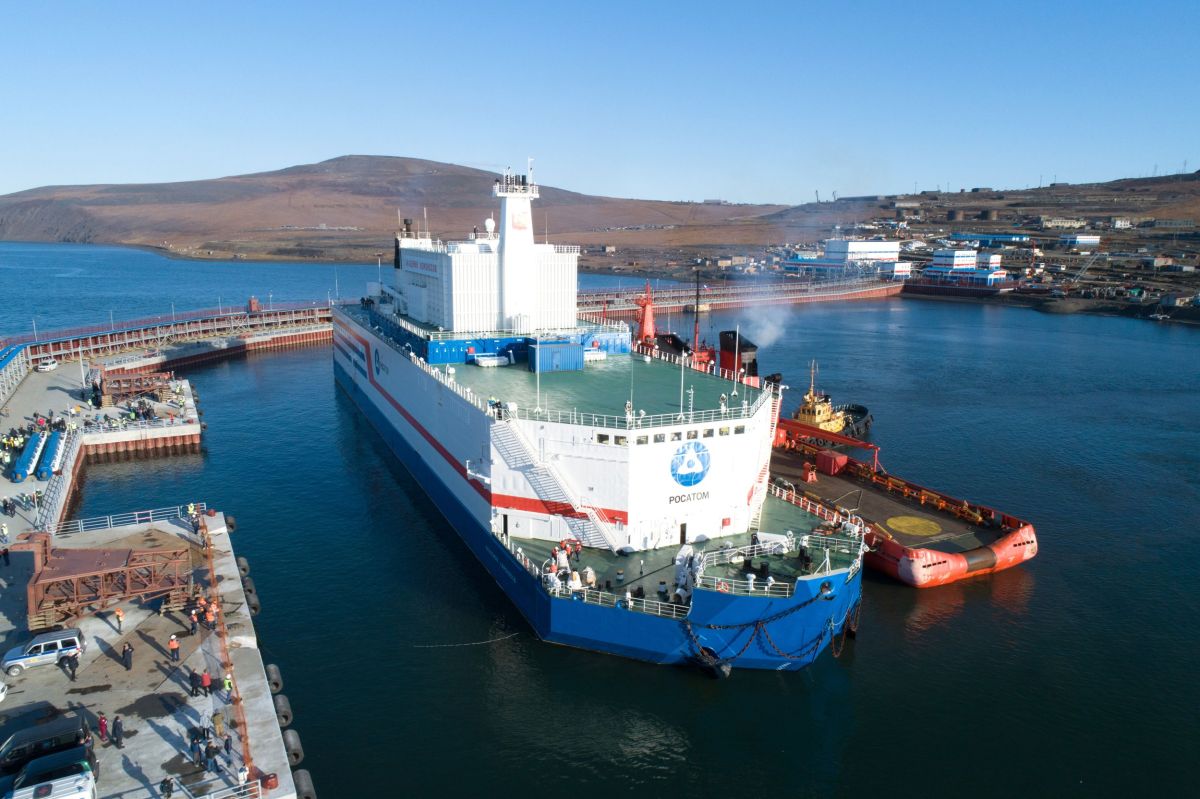
The Akademik Lomonosov is a floating nuclear reactor that sits offshore from Pevek, Russia. It has been generating power since 2019. (Photo courtesy of Rosatom)

This is the second article in a four-part series exploring how advancements in nuclear technology might impact Nunavut.
Floating offshore from the community of Pevek on Russia’s Arctic coast is a small nuclear reactor, one of only two of this scale operating in the world.
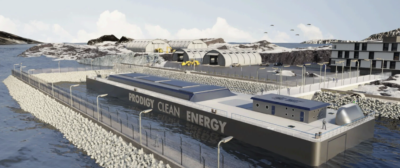
Prodigy Clean Energy, based in Canada, is developing a portable power plant to move advanced nuclear reactors by sea. (Image courtesy of Prodigy Clean Energy)
It’s also the lone small nuclear reactor in the Arctic.
The Akademik Lomonosov was constructed in St. Petersburg and towed north to Murmansk in 2018. From there, it made a 4,200-kilometre journey east along Russia’s Arctic coast to Pevek.
It generates 70 megawatts of electricity for the community of 4,000 people and the neighbouring area. It’s reportedly the first of a planned fleet of floating, small nuclear reactors Russia wants to deploy to various remote mines and communities.
“Russia decades ago developed the technology for seaborne reactors,” said David Novog, an engineering professor at McMaster University in Hamilton, Ont., who specializes in small nuclear reactors.

“The design and the footprint isn’t that much different than a barge, so Russia decided maybe 10, 20 years ago to put reactors on a barge and make them portable.”
Originally projected by the Russian government to cost US$140 million, the final cost was reported by various news outlets to be much higher — between US$232 million and US$740 million, equal today to between US$302 million and US$973 million — and connected to the grid nearly 10 years later than planned, in 2019.
Novog said water might provide the easiest route to transport small nuclear reactors to remote areas.
While some nuclear reactor prototypes can be small enough to fit on the back of a truck, the problem is the weight of the uranium they use to generate electricity. It’s the heaviest naturally occurring element in existence.
“When you’re transporting that on the back of the truck, yes, the truck can take it, it’ll be a big semi with a wide load,” Novog said.
“But let’s say you hit a patch of ice and that truck goes into a field beside the road. It weighs so much that it’s going to sink into the ground and you’re not going to be able to get it out.”

Nuclear reactors are complicated enough, but transporting them poses an entirely different challenge.
“If you’ve been following the industry the past 10 years, many companies have been focused on developing the actual reactor system itself,” said Lori-Anne Ramsay, co-founder of Prodigy Clean Energy, a Canadian firm.
“We do not develop nuclear reactors. Instead, we design and engineer a factory-built and transportable power plant infrastructure that can package, transport and deploy [small nuclear reactors] to any coastal location.”
It’s a “similar deployment approach” to the Akademik Lomonosov, Ramsay said.
She described Prodigy’s product as a heavy-lift vessel, designed to carry extremely large and heavy loads. So large, in fact, its marine classification is closer to an offshore structure than a marine vessel.

“It’s not a ship. It’s not a barge. And that’s important,” Ramsay said. “It’s not something you can drive away with.”
Ramsay, in an interview, teased an agreement her company recently made with a First Nation to deploy the first advanced nuclear reactor along the East Coast.
The aim is to get the project running by 2032, with hopes the plant will demonstrate its potential for northern applications.
Nunavut’s power provider, Qulliq Energy Corp., is interested in nuclear power and its capabilities but isn’t in a position to invest in the expensive, volatile world of nuclear, said Ernest Douglas, its president and CEO.
But if a community came forward with a plan, that would be a different story.
“We’ve seen many successes with our transition away from carbon fuels, but they’re community led, Inuit led,” said Douglas, pointing to various projects including a wind farm in Sanikiluaq, solar project in Naujaat, and Iqaluit’s proposed hydroelectric project.
All Nunavut power plants burn diesel fuel to generate electricity, and 10 of them are more than 40 years old, operating well beyond their lifespans. Qulliq Energy Corp. is replacing its 10 oldest plants with four currently under construction and a $987-million funding proposal to replace the other six.
These replacements are also diesel-burning but will be designed to be hybrid — they can hook up to renewable energy sources if and when they become available in a community.
That includes nuclear, said Douglas.
“The versatility is exactly what we’re trying to do,” he said.
Meanwhile, in the United States, President Donald Trump is pushing advanced nuclear projects through a program that frees 10 start-up firms from the usual regulatory red tape surrounding the nuclear industry. It’s a bid to fast-track development of the world’s first advanced nuclear reactor.
The only catch? Their deadline is July 4, the country’s 250th birthday.
Coming up in Part 3: The race in the United States to develop advanced nuclear technology.
What is the benefits of dumping boiling hot coolant water into the Arctic Ocean?
😆
“Novog said water might provide the easiest route to transport small nuclear reactors to remote areas.” All the more reason for the GN or the Feds to bilge up the NWP and make it all Canadian/Nunavut waters!