


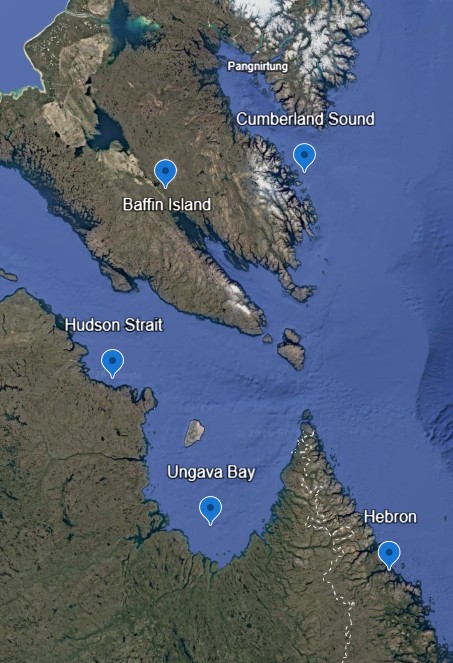
Little is known about Nangmayo, a woman who lived among the Ungava Inuit at Hebron, in the 1850s. There is some evidence she travelled south from Cumberland Sound. This map shows how far she would have travelled. (Map courtesy of Google Earth)
The mysterious Nangmayo
As I showed in my last article, the Hudson’s Bay Co. denied the Moravian Brethren the right to establish a mission in Ungava Bay because they would have supported such a mission by trade with the Inuit.
The Hudson’s Bay Co. had the sole right to trade in Rupert’s Land, even though it had no post in Ungava. The company finally opened a post at Fort Chimo (now Kuujjuaq) in 1830, the same year the Moravians established their most northerly post at Hebron.
Hudson’s Bay Co. also opened a second Ungava post at George River (now Kangiqsualujjuaq), marginally closer to Labrador, in 1838. In the intervening years, Inuit from Ungava had continued to visit the Labrador coast periodically to trade at Okkak.
The Hudson’s Bay Co. had limited success in Ungava. It closed its post at George River in 1842, and Fort Chimo the following year.
Many Ungava Inuit had continued trading with the Moravians on the Atlantic coast; they were said to pay a better price for fur and supply trade goods at a cheaper cost. With no Hudson’s Bay Co. post in Ungava after 1843, trade between Ungava Inuit and the Moravians increased.
But when Ungava Inuit visited Hebron or Okkak, it was solely for trade. They expressed no desire to convert to Christianity, which would have meant moving to the Atlantic coast to be close to a mission. In 1844, a group told the missionary at Hebron that “they would never be converted, because our land [Labrador]was not so rich in reindeer as their own.”
In the winter of 1846-47, a large group of Ungava Inuit arrived at Hebron and reported a famine in the bay that had taken many lives.
When the party left Hebron in the spring to return home, one woman remained behind. It was unusual for the Moravian missionaries to name individual unbaptized Inuit in their reports, so this woman must have been exceptional.
The Periodical Accounts, an annual report of the Moravian church, noted:
“One member of the Ungava party remained at Hebron… Nangmayo was a tall and robust elderly woman… who died at the mission station several years later.”
The fact that we know her name and a few details of her life, are because a missionary in Hebron in 1860 mentioned her specifically in the mission diary, even though she had died some years earlier. He wrote:
“At her own special request, she was left here and found a home in the family of our late brother, the well-known native assistant, Renatus, who faithfully cared for her, till her death.”
Renatus, whose birth name was Uiveruna, was an Inuk who was a chapel servant (a type of catechist) at Hebron. He died on May 8, 1853, so Nangmayo had died before that date.

The missionary wrote that her language was very different from that of the Hebronimiut, and “she even had difficulty in making herself understood by the Northlanders.”
By “Northlanders,” he could have been referring to unbaptized Inuit from farther north but more likely to visitors from Ungava Bay.
It is unusual in Moravian accounts for a missionary to comment on dialectal differences, so her speech must have been quite different to warrant such a comment.
The missionary added: “She probably did not comprehend much of what was said to her here, particularly respecting the salvation of her soul.”
Where had this unusual woman come from? The missionary reported:
“The Northlanders stated that she came from a country, which lay opposite to theirs, and which was called Iglorarsuk. They further said that this region could be approached from their country in boats, that ships came there every year to get whales, and that there were many people there.”
This is the mysterious place which previous Moravian accounts spelled slightly differently as Igloarsuk. I mentioned it in my first article in this series. The Moravians had known about Igloarsuk since Kohlmeister and Kmoch’s 1811 expedition, but without knowing much about it except its name. It was thought to be on the north side of Hudson Strait, on the Baffin Island coast.
The Hebron missionary speculated that Nangmayo may have come from Northumberland Inlet, an early name for Cumberland Sound, on the southeastern coast of Baffin Island. He knew from his reading that a whaler, Capt. Parker, had visited that inlet in 1846 and that the Inuit there were suffering from a widespread famine at that time.
The missionary wrote, “We were the more interested in this subject [Northumberland Inlet], because we have some reason to believe that we have had a member of the Esquimaux tribe at that place, living here with us.”
He was referring to Nangmayo.
Despite living with an Inuit chapel servant and his family in Hebron, Nangmayo never converted to Christianity — the evidence for this is that she was never a candidate for baptism, and her death is not mentioned in the Hebron church records.
Now, allow me a moment of speculation. I think the name Nangmayo sounds a lot like Nangmalik, a name well-known in Baffin Island today. Perhaps that is the name the missionary was trying to write.
Why had Nangmayo left Baffin Island, if indeed that is where she came from? Was it to escape famine? Was she a widow with no means of support?
Unfortunately, we will never know more about this fascinating woman and the reasons why she chose to leave her homeland to live in far-off Hebron.
Taissumani is an occasional column that recalls events of historical interest. Kenn Harper is a historian and writer who lived in the Arctic for over 50 years. He is the author of Give Me Winter, Give Me Dogs: Knud Rasmussen and the Fifth Thule Expedition, and Thou Shalt Do No Murder, among other books. Feedback? Send your comments and questions to kennharper@hotmail.com.
*Could her name have been something close to…
‘Nangmajuq’? or perhaps even, ‘Naangmajuq’ ?
(Were the Moravians sensitive to recording vowel length and consonant length? Just curious… )
*So poignant to think of this lady being hundreds of kilometers from her family, choosing to live with strangers, and speaking a dialect so different that exchanging ordinary, everyday speech was a problem for her and for her hosts. So sad.
“Thank you” to Kenn Harper for writing this up for us.