


Forget the $100 — How does NTI get past voter apathy?
Vouchers on table ahead of May 27 byelection; Inuit organization admits life getting worse in Nunavut
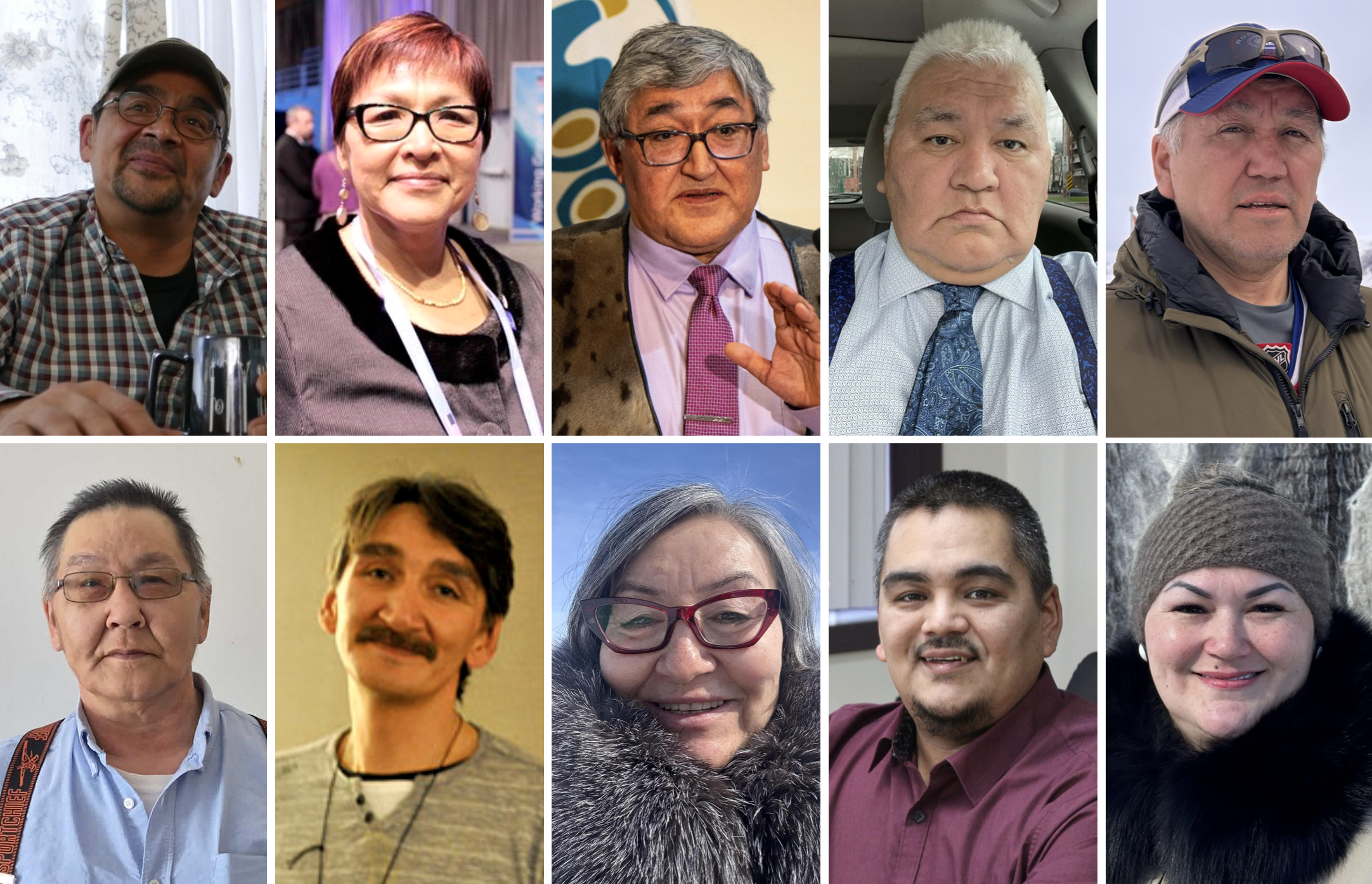
Ten candidates are running to be president of Nunavut Tunngavik Inc. in a May 27 byelection. They are, in the top row from left to right, Samuel Alagalak, Okalik Eegeesiak, Paul Irngaut, Jerry Komaksiutiksak, and Andrew Nakashuk. In the bottom row, from left to right, are Willie Nakoolak, Jerry Natanine, Cathy Towtongie, Jeremy Tunraluk and Gloria Uluqsi. (File photos)

This editorial was updated on Saturday, May 23, 2026, at 6:30 p.m.
There is no shortage of people who want to run Nunavut Tunngavik Inc., but there is certainly a shortage of voters who share the same interest in its elections.
Ten candidates have put their name in the ring ahead of the May 27 byelection to replace former president Jeremy Tunraluk, who resigned in January. (He’s also running for re-election.)
The contest attracts a dismal voter turnout. Before the organization’s $100 voting voucher, introduced in 2024, less than 20 per cent of NTI’s approximately 22,200 beneficiaries have historically cast ballots. The voucher brought turnout up to 67 per cent.
The organization does important work and manages a lot of money. With the creation of Nunavut, Inuit became the inheritors of their land through NTI, which makes sure promises made under the Nunavut Agreement are kept.
NTI and regional Inuit organizations rake in millions from mines operating on Inuit Owned Land. The Nunavut Trust, which generates income for beneficiaries and helps fund NTI, was worth $2 billion as of last year.
One of the most significant outstanding pieces of the Nunavut Agreement is a Nunavut Land Use Plan, which would guide development in the territory by evaluating areas of mineral potential against environmental concerns. The latest draft is sitting unsigned almost three years after it was submitted for approval, in 2023.
NTI leadership has also added a focus on federal and territorial partnerships over the past few years by establishing committees to keep Inuit at the table while decisions are being made.
Beneficiaries should certainly hold their leaders to account for this work. But it’s a lofty goal, considering the challenges Inuit in Nunavut face.
“By all social indicators, life in Nunavut is getting worse,” says NTI’s most recent strategic priority document, released in February 2025. The eight-point priority list touches on all the greatest hits: there continues to be a dire need for housing, infrastructure, language preservation, access to food, better education and work opportunities.
Without these needs met, it’s hard to expect the average beneficiary to have the time to engage in NTI’s affairs.
There are other challenges as well, caused by the bureaucracy of NTI. Nunatsiaq News canvassed former politicians who played a role in hammering out the Nunavut Agreement to ask them, ahead of the 2024 NTI presidential election, about voter apathy.
Apathy stems from millions of dollars going into NTI with nothing to show for it, said Peter Ittinuar, Canada’s first Inuk MP. Similarly, former senator Dennis Patterson and former MLA Tagaq Curley both called out a lack of transparency, which might explain why a perennial promise among candidates running to lead NTI centres around openness and dialogue.

This round of candidates is bringing a new set of ideas and goals for Nunavut and NTI. You can read them all here.
If you’re reading this editorial, you likely keep up with the news and you’re probably already familiar with who is running in next week’s byelection. You still have time to talk to your neighbours, your friends, your colleagues. Encourage them to read about the candidates and cast a ballot.
And once the race is over, the real work begins.
I encourage all beneficiaries to remember the winning candidate’s promises and hold them to account.
Because if NTI can break out of its bureaucratic enclave and make life better for Nunavummiut, then maybe it won’t take the promise of $100 to get voters engaged enough to cast a ballot in future elections.

Correction: This editorial has been updated to correctly specify the amount of beneficiaries eligible to vote in NTI’s presidential byelection.
It’s difficult to get 65% turnout in federal or provincial elections in Canada. At that level legal, taxation, education, health,defense and trade matters are determined. For NTI, everyone knows that the organization is essentially useless except for its favored few who receive positions or graft. Same for the regional IAs. There’s no disputing that
Life is getting worst because there are too many handouts. In Greenland and Alaska, there are next to no handouts, so why is Nunavut so different?
Handouts (and stuff like free housing) foster dependency, diminish personal initiative, and erode dignity, rather than creating long-term self-sufficiency, which goes against all IQ principles.
Yet, NTI seems to ignore these principles, all in the name of “increasing voter turnout”. Taking a page right out of the banana republic handbook. Inuit deserve better.
How or where do you guys get free housing
I never known housing here to be free
$100 won’t go far in Nunavut so all you think NTI beneficiaries gets everything free
You think we kick our boots off and rest now because of the $100
I used to work at housing. The number of people, both inuit and non- inuit, that get $60 rent per month is baffling. And the number of households that haven’t paid rent in years, but still manage to somehow get new skidoo every winter, is ever worse. Then when they start working their rent goes up so they stop working.
Nowhere else in the world can you rent a 3 bedroom house for 60 bucks a month. People need to be more responsible.
Inuit were promised a payout when we signed the land claim for giving up our land, we voted for it and every leader since then did not pay out any thing to the beneficiary’s, look at Nellie cornyea over in the west, they pay a dividend from the profit of the settlement, and also from the profit of the business arm, this is what happens when the leadership does not lead, and you have voter apathy.and who really runs NTI the accountants and bankers and elites investing in businesses, with no returns, and the RIAs are creating empires with no Inuit benifitting.need someone to say enough and look at the people that gave up their land,
giving up land?, arent canadian governemnt force inuit to go upper north? cuz they knew someone would take north pole or upper canada, just to control inuit/north pole, 3 bed room for 60 is crazy, in nunavik that would be 300 to 400, yall lucky, but sanikiluaq is kinda on edge, cuz quebec government took fresh water from hudson turn into electric, they didnt wanna make electric from salted water
And when that $60 per month for rent comes from their income assistance payments? Yeah, that’s definitely free housing.
How can it be free if income assistance pay for it, in actuality we are paying for it the TAX payers.
Free for the end-user. Costs a whole lot for taxpayers.
It’s not tax payers money, it’s agreement money settled with the Nunavut Agreement. Money that Inuit are entitle to in exchange for define rights vs Inherit rights that have not been define yet.
Yes Inuit are rich, they make average $100,000,000 each but still rely on free housing!
There are no hand outs, there income support for people that cannot work for one reason or another, EI for people that were laid off for no fault of their own. IN Greenland there’s the Nordic Co-operation an income support program that provide basic needs, shelter, food and other essentials. The Borgen Project to supplement retirement income. In US there the SNAP program (food stamp), Temporary Assistant for Needy Family Program ,and Medicaid and Chip Program. The vouchers are not hand out, they are an incentive from Nunavut Agreement that is a modern day treaty not tax payer money. It’s an incentive to increase voter turn out, and it increased voter turn out last election.
Go kick rocks 😂 cry louder
Voting booths set up in the most frequently visited used locations would make a difference, and keep those wait lines short short.
So… Down at the local stoner shack?
Democracy doesn’t exist on any action needed to solve issues,, only the gossips of doings that aren’t approved.. what good is NTI on whole of the ,Inuit society? Just a lawyer agreements signatures… NTI is just a subject idea of the crowns polishing subjects… what good will it do? Voting is stupid… war is stupid… money is stupid…king is stupid…
? back to the drawing board?
Cant wait till the election is over for all these candidates to ignore us again
The President and VP are only 2 people on an 8 member Board that decides things for NTI.
6 of the Board members are from our RIAs. The RIA Board members owe no political or ideological allegiance to whomever is voted in for President or VP of NTI. I am sure it is common for an NTI President and RIA President even from the same region to have different views on what needs to be done.
The 3 regions carry the vote, and they drive the mandate of NTI, not the directly elected positions. The interplay of regional interests are front and center in what NTI does.
This is common knowledge among Inuit. The NTI Board structure has been designed this way specifically because our RIAs wanted it that way through years of discussion.
Therefore, whatever an NTI Presidential or Vice Presidential candidate can say to potential voters to incent them to vote for them are known to be hollow promises. Neither of these directly elected positions have the votes, clout or influence on the NTI Board to make these things happen by simple virtue of being elected.
Even if one Presidential candidate articulated a better position on issues, or said they would make a popular or much needed decision, Inuit know that it may not be in the power of that person to actually make it happen. In fact, there is a good chance it will not happen.
So, a voter in NTI elections is left with a choice of who would be the best spokesperson for Nunavut Inuit, which is a fairly inconsequential decision to make.
Only people that care who our spokesperson is can rationalize voting in this election, plus the people that want $100.
None of our business, why would you post an article by someone who is not a beneficiary?