

After she was struck by ATV, Gjoa Haven nurse hopes to return to hamlet
Teresa Vo calls for safer roads after suffering several fractures and abdominal injuries in collision
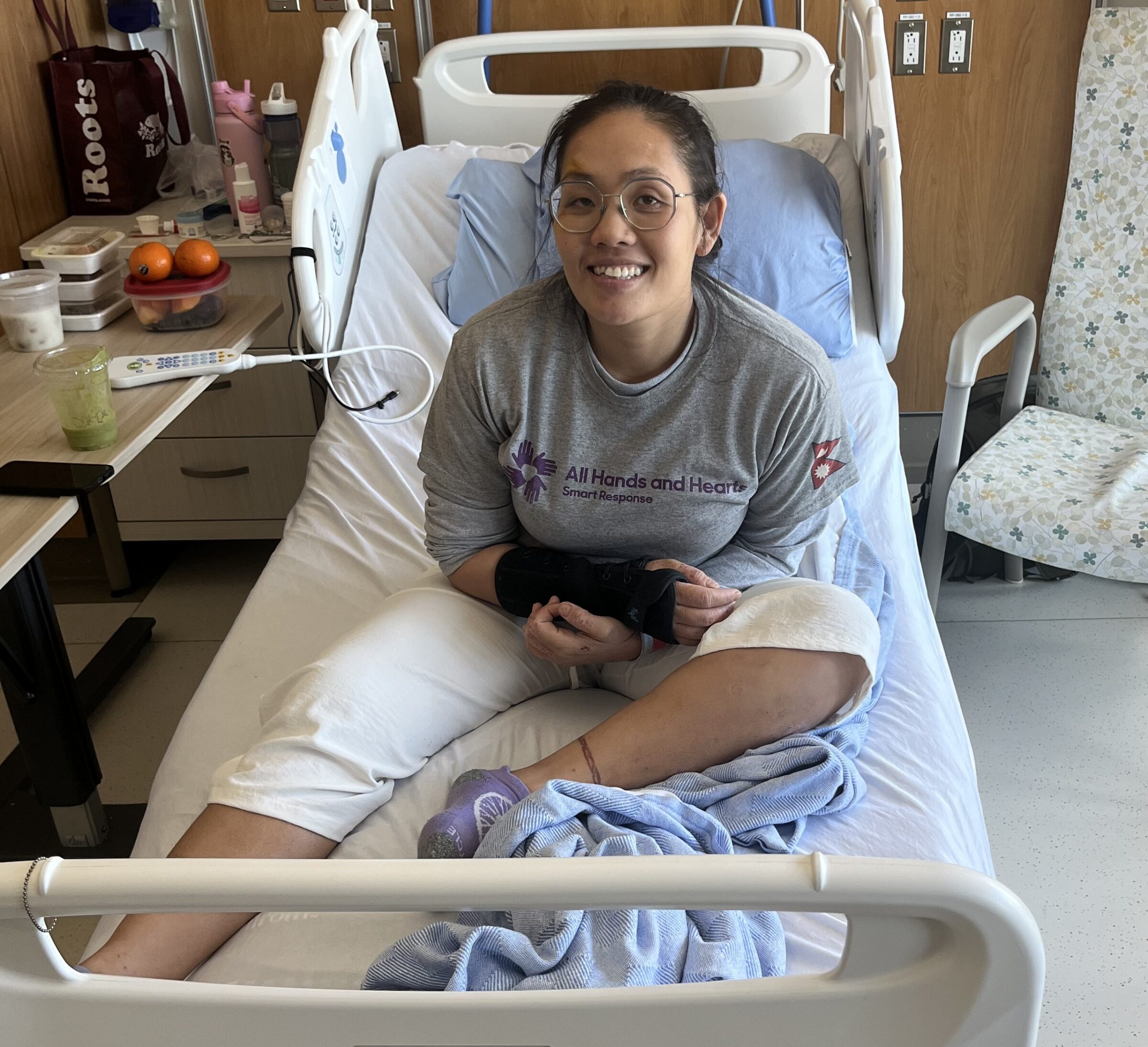
Teresa Vo, a visiting emergency and trauma nurse injured in an ATV collision in Gjoa Haven, recovers at West Park Healthcare Centre in Toronto on Tuesday, July 7, where she is receiving physical therapy. Vo suffered a fractured femur, facial fractures, a wrist fracture and abdominal injuries in the June 18 crash. (Photo by Sam Laskaris, special to Nunatsiaq News)

Emergency and trauma nurse Teresa Vo says working in the North requires “thick skin” and the ability to handle the unexpected.
Last month, the unexpected happened to her.
Vo, a visiting nurse on a four-week assignment in Gjoa Haven, was walking home from a late shift at the community health centre on June 18 when an ATV struck her.
“I heard the revving of an engine, looked left, and saw an ATV coming straight towards me,” Vo said Monday from a rehabilitation facility in Toronto.
She recalled how she tried to dodge the vehicle by jumping to the side.
“The next thing I remember was me being on the ground in a lot of pain,” Vo said.
Vo suffered fractures in her femur, wrist and face, and abdominal injuries in the collision. Over the next 48 hours, she nearly died twice while waiting to be medevaced out of Gjoa Haven to Edmonton for specialized trauma care.

As everything was happening, Vo said her colleagues at the health centre kept her informed as her condition changed, including when her hemoglobin dropped due to blood loss and she developed a fever.
“Even though I was scared and at one point I thought I was going to die, I never doubted their competency,” she said.
Vo said the evacuation was one of the most difficult parts of the experience, with weather and staffing issues delaying her exit from the community.
There was also a communication issue, with requested blood not arriving with the medevac team.
“As a nurse, it’s frustrating because it’s something out of your control,” Vo said.
“As a patient, you’re scared. You’re in a situation where nothing else can be done for you unless you’re at a bigger hospital.”

The incident prompted the hamlet to move ahead with updating its outdated ATV bylaw, but the bigger problem could be lack of capacity for enforcement, Vo said. Gjoa Haven has a three-member detachment for the community of roughly 1,500 people, and one municipal bylaw officer.
“I’m happy that they’re addressing it, but I don’t know if there are enough RCMP officers to monitor people following the rules,” she said.
Safety issues have been a persistent problem on Gjoa Haven’s roads.
About two weeks before Vo was injured, a young person was hurt in an ATV collision and had to be medevaced to Yellowknife with a shoulder injury.
She said she had also noticed other things on past visits to Gjoa Haven, including speeding vehicles, children operating ATVs and riders travelling without protective equipment.

Now recovering at West Park Healthcare Centre in Toronto, Vo is focused on strengthening her injured leg through physiotherapy.
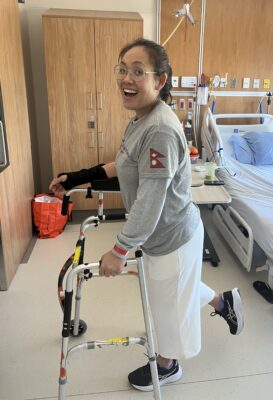
Teresa Vo smiles as she uses a walker during rehabilitation at West Park Healthcare Centre in Toronto on Tuesday.(Photo by Sam Laskaris, special to Nunatsiaq News)
A GoFundMe campaign organized by her colleagues has raised over $15,000 to support her recovery.
Vo said she is also waiting to learn whether she qualifies for workers’ compensation from the Government of Nunavut because she was injured while walking home from work.
Despite the ordeal, Vo said she does not blame the young driver or the community.
“I’m not upset at the kid that drove the ATV,” she said, adding that the young driver later came to the health centre with his mother and left an apology letter.
“I’m not mad at the community and I don’t have any grudges. I’m not resentful,” she said.
Vo said she hopes to return to Gjoa Haven once she has recovered and plans to begin nurse practitioner studies in September.
It’s unfortunate that it took an incident like this to bring some attention to the underlying issues. That said, it’s encouraging to see road work being done and the mechanics getting overtime to keep the hamlet’s fleet operating.
I hope this momentum continues and the focus stays on strengthening our core public works services—road maintenance, fleet reliability, and the infrastructure we all depend on every day. Those foundational services need to come first. Once they’re consistently reliable, then we can start talking about the extras instead of promising rainbows and unicorns.