


Detecting whales and submarines: how northerners could benefit from defence spending
Gen. Jennie Carignan visits Iqaluit to discuss military plans for North
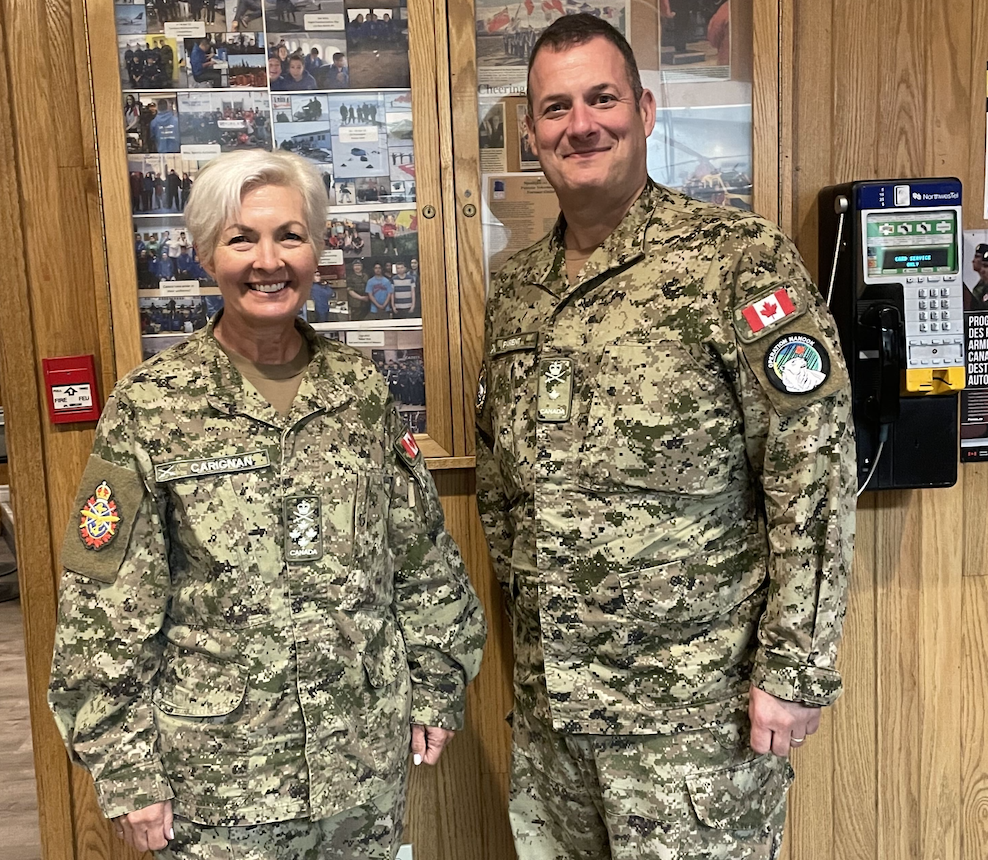
Gen. Jennie Carignan, Canada’s chief of defence staff, visits Iqaluit Wednesday to speak to Inuit and territorial leaders about the military’s plans for expansion across the North. Alongside her is Brig.-Gen Marc Parent. (Photo by Lilli Apkaleeapik)
This story was updated on Tuesday, Sept. 8, 2026, at 8:45 a.m. ET.
The Canadian military is expanding its definition of defence spending to meet its multibillion dollar NATO commitment, says the chief of defence staff.
Gen. Jennie Carignan was in Iqaluit Wednesday to meet with Inuit and territorial leaders, as well as Canadian Rangers, to talk about the Canadian military’s ongoing plan to bolster Arctic defence.
Northern sovereignty has been front and centre since Mark Carney became prime minister in March 2025. His Liberal government has pledged to meet Canada’s obligations to the North Atlantic Treaty Organization, or NATO, by gradually increasing the amount it allocates to defence spending to five per cent of Canada’s Gross Domestic Product by 2035.
The government met a two per cent pledge — or $81.1 billion of the country’s GDP — to defence in 2025.
To meet this commitment Carney has looked North, unveiling more than $40 billion dollars worth of northern defence upgrades and an advanced radar system to detect over-the-horizon missile threats.
This new attention has spurred some, including the Federation of Canadian Municipalities, to urge the government to expand what counts as defence spending to include all infrastructure, like recreation centres, housing and health centres.

The organization argues any infrastructure in the North has dual-use potential, meaning it can be useful to military and civilians.
Carignan said the Department of Defence is already thinking along these lines.
“We’re going to need all of this support to operate and we don’t want to be a burden on the community,” said Carignan, pointing to the need to expand power, sewage, water and bandwidth capacities in communities with a military presence.
She also mentioned drones, which the military is planning to equip Canadian Rangers with, in an effort to modernize their roles and missions.
“We need to detect the whales as well as the submarines,” she said, “So drones could be another example of dual use equipment.”
After meeting with Carignan and other military officials Wednesday in Iqaluit, Premier John Main reiterated a sentiment he’s shared before in regards to the increased military spending in the North.

“Defence investments should also create lasting benefits for Nunavut’s communities, infrastructure and people,” he said in a Facebook post.
There is no current estimate of the Arctic infrastructure gap, but Inuit Tapiriit Kanatami released a report in 2020 that estimated it to be $75.1 billion.
There are needs all across northern communities, where people live in overcrowded housing conditions, aging schools have dangerous infrastructure issues, and water treatment plants are corroding and failing.
The Department of Defence is planning to split its eventual five per cent defence spending obligation to NATO by allocating 3.5 per cent to direct military spending and 1.5 per cent toward dual-use infrastructure. This would work out to $60 billion going to dual-use projects in 2035, the Department of Defence estimates, according to a report released in February by the Office of the Parliamentary Budget Officer.
Kaya Dupuis, a junior research fellow at NATO Association, a non-profit research group, asked in a June 17 opinion piece.

“Until the government produces a multi-year spending plan that ties capability investments to the five per cent target, the ambition might be received by allies as a political gesture rather than a strategic commitment,” Dupuis said in the piece.
In Iqaluit, Carignan didn’t offer details or timelines for any new major infrastructure projects. But she did say officials are talking with people in the North about what their needs are.
“Some places are more ahead than others, we have a little bit more information, but taking the time for consultation is important,” she said.
Correction: This story has been updated to correct information about NATO Association’s affiliations, and to remove attribution of an idea to the the author of the analysis published by NATO Association.
(0) Comments