


Military spending shouldn’t ‘fly in the face’ of impoverished communities: Main
Nunavut premier makes case in Ottawa that Arctic security includes taking care of the people who live there
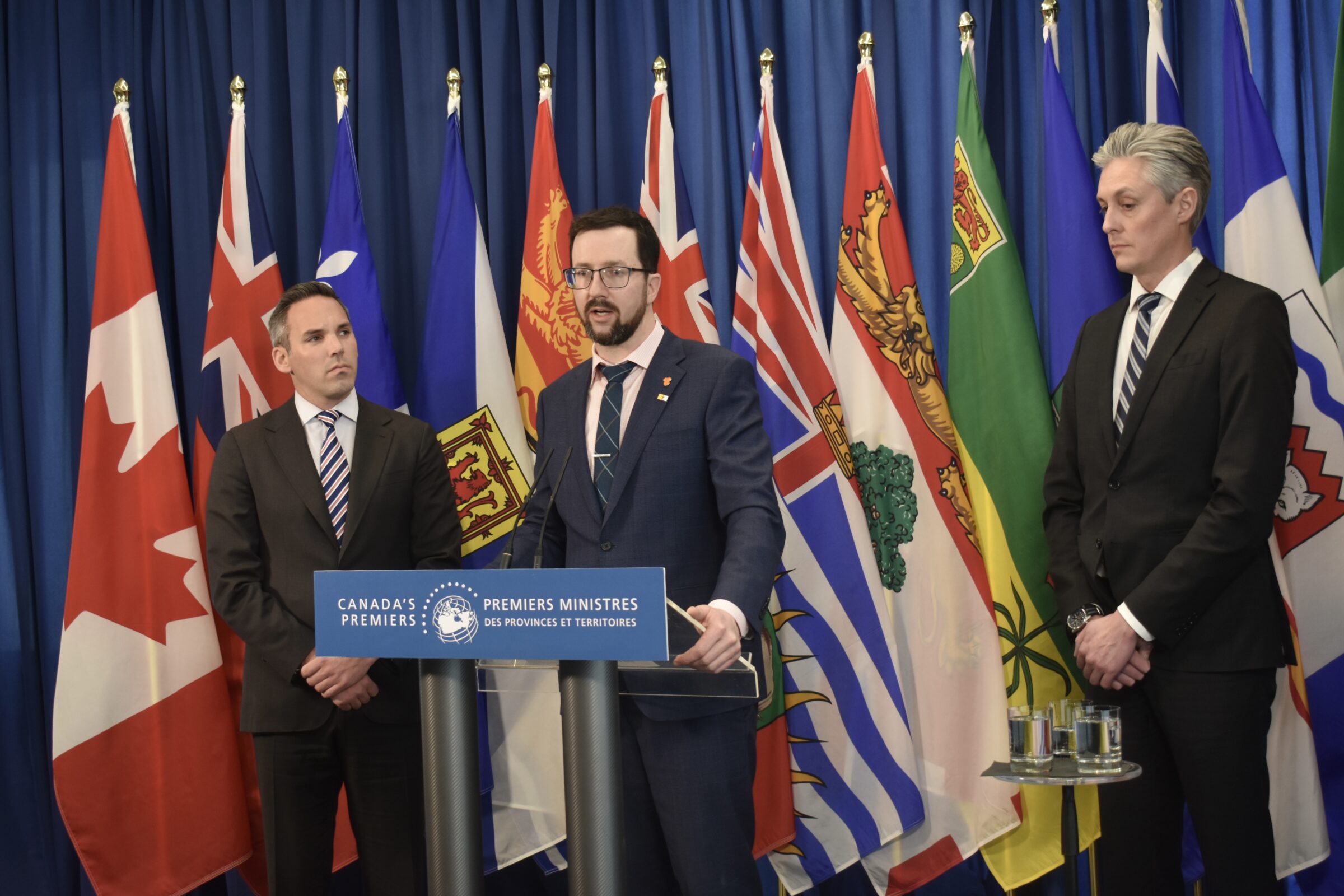
Nunavut Premier John Main, centre, speaks to reporters ahead of a premiers’ meeting in Ottawa Wednesday. He’s flanked by Yukon Premier Currie Dixon, left, and Northwest Territories Premier R.J. Simpson. The northern leaders discussed Arctic security, infrastructure, and economic development. (Photo by Nehaa Bimal)

As Ottawa seems ready to spend big money on Arctic security, Nunavut Premier John Main is making the case that community health and well-being are just as important as military prowess in bolstering Canada’s claim to the North.
Arctic security has become a major priority for Canada since U.S. President Donald Trump started his second term as president in January 2025.
The federal government has announced billions of dollars for various military projects, including $2.67 billion for operational support hubs in Iqaluit, Yellowknife and Whitehorse, and $6 billion for an over-the-horizon radar system.
But this spending needs to be coupled with investments in people, Main argued before meeting with the country’s 12 other premiers in Ottawa Wednesday to discuss shared priorities including security and trade.
“We can’t have state-of-the-art military technology flying in the face of communities that are impoverished and in need of basic infrastructure,” he told reporters.
Main said he was encouraged by discussions so far, including a meeting Tuesday with Prime Minister Mark Carney who he said was receptive to the “desire to see things done in a balanced manner.”
“We are very excited and seized with the energy that’s in Ottawa as of late in terms of the focus on the Arctic and all the talk about Arctic security and sovereignty,” Main said.
He also met Wednesday with Transport Minister Steven MacKinnon to discuss the federal government’s $1-billion Arctic Infrastructure Fund.
Main highlighted various Nunavut priorities including the cost of groceries and the Non-Insured Health Benefits program, which Nunavut administers with federal funding amounts that Main has long criticized.
“In terms of the Arctic, it’s going to need sustained effort and sustained investments if we’re going to see changes to human health outcomes [and] in terms of economic well-being of households,” Main said.
He also spoke of how partnerships with southern provinces will help boost Arctic security. He pointed to the Kivalliq Hydro-Fibre Link, a proposed 1,200-kilometre, 150-megawatt transmission line and fibre optic cable that would connect Manitoba’s grid to five communities in Nunavut’s Kivalliq Region.
As well, in response to questions about Manitoba Premier Wab Kinew’s recent comments promoting Churchill as a hub for Arctic trade — and whether southern premiers are blurring the lines on what counts as an Arctic project — Main emphasized the need for southern partnerships.
“Development of the Port of Churchill should benefit Nunavut, providing links up to our territory,” he said.

Mainly in the USA, but true for Canada also, military bases in a locality are readily recognized as major, positive economic opportunities.
As an example, a 1987 study of CFB Esquimalt determined the economic impact of this one base with an operating federal budget of $400M, 5,000 military personnel, and 2,000 on base civilian employees.
The study found CFB Esquimalt induced 7,000 other civilian jobs in the Victoria area, which also indirectly created a further 7,000 jobs, for a total civilian impact of 14,000 new other jobs. In terms of dollars, this represented an addition of $665M per year in more wealth being generated in the Victoria area.
This is over and above Federal spending and salaries.
These well established economic multiplier effects within a local or regional economy is partly why the military/industrial complex in the US has maintained such consistent and wholehearted political and public support.
Just ask Inuvik how much of a hurt was put on them when our Armed Forces pulled out of their town.
The point being, miliary spending in the north is not an either/or thing as may be being implied here.
The real choice here is closer to a) propping up the north with tax money while choosing not to defend it as opposed to b) defending the north while also propping it up.
Our electricity rates will now be set in Manitoba. We will have to ask them, how much money they want. Not helpful for trying to run our own ways. Perhaps installing wind power in windy Keewatin to generate our own electricity can be more beneficial for Nunavut. We need some leaders who will look into the long term well being of Nunavut.
You would complain that you got wet from water, can’t make progress without someone to nitpick!
“… community health and wellbeing is just as important…” (Ahem) Isn’t that Government of Nunavut role.
Military has their own agenda.
Nunavut has the Rangers.🪖🤟
Communities would not have to be impoverished if Inuit had the managerial, professional and trades jobs in there. And what about a full-fledged Inuit regiment trained for arctic and mountainous conditions–like US 82nd Airborne or the Italian Alpini? And an Inuit air squadron comprising fully qualified pilots and mechanics?
Total all-level government spending (taxes etc) in Canada annually is $25,000 per citizen. Thst covers everything from health care to bridges, education the defense. For Nunavut, that number is $70,000 per citizen. Nesrly every penny of that $70,000 iz covered by taxes generated outside of Nunavut. The average tax-payer in Canada contributes 50% of his income to taxes. John wants the average citizen to pay more taxes.
If Canada wasn’t so pitiful it wouldn’t be so pitiful
“The average tax-payer in Canada contributes 50% of his income to taxes.” Yikes! That’s terrible … or it would be if it were true, which it isn’t. Not even close.
It’s even worse than that, TC; despite the 50% of income that is taken through taxation, much of that is squandered by the various levels of government that take it. But even worse than that are the reams of unnecessary and antisocial regulations and policies that are hindering our well-being – just to keep folks all lined up with their heads in the sands and their elbows stuck up.
There are so many technologies that can benefit Nunavut, examples include LEO’s for internet, and Small Reactor Technologies for power supply, but lack the big money contracts that the fibre/hydro link will bring. Nunavut relies on Federal dollars which accompany these type of projects. Plus how soon we forget that there was a community in Northern Manitoba which was evacuated a couple of weeks ago because the link failed and they lost the infrastructure because of freezing.
Absolutely right! Get bombed then we don’t have to feed you .
Too much spending, less institutional, foreign policies get more idea from india africa or some countries of what they think of our small nunavut population. Too much bullying from these huge population
There should be check on the fundings at quit at cigarette by the government. See how much they spent. They went through Supreme Court. Nunavutmi it needs to know too.
Alberta is hard driving to leave Canada and Saskatchewan is not far behind. Which has Yukon and NWT now pondering the idea.
Even BC citizens who live not in ‘Vancouver-model’ Vancouver or over on the Island are also thinking about their future in Canada.
Manitoba has their focus on the Government opening their first supervised hard drug consumption site in Winnipeg.
Then will Kitikmeot and Kivalliq in Nunavut follow departures, knowing if the western provinces do leave there will be a negative financial shock across Nunavut.
Is it a given Ottawa-North-Iqaluit with lockdown Baffin to remain in Canada/24 Province of China?
But if Quebec starts following through with separation, then what will Baffin become?
One thing is for sure, that failure is certain if you try to please everyone, it’s just the way things are.