


Group urges Ottawa to expand definition of military spending
Dual-use infrastructure could include housing, recreation centres, says Federation of Canadian Municipalities
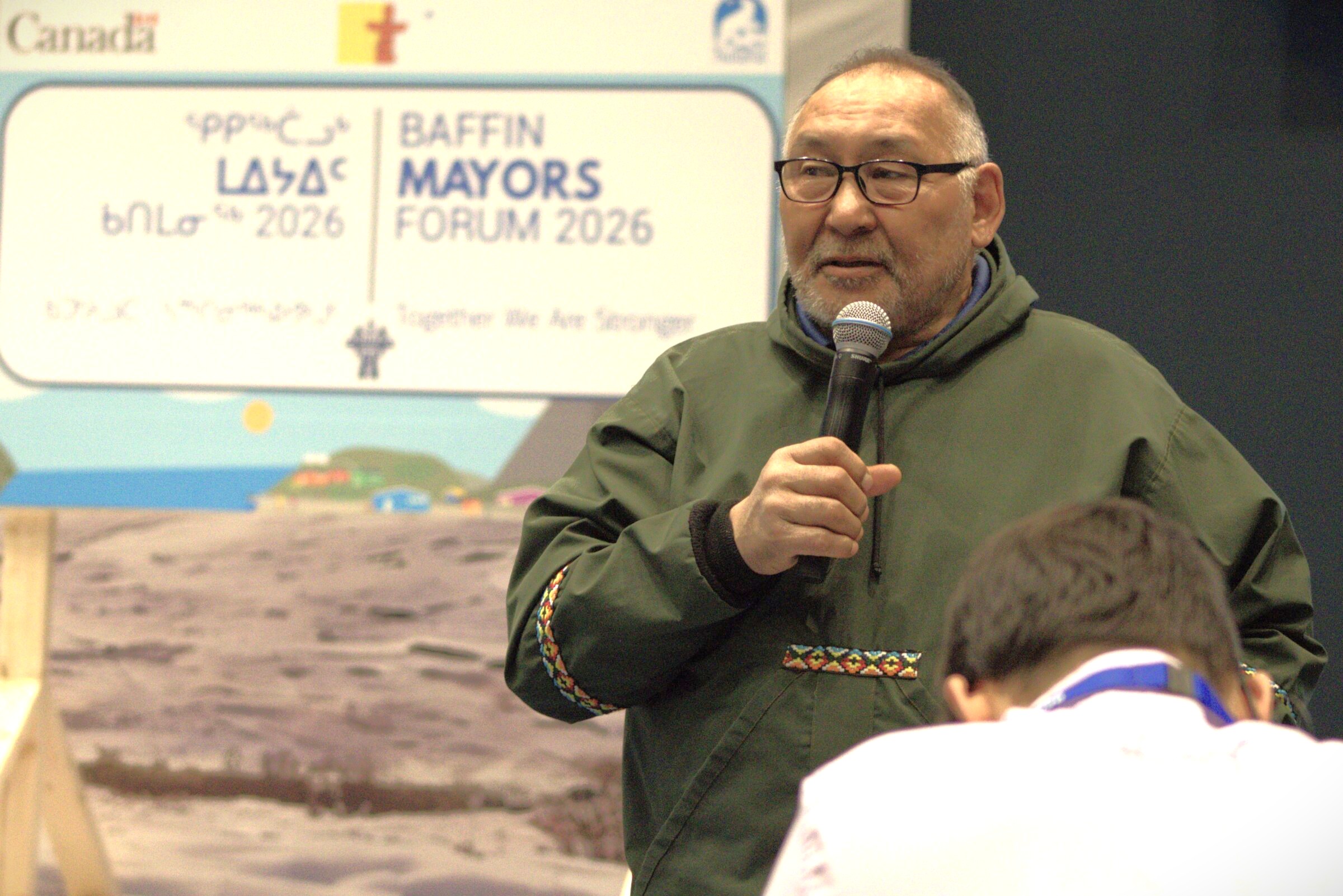
Iqaluit Mayor Solomon Awa addresses fellow hamlet leaders at the Baffin Mayors’ Forum in Iqaluit in March. Awa is pushing for more infrastructure investment in the Arctic. (Photo by Daron Letts)

Dual-use infrastructure projects will literally pave the way to Arctic sovereignty and security, says a report released this month by the Federation of Canadian Municipalities.
The Future of Northern and Arctic Canada makes the case for Prime Minister Mark Carney to define all northern municipal infrastructure as dual-use, which means projects traditionally thought of as civilian could fall under the umbrella of defence spending.
“Arctic sovereignty and security depend on strong local governments and reliable infrastructure,” federation president Rebecca Bligh said in a phone interview. “Thriving communities are part of that.”
The idea is to use Canada’s commitment of funnelling five per cent of the country’s GDP into defence spending to close the infrastructure gap between the Arctic and the south. For 2025, the five per cent threshold worked out to $81.8 billion.
The report calls for Ottawa to consider dual-use for such infrastructure as recreation facilities, because “any increase in military personnel will likely increase the need for recreation infrastructure, but outstrip local governments’ abilities to pay for this infrastructure.”
The report cites Inuit Tapiriit Kanatami’s finding that a $75.1-billion infrastructure gap exists across Inuit Nunangat. The federation calls for $10.6 billion for Yukon and $17.8 billion for the Northwest Territories.
Nunatsiaq News was unable to obtain an estimate for Nunavut’s infrastructure gap from the Federation of Canadian Municipalities, Nunavut Association of Municipalities or the territorial government.

“We know that the federal government has already got its eyes on northern and Arctic regions,” Bligh said. “Federal investments in defence and economic development must deliver tangible benefits for northern communities.”
Under the federation’s proposal, Department of National Defence spending could apply to housing, roads, ports, sea ramps, airports, water/waste systems, recreation facilities and other local buildings.
“Everything is connected,” said Iqaluit Mayor Solomon Awa, who chaired the federation’s Northern and Remote Forum that informed the report. “My theory is that if you want to go fishing you don’t bring a hook alone.”
Nunatsiaq News reached out to the Department of National Defence for comment but did not receive a response by press time. Prime Minister Mark Carney’s government, however, has earmarked $35 billion to establish forward operating locations and nodes across the three territories, as well as a $6.7-billion over-the-horizon radar system.
As well, Iqaluit, the future site of one NORAD Forward Operating Locations, is getting $108 million to upgrade its sewage system, which will allow the city to double its housing capacity.
The proposed $1-billion Grays Bay Road and Port project, which would provide the first all-weather road linking Nunavut to the rest of Canada, is being fast-tracked as well.

The federal government announced this week $50 million for pre-construction work on Grays Bay.
There is precedent for this. The US interstate highway system was dual-use for the purposes of civilian traffic (the vast majority of its current use) and the routing of defence forces and materiel.
A $75.1 Billion infrastructure gap for 70 000 people. That works out to over a million dollars per person.
How do you take that seriously?
I think it’s because everything up north is 3 times more expensive but I could be wrong!
” We are fools to make war on our brothers in arms” Mark Knopfler (Dire Straits).
“Money for nothing and chicks for free”. Mark Knopnfler Dire Straits.
Wise man Mark Knopfler and oddly, both quotes are quite relevant here.
A war protest song, and a song about the life of rock stars – worlds apart 🙂
A satirical song about rock stars that suits the discussion.
It’s a song about two appliance delivery men, standing around at work, watching tv, doing nothing. The whole time complaining about how hard they work compared to these lucky rock stars. Completely ignoring the lifetime of hard work, sacrifice and poverty it took the rock stars to get there.
Read out of this what you choose. But I see relevance in a conversation about a group of 70 k people asking for $75 Billion in infrastructure.