


Contract nurse questions workers’ compensation denial after she was hit by ATV
Teresa Vo’s claim denied, accepted and denied again after she suffered injuries on walk home from work in Gjoa Haven
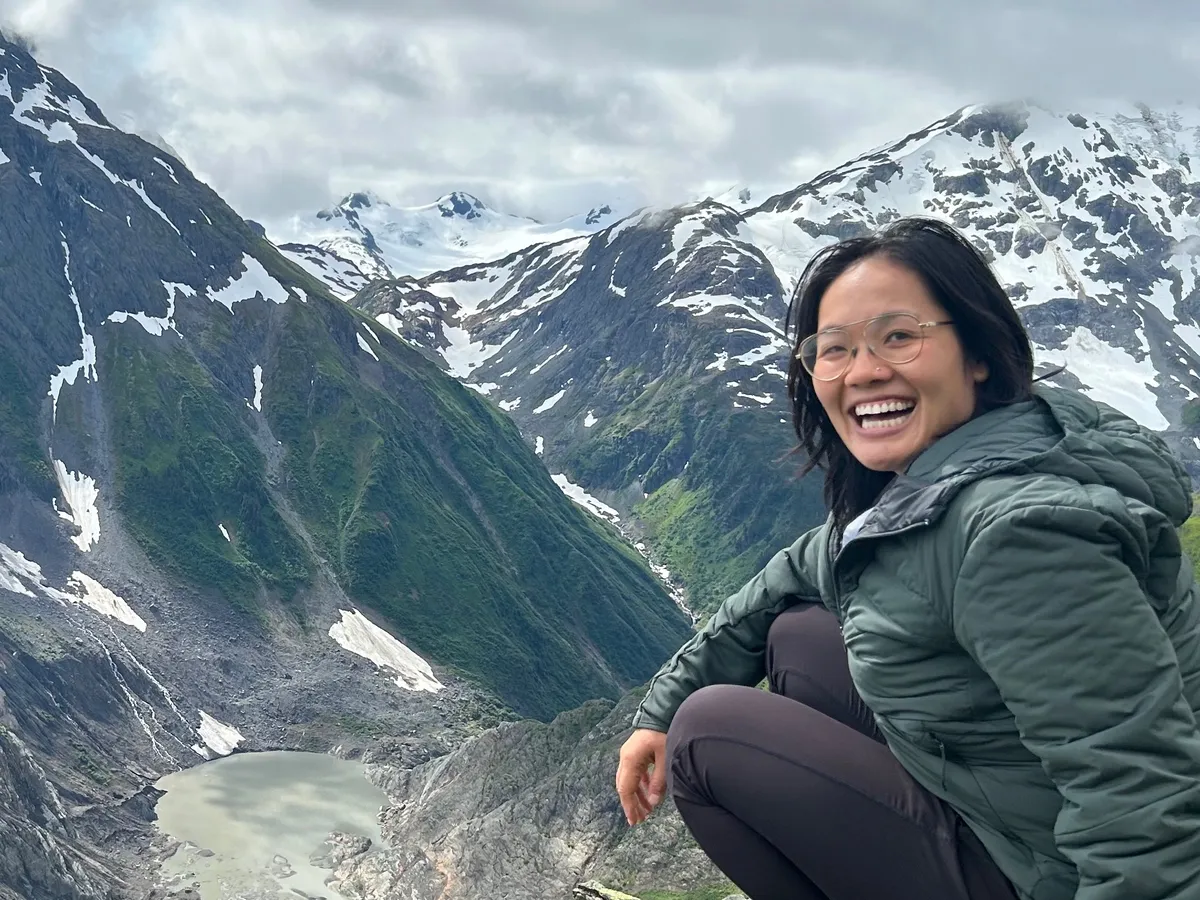
Teresa Vo’s workers’ compensation claim was denied, accepted and later overturned after she was struck by an ATV on June 18. She was walking from the Gjoa Haven health centre to her employer-provided accommodation at the time. (Photo courtesy of GoFundMe)

A nurse who was struck by an ATV this summer in Gjoa Haven says she won’t return to Nunavut because she feels unsupported by the territorial government and Workers’ Safety and Compensation Commission.
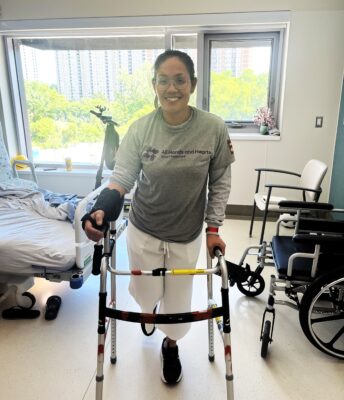
Teresa Vo uses a walker during rehabilitation at West Park Healthcare Centre in Toronto in July. She is now an outpatient at the health centre. (Photo by Sam Laskaris, special to Nunatsiaq News)
Teresa Vo was in the middle of a four-week nursing contract when she was walking home from a late shift at the hamlet’s health centre on June 18. A child driving an ATV struck her, leaving her with multiple fractures and internal injuries.
She is still in physiotherapy, limited in how far she can walk and unsure when she will be able to work again.
While in recovery, Vo fought a second battle over whether the accident happened during “the Course of Employment” — a technical determination on which thousands of dollars of workers’ compensation payments hinged.
“Dealing with this, feeling like I’ve been thrown under the bus and having to figure all this out on my own, is quite daunting,” she said.
Vo said her nursing contracts did not tell her that an injury while walking between her employer-provided accommodation and her work might not be covered. She also said she has not received return-to-work support from the GN, such as disability support she received from another employer in the south.
“I believe there is a broader issue here about how remote and northern health-care workers are protected, supported and treated when something goes seriously wrong,” Vo said.
Claim denied, then accepted … then denied again
The Workers’ Safety and Compensation Commission first denied Vo’s claim on July 24. She appealed on Aug. 6, which the commission accepted.
The commission paid out $3,783.89 on Sept. 2 for two weeks of missed work.
Then, on Sept. 3, the commission overturned its decision again, citing information provided by the GN, and Vo was asked to repay the money she had received.
The commission sent her another letter on Sept. 17, saying it wouldn’t attempt to recover that initial payment. (WSCC does not recover payments it made if “a previous compensation decision is changed.”)
The claim denial cited a policy that says since Vo was not on employer premises, no work incident had occurred and the injury did not arise out of and during the course of employment.
Vo disputes this because she was a travelling nurse, living at employer-provided accommodations, and had no other reasonable option to get home.
She had worked overtime on the night of the incident until about 7:30 p.m. and, because she was not on call, said she could not use one of the two vehicles reserved for nurses who might need to return to the health centre quickly.
She was also unable to hitch a ride with the two other nurses on duty.
Travel insurance helped cover costs associated with her treatment and return south, while Ontario’s public health insurance covered her eligible medical care in Ontario, Vo said.

She hoped WSCC compensation would replace lost income and help pay her mortgage, bills and day-to-day expenses while she cannot work.
‘Employer has a responsibility,’ say labour experts
Christopher McLeod, a University of British Columbia professor and director of the Partnership for Work, Health and Safety, said workers’ compensation systems have traditionally drawn a line between the workplace and a worker’s commute. But that line is more grey in Vo’s case.
“If she was at employer-provided accommodation and going back and forth between her place of work and her accommodation, I think you can make a really strong argument that the employer has a responsibility to ensure that she can get home safely,” McLeod said.
The commission acknowledged the limited infrastructure in Gjoa Haven but said she had completed her shift, was travelling home for personal purposes, was not on call and was not performing work-related duties. Transportation to and from work was not part of Vo’s contract and she was expected to walk, the denial said. Taxis were available if she was uncomfortable walking.
“At the time of the accident, I was travelling directly from my workplace to employer-provided accommodation. This was not an ordinary commute from work to my personal residence,” Vo said in her Aug. 6 email that appealed the decision.
“Taxi service was unreliable to the point that it could not reasonably be depended upon, leaving walking as the only practical means of travelling between the workplace and the accommodation.”
Barbara Neis, professor emerita at Memorial University and author of Occupational Safety and Health and Canada’s Mobile Labour Force: Obstacles to Regulatory Effectiveness, said workers’ compensation law does not take into consideration commuting while living in an isolated community for work.
“In theory, the employer should know that there are children driving ATVs. It’s often dark in the North. They should know that the conditions of getting back and forth to their place at work could be hazardous,” Neis said.
“They do have, one would think, responsibility for the safety of their workers. This worker wouldn’t have been there if they weren’t employed.”
Nunatsiaq News asked the Health Department whether nurse retention remains an issue in Nunavut and what Vo’s situation says to other nurses considering employment in the territory.
Department spokesperson Charmaine Deogracias declined to comment on the specifics of Vo’s employment but said the department faces challenges recruiting and retaining permanent nursing staff.
The department is “actively” reviewing practices, she said.
In the meantime, Vo’s knee remains badly injured. She uses a walking stick. Doctors told her in late August that it could take six months to a year before she can walk and work normally again.
She said $16,233 raised through a GoFundMe has helped her cover expenses while she cannot work.
“Nurses and other health-care professionals are asked to work in communities where transportation, housing, health services and other resources can be limited,” Vo said. “If nurses are going up North, they should have full transparency on if they will be protected or not.”
Has the person who hurt her offered her any support?
Underage driving is a big problem. There is a reason that hondas and skidoos have age restrictions. Some Young people are not physically capable of handling a honda or skidoo when things go wrong and are also not expected to be held responsible. That is why under 16 should not be driving hondas in town. Out of town ok as practice is important and having your kid drive helps. But not in town.
Stupid, and we wonder why Nurses do not want to come North to work, her employer whoever it is should be held accountable, all the businesses in Nunavut must have WCB coverages, another example of incompetence,why do they get a free pass.remember this
No the parents and kids should be held accountable. The only way the employer should be held accountable is if it was a person from the employer and a employer vehicle.
When I am walking home from the Northern, if I get hit by a honda driven by a kid is it there fault? Because they didn’t drive me home?
Sue the Hamlet. Get a lawyer and find out everything about the driver. Were they insured? Licensed? Was the Hamlet enforcing the Highway Act? After the driver was apprehended, did they run a field sobriety test? Was the ATV roadworthy? Was the operator driving erratically?
Their negligence shouldn’t result in your suffering. I would sue for millions.
Driving underage is rampant in Nunavut ,
And to top it off — most of all the atv’s on Nunavut roads are not the insured .
Though this is a horrible situation, WSCC should not be responsible for this. If I’m called into my work in Iqaluit and am walking, driving or taxiing, and something happens along the way between work and my staff housing, there is no way my work should be responsible. Someone should be responsible, but it isn’t the employer or WSCC. This has exposed a problem though.