

Baffinland can’t overwinter fuel barge in Steensby Inlet: NIRB
“Risk of a large accidental fuel spill which could cause irrevocable harm to the local Arctic marine environment”
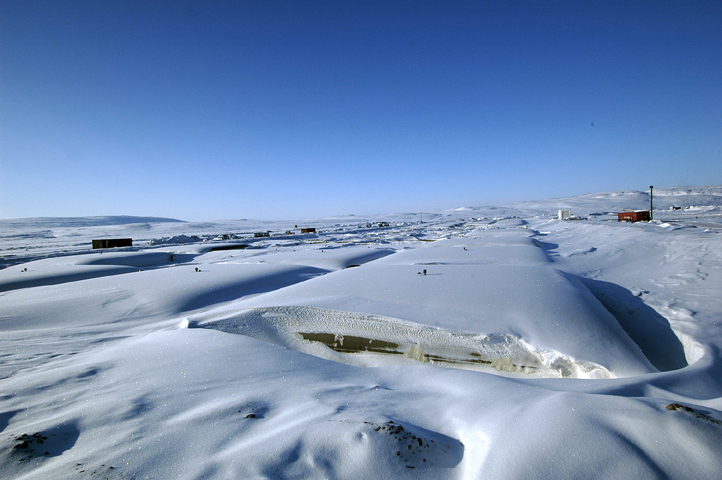
The Baffinland Iron Mines Corp. has stored seven million litres of diesel fuel inside collapsible rubber bladders at its camp at Milne Inlet, southwest of the community of Pond Inlet. (FILE PHOTO)
Baffinland Iron Mines Corp. won’t be able to keep 10 million litres of fuel throughout the winter of 2012 on a barge in Steensby Inlet, the Nunavut Impact Review Board ruled March 5.
The company, which wants to turn its Mary River iron exploration project into a huge iron mine, submitted a revised 2012 work plan to the NIRB in January.
The NIRB assessed Baffinland’s “Mary River 2012 Work Plan” as an exception from the NIRB review of the Mary River project, set to move into final hearings this July.
The proposed storage of fuel in Steensby Inlet carried a “risk of a large accidental fuel spill which could cause irrevocable harm to the local Arctic marine environment,” the NIRB decided.
In assessing the work plan, the NIRB said it considered potential environmental and socio-economic impacts, as well as comments on the plan from authorities and communities.
The NIRB has determined that all but one of proposed activities in the work plan could proceed as exceptions to the review in its “determination report,” signed March 5 by Lucassie Arragutainaq in Sanikiluaq, and delivered to Aboriginal Affairs and Northern Development Canada, Fisheries and Oceans Canada, Natural Resources Canada, Transport Canada, and the Qikiqtani Inuit Association.

“The NIRB has determined that the overwintering of a 10 Million Litre (ML) fuel barge at Steensby Inlet cannot proceed as an exception,” its determination report says.
The NIRB expressed concern over “the heightened potential for a large and undetected fuel spill and concerns over the difficulty of having effective spill response to address releases on and under sea ice.”
Environment Canada said bulk fuel storage on barges in landfast ice can’t be considered as “a best practice.” This type of fuel storage “presents a higher degree of risk of accidents and could result in significant environmental effects if the integrity of the barge’s tanks (which are designed for transport, not long-term storage in ice) are compromised by the surrounding ice,” Environment Canada’s comments said.
So, given “the significant public concern associated with potential spills resulting from the overwintering of fuel barges,” the NIRB decided “to exclude that activity from those to be allowed to proceed… the NIRB is of the opinion that the structures and activities as proposed should not cause permanent or irreversible disturbance or impacts.
The NIRB also said the proposed fuel storage scheme fell outside the scope of regulatory agencies. That means “no responsible authority is currently able to safely and effectively mitigate and monitor the potential impacts of such storage through the implementation of terms and conditions that might be recommended by the NIRB.”
The NIRB determination report also set out many terms and conditions for the 2012 work plan intended to mitigate potential impacts to the environment.

That work plans calls for work on a 30-person camp for Milne Inlet, a 100-person camp at Mary River, and a 40-person camp at Steensby Inlet, along with water supply, sewage treatment and solid waste disposal facilities, and incinerator, along with fuel deliveries and staging of construction equipment and material required for development of the Mary River project.
Baffinland has said it needs the 10 ML fuel barge or vessel, that would anchor and overwinter in Steensby Inlet, to provide the necessary diesel fuel to carry out the 2012 work plan and potential “pioneer development work” on the Mary River mine.
If NIRB project certificate is granted later this year, Baffinland has said nearly all proposed project activities associated with the current work plan would be completed between May and October 2012, but that some activities might be postponed until 2013.
Baffinland, a private company now under the control of ArcelorMittal, the European steel-making giant, and a private investment firm, Iron Ore Holdings LP, wants to see the Mary River mine churn out about 18 million tonnes of iron ore a year, which will then be shipped out year-round to markets in Europe and Asia for at least 20 years — and some predict up to 100 years.
The construction workforce will range in size from 1,700 to 2,700 persons, while the estimated workforce during the operation phase is about 950 persons.

The decision to refuse fuel to overwinter at Steensby Inlet could upset Baffinland’s plans.
Meanwhile, the QIA still wants Baffinland to assess an alternative to the proposed Steensby Inlet port site.
(0) Comments