


Plan Nord will address Nunavik’s housing crisis: Quebec
“Our government will never sacrifice a generation of young Inuit because of a housing problem”
KUUJJUAQ — The Quebec government says that tackling Nunavik’s housing shortage is a “number-one priority” that will be reflected in the province’s Plan Nord for northern development.
That was the message carried by a delegation of provincial ministers to Kuujjuaq Mar. 3, where they met the public at the Katittavik town hall.
The ministers didn’t share many details of Plan Nord, their much-anticipated draft for development above the 49th parallel, but assured everyone that the plan would address the region’s shortage of housing, which is estimated at about 1,000 units.
They said they would create a new north-south liaison committee on housing, which Quebec’s native affairs minister Geoffrey Kelley called a “permanent mechanism to meet with stakeholders.”
“In concrete terms, there will be a solution in the Plan Nord for the housing shortage,” Nathalie Normandeau, Quebec’s minister responsible for the plan, said at the Kaittitavik meeting. “Our government will never sacrifice a generation of young Inuit because of a housing problem.”
Normandeau and Kelley admitted that the 2010 renewal of a five-year social housing agreement to build 340 new units across the region fell well short of meeting Nunavik’s needs for housing.
While working on Plan Nord, Quebec receive 300 requests for projects needing money from Inuit, Cree, Innu and Naskapi who sit on a a Plan Nord working group.
Kelley said they’ll meet with that group once more March 14 before the Plan Nord is officially launched later this month, adding the plan will continue to evolve beyond then.
Projects covered under the 25-year plan are expected to be rolled out every five years.
In a presentation at Kaittitavik town hall, the ministers laid out parts of Nunavik’s wish list which could see funding under the plan:
• a renewed agreement between Avataq Cultural Institute and Quebec’s art council, le conseil des arts et des lettres du Quebec;
• a program to encourage educational success;
• the creation of Nunavik Sivuniksavut, a regionally-adapted college prep program;
• an update and finalization of technical, environmental and economic studies for connecting Kuujjuaq and Kuujjuaraapik to Hydro-Quebec’s electricity grid;
• a feasibility study and construction of a small hydroelectric project in Inukjuak;
• development of two more provincial parks; one near Umiujaq, the other near Tasiujaq;
• identifying 12 per cent of the region’s lands to become protected areas by 2015, with the goal of reaching 50 per cent; and,
• $6 million for a “phase two” of Xstrata Nickel’s Raglan project.

But news of these projects, designed to develop Quebec’s north, did not do enough to assure the Nunavik leaders present, who said they need more help now to lower the cost of living and improve Inuit success in education and access to jobs.
Kativik Regional Government executive member Michael Cameron said his Salluit household spends between $700 to $800 a week on groceries, a cost he works out to being five times higher than in the South.
“The government says they haven’t started the [Nutrition North] program yet, yet we feel the effects of it,” Cameron told the meeting. “It’s become really hard on us.”
That, at least, will be alleviated by Kelley’s March 3 announcement that a provincial cost of living subsidy will be renewed in Nunavik, until 2012, for a cost of $4.6 million.
Kelley also said he plans to meet with Indian and Northern Affairs Canada officials to discuss a more gradual transition of the Nutrition North program.
Other speakers at the Kaittitavik meeting asked the ministers for help with high drop-out rates and preparing Inuit youth to fill jobs in the region so to reduce a dependency on southern hires.
“Education is a huge issue,” said Jobie Tukkiapik, executive director of the KRG. “A lot of people come up here to work because they have the education required to fill the jobs. The Inuit of Nunavik are way behind in terms of education.”
Allan Brown, the KRG’s regional councillor from Kuujjuaraapik, stressed the need for more local training opportunities to fill jobs that the Plan Nord promises to bring to the region.
School board commissioner Mary Joanne Hauki said that a Nunavik needs its own university or institute for higher learning.
Ministers promised to help Nunavimmiut address their concerns, although these couldn’t all be targeted in the Plan Nord, they said.
Kelley later said how much the region has grown since the early 1990s when he first got into politics.
He described the relationship between Nunavik and the provincial government then as “heavy-handed.”
“It’s very different now,” he told Nunatsiaq News. “I think we’ll continue to see greater decisions taken in the North, but by northerners.”
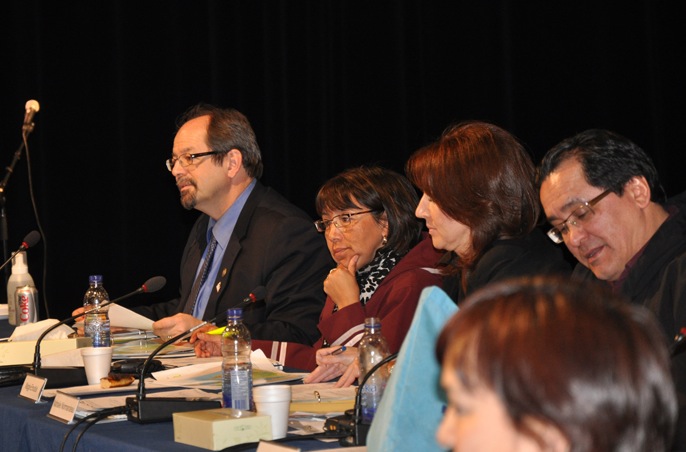
Speaking in Kuujjuaq March 3, Quebec’s native affairs minister Geoff Kelley, far left, promised that the province’s Plan Nord will tackle the housing needs in Nunavik. (PHOTO BY SARAH ROGERS)
(0) Comments