

Nunavut MLAs reject devolution budget cut
Elliot objects to spending more on sluggish file
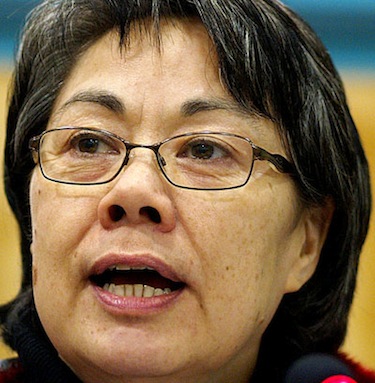
We are devo: Premier Eva Aariak defended her government’s spending on its devolution division in the legislative assembly last week as cabinet minister banded together to shoot down an effort to cut almost $300,000 from the devolution budget. (FILE PHOTO)
Nunavut’s cabinet voted as a block March 11 to reject a proposed $297,000 cut to the government’s devolution budget.
The motion, in committee of the whole hearings on the territorial budget, was put forward by Quttiktuq MLA Ron Elliott, who complained the budget for Nunavut’s devolution office, a part of the Executive and Intergovernmental Affairs department, is set to grow by nearly $300,000 this year.
“We’re being asked to approve almost $300,000 more, yet… as a regular member I don’t see this issue moving forward,” Elliott said.
Government spending on the devolution division of EIA has doubled in the last three years, according to the Government of Nunavut’s own budget estimates, from $771,000 in 2010 to a projected $1.5 million in 2012.
The money has gone to hire more staff to work on the issue.
Striking a devolution deal with Ottawa has become a major objective for Eva Aariak’s government, but there’s been little show for the effort so far.
The federal government has yet to appoint a devolution negotiator since Canada and Nunavut hammered a protocol for negotiations back in 2008.
“I don’t see the point in having [the devolution branch] grow at this point or at least until there’s a devolution negotiator named by the federal government,” Eliott said during debate on his motion. “I can’t see how we can move forward on the file until one is actually named.”
Answering questions during committee of the whole, Aariak said the expanded budget is required to get Nunavut’s government ready when — or if — negotiations begin.
“We have our employees who are busy doing some research work and preparing for the commencement of negotiations,” Aariak said. “We cannot go into negotiations without being prepared.”
It’s thought that Ottawa is reluctant to work on a devolution deal with Nunavut because the territory lacks the human resources capacity to take on regulatory roles currently performed by the federal government.
Last month, the Northwest Territories reached a devolution agreement in principle with Ottawa, leaving Nunavut as the last territory without some kind of devolution arrangement with Ottawa.

Aariak said she sensed progress on the file during recent discussions with the federal northern affairs minister, John Duncan, and she said Nunavut can take on greater responsibilities.
“We do not have an issue with capacity,” she told MLAs.
John Ningark, the MLA for Akulliq, argued Nunavut can only reap the full benefit of resource industries if it has “province-like power up here.”
He said Nunavut needs revenue from a devolution deal to fund badly-needed social programs.
“We need to reduce the poverty,” Ningark said. “We need more social housing, we need more money for breakfast programs.”

Elliott, along with regular MLAs Fred Schell, Johnny Ningeongan, Alan Rumbolt and Jeannie Ugyuk voted in favour of the motion. Cabinet ministers Hunter Tootoo, Dan Shewchuk, Tagak Curley, Peter Taptuna, James Arreak, Lorne Kusugak and Keith Peterson voted against the motion, as did Ningark.
Aariak did not vote, because as minister of Executive and Intergovernmental Affairs, she was a witness during the committee of the whole hearing.
(0) Comments