

Popular Facebook page takes a look at “Inukness”
“You might be Inuk if…”
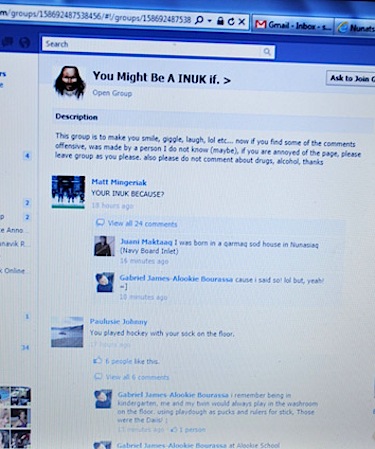
More than 3,400 Inuit from across the world have joined a Facebook group to share what it means to be Inuk. (PHOTO BY SARAH ROGERS)
You might be Inuk if you’re one of thousands of Inuit who have joined a Facebook page to talk about what it means to be an Inuk.
Since it was created earlier this year, more than 3,400 people have joined the Facebook group called “You might be a (sic) Inuk if…” to share their take on Inuit culture and stereotypes.
But a word of advice: don’t bother joining the group if you don’t have a sense of humour.
Many of the 11,000 plus posts poke playful fun at Inuit culture or how it is seen and even stereotyped by southerners.
A group member called Baffin Islandman posted about watching southerners feeding Canada geese at a pond outside a motel in Hamilton, Ont.
“[I] waited for the sun to go down, went to the pond with a plastic bag and some bread [and] started feeding the geese. When one got close enough, [I] grabbed it by the neck, put it inside the bag, went back to the motel and cooked it,” Islandman wrote. “Mmmm it was so good, good to be Eskimo sometimes.”
You might also be Inuk if “you wear Northern bags when your feet are wet,” wrote Patrick Kuniliusee or if you “drink pop anytime of the day,” said Steven Killiktee.
Cliff Evo said you might be Inuk if “you type your name on the computer and spell check wants to fix it.”
Some of the group’s humour comes off as self-deprecating, such as posts about very young, large and extended Inuit families.
You might be Inuk if “If your boyfriend/ husband/ brother/ uncle/ cousin/ ex is a father to many kids out there!” wrote Joyce Kogvek. “But you still love ‘em anyways!”
Reoma Pewatualuk wrote that Inuit “become a parent by the age of 16 and a grandparent by the age of 35.”
You might be Inuk if “you don’t know who your father is,” said Vince Lange, ending the post with a happy face.
But large families are also a point of pride for group members like Annie Hannah Tukuluk, who wrote that you’re “most definitely Inuk if you have over 100 cousins.”
In fact, the vast majority of posts on the Facebook page, which has drawn Inuit and non-Inuit from across the circumpolar world, show a strong pride in Inuit language and culture and a desire to maintain them in an increasingly modern world. Despite this, the group writes mostly in English.
You might be Inuk if “you’re happiest when you’re out hunting or camping,” said Makpa A.
Atsinak Bishop said you might be Inuk if “you’re always saving cardboard for chopping frozen meat for a meal.”
And Adamee Atsiqtaq said you’re Inuk if “you hate all Greenpeace and other f—ing animal rights activists, although commenter Aiden Koonark pointed out that he “sometimes likes Greenpeace when they distract oil drillers at the sea.”
The online group is one example of the growing popularity of Facebook and other social media sites among Inuit – at least in Canada, where communities in Nunavut and Nunavik are using Facebook as a forum to discuss politics, post public service announcements and to buy and sell merchandise.
Earlier this year, hundreds of Facebook users in Nunavik created a page in the months leading up to the vote on the Nunavik Regional Government last April. The site became a place to discuss the proposed governance model and many say it played a large role in the resounding rejection of it.
So, as group member Barney Konana pointed out, you might just be Inuk if you’re on Facebook.
And Marlene Willis said “at the end of the day everything is always right… to end my day with ‘you might be a Inuk.’ Good night.”
(0) Comments