

Polar bear cub in Toronto zoo clings to life after siblings die
Stress of captivity may have played a role in mother’s attack
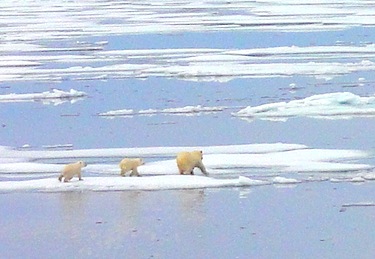
These polar bear cubs race after their mother out on the sea ice near Gjoa Haven. In the wild, the survival rate of polar bear cubs is not high, and it’s not unheard of for polar bears to eat their cubs.The Toronto Zoo has not provided details on why its mother polar bear might have turned on her cubs, but Wayne Goodey, a zoologist at the University of British Columbia, said stress caused by being in captivity may have played a role. (FILE PHOTO)
THANDI FLETCHER
Postmedia News
Only one of three newborn polar bears was still clinging to life in the intensive-care unit of the Toronto Zoo on Thursday, after his two siblings succumbed to injuries inflicted by their mother.
Zoo workers are struggling to keep the tiny cub alive, born prematurely on Tuesday and then rejected by its mother, 10-year-old Aurora.
“Less than 48 hours after birth, a second newborn polar bear cub succumbed to wounds inflicted by its mother,” the zoo said in a statement. “An uninjured male cub remains in the zoo’s intensive care unit under 24-hour care with staff being hopeful that each day he will get stronger.”
On Wednesday, zoo workers noticed Aurora was lashing out against her young and quickly intervened in an effort to save the newborns, two males and one female. One of the cubs died immediately. The zoo did not provide details. Staff removed the two other cubs, taking them to the facility’s ICU.
The surviving cub was receiving “round the clock care,” the zoo said in a statement on Wednesday.
The zoo has not provided details on why the mother polar bear might have turned on her cubs, but Wayne Goodey, a zoologist at the University of British Columbia, said stress caused by being in captivity may have played a role. In the zoo staff’s excitement over the births, Goodey said it’s also possible the extra attention may have caused further stress on the mother.
“You can believe for sure that the zoo staff were all glued to the windows watching what was going on … there could have been a fair bit of cheering when the babies popped out,” he said. “She might have been quite upset and troubled by that kind of activity.”
In the wild, the survival rate of polar bear cubs is not high, and it’s not unheard of for polar bears to eat their cubs.
When faced with stressful factors like not being able to hunt seal, its main food source, due to melting Arctic sea ice, Goodey said male polar bears will often eat cubs. “It’s an easy meal,” he explained. “It’s easier than hunting a seal.”
In nature, mother polar bears will also sometimes eat their young when they seem to be ill. Polar bears typically give birth at the end of November and in December. This week’s birth is likely the earliest recorded birth of polar bears in captivity, the zoo said.
Being premature, Goodey said it’s possible the cubs did not behave as would be expected from normal newborns.

“Normally, they would pop out and they would be pretty quickly … complaining and moaning and groaning,” explained Goodey. “It’s possible that she would have perceived them as being sub-normal and therefore might have been inclined to eat them.”
Without knowing the specifics of the case, Goodey said his theories are only that – theories.
Rob Laidlaw, a biologist and the founder of wildlife protection group Zoocheck Canada, said the incident raises questions about whether polar bears should be kept in captivity.
“It’s almost impossible for us to understand the minds of these animals, but captivity itself has profound negative consequences to many animals,” said Laidlaw. “They face challenges like confinement, boredom, frustration, or health because of a lack of activity … They become stressed and suffer. I think it’s a combination of all of those things that leads to … rejection and infanticide.”
As newborns, polar bear cubs are blind and only weigh about 600 grams making them very vulnerable, said Laidlaw. “They rely on touch, on warmth, on mother’s milk to get antibodies so they can fight disease and develop normally,” he said.

Aurora, who was still on exhibit in the Toronto Zoo on Thursday, is not the first polar bear to reject her cubs in a zoo. In 2006, the Berlin Zoo handreared a polar bear cub rejected by his mother at birth. The cub, Knut, became a celebrity, but drowned earlier this year.
(0) Comments