

Sudliq Developments wins appeal on GN-awarded contract
Board confirms errors by Government of Nunavut
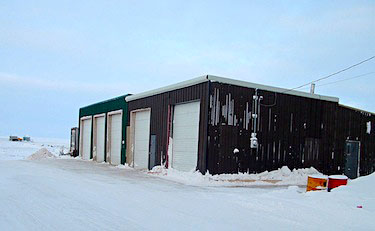
Louie Bruce, the owner of Sudliq Developments Ltd. in Coral Harbour, built this heated garage — the only one in the community — so that fuel delivery trucks could be kept warm and operate without problems in the winter. (FILE PHOTO)
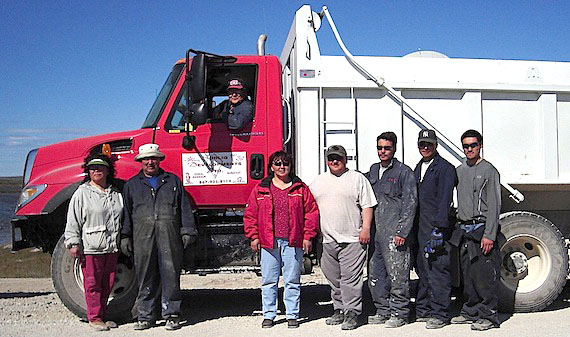
Sudliq Developments Ltd. of Coral Harbour, whose workers are shown here by one of the company’s trucks, won its appeal with the Nunavummi Nangminiqaqtunik Ikajuuti appeals board against the Government of Nunavut’s decision to grant the fuel contract to Katudgevik Co-op Ltd., part of the Arctic Co-operatives Ltd. network. (FILE PHOTO)
(updated Dec. 13, 1:00 p.m.)
Business-owner Louie Bruce of Coral Harbour is a happy man today.
Late Dec. 11 he learned that Sudliq Developments Ltd. had won its appeal to the Nunavummi Nangminiqaqtunik Ikajuuti appeals board against the Government of Nunavut’s decision to grant the fuel contract in Coral Harbour to the Katudgevik Co-op Ltd., part of the Arctic Co-operatives Ltd.
Bruce’s 100-per-cent Inuit-owned company, Sudliq Developments Ltd., had held that contract for 25 years.
The NNI policy is the GN’s instrument for complying with Article 24 of the Nunavut Land Claims Agreement, which says governments must do things to help Inuit-owned businesses get government contracts.
Since Nov. 1, the Katudgevik Co-op Ltd. has taken over fuel delivery in Coral Harbour.
That’s because section 18.25 of the NNI policy reads “notwithstanding that an appeal is pending, the Contracting Authority, in its discretion, may enter into a contract with the successful Bidder or Proponent.”
However, the decision doesn’t mean that the contract will immediately revert to Sudliq.
The NNI appeals board decisions are “not binding” on the GN,said Matthew Illaszewicz, manager of communications for the GN’s department of economic development and transportation in a Dec. 13 email.
The “Contracting Authority,” that is, the department of government and services, is not bound to accept these recommendations, he said.

The only requirement on the “Contracting Authority” exists under Section 18.26 of the NNI Policy, which requires that the “Contracting Authority” issue written reasons if it chooses to not accept the recommendations of the board fully.
“Right now the Government of Nunavut needs to decide how to respond to the appeals board decision,” Illaszewicz said.
But in its decision, the appeals board found an error in how the GN had communicated with Sudliq.
Its members also rapped the GN for making changes to its NNI forms and for overstepping its authority over the NNI — which is supposed to operate independently from the GN.
Sudliq’s appeal was considered by three NNI board members: chair Barry Cornthwaite and members Sarah Maniapik and Al Lahure.
They met in October, and then again on Nov. 17 and 18 to hear arguments from Iqaluit lawyer Ann Crawford who, speaking on Sudliq’s behalf, alleged seven reasons suggesting the contract had been improperly awarded.
The board members dismissed all but two of her concerns because these dealt with procurement issues in general.
But in their judgement, they acknowledged flaws in the NNI process and in the forms used by the GN to evaluate “Inuit content” for its RFPs.
They also cited errors in how the “Inuit Labour and Training” scores were reported to Sudliq in a “letter of regret” sent Sept. 2 by the GN.
“The Board feels detailed and accurate letters of regret form an integral part of the NNI policy” because they allow applicants to learn “where improvements can be made in future submissions.”
They acknowledged that an appealing party like Sudliq is “at a disadvantage” because they don’t see bids made by other proponents.
And even the NNI board apparently didn’t feel it had all the information about how the contract decision was made.
To correct that situation, the board’s 11-page judgement recommended the NNI board should have access to “detailed notes” about how the GN’s evaluation committee comes to conclusions so it can be “readily understood and easily compared.”
The board also questioned aspects of the co-op’s RFP submission. Instead of using the form filled in by Sudliq called “NNI Incentives Application Form,” the co-op used a form of its own design.
In its listing of Inuit firms that would benefit from the contract, “the information [from the co-op] was being provided in a way that could not be verified.”
“It is unclear to the Board how any award could have been made, as the information was being provided in a way that could not be verified,” they said, and, as a result, “could not have applied the NNI Policy correctly.”
To avoid that situation in the future, the board recommended that “the GN start using standardized forms.”
As well, the board members noted the GN had added a third category, “training,” to its RFPs on “Inuit Content,” which the NNI says consists of “Inuit employment” and “Inuit ownership.”
They said that despite the GN’s assertion that it could change the forms, it can’t. If the board accepted that, this would mean the GN can “arbitrarily change” the NNI policy.
“That is a proposition the Board does not accept.”
These rebukes to the GN comes as Nunavut Tunngavik Inc. has questioned how effective the NNI policy is in giving preferential treatment to Inuit- and Nunavut-owned businesses when awarding procurement contracts.
The board recommended that a standardized NNI incentive form should be mandatory, that the evaluation committee should supply detail notes, and that the contract handed to the co-op be terminated Dec. 11.
Bruce learned in September that company had lost the GN fuel distribution contract to Katudgevik Co-op Ltd..
A journeyman mechanic now in his 50s, Bruce started Sudliq Developments in 1986 to create Inuit jobs in his community.
Due to the loss of the contract, Bruce faced laying off many of his 10 full-time and 35 to 40 part-time employees.
(0) Comments