

Quebec court to ponder big changes to High Arctic exiles’ ailing trust fund
Makivik, trustees want access to $3 million of principal

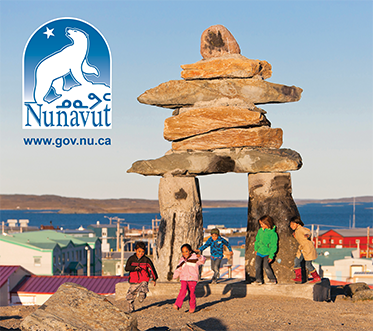
Today, Resolute Bay is a functioning Nunavut community. But in the early 1950s, it was a place of deprivation and suffering for Inuit families moved there from Inukjuak and Pond Inlet. (FILE PHOTO)
(Updated 4:00 p.m., April 7)
The High Arctic exiles trust fund is now in big trouble.
Battered by the recent global financial crisis, the trust’s earnings shrank steadily in most of the years after 2002, and the fund did not earn enough revenue in 2009 even to pay its administration costs, documents obtained by Nunatsiaq News reveal.
To fix that, a six-person board of trustees will ask a Quebec judge to amend the trust deed to let them take up to $3 million from what’s left of the fund’s principal.
The High Arctic Relocatees Trust, or “HART fund,” stood at $10 million in 1996 when the federal government turned it over to a six-person Makivik-appointed board of trustees.
In 1996 and 1997, the trustees took $2 million of it to distribute in equal amounts to the original High Arctic exiles, leaving $8 million invested to produce earnings for future cash distributions.
A financial statement acquired by Nunatsiaq News shows the fund was valued at only $7.26 million as of Dec. 31, 2009, and that the trust owed $129,735, mostly in unpaid administration costs, and made no payments to beneficiaries in 2009.
In a motion filed Feb. 17 at the Quebec superior court office in Old Montreal, Makivik and and the HART trustees say they want to take up to $3 million out of the principal so they can resume cash distributions to beneficiaries and pay administration expenses.
Lawyer Marie-Andrée Godin filed the motion. She works for the same law firm — Silverstone, Larriviere, Arteau, Dorval, Godin — as Sam Silverstone, a long-serving Makivik lawyer who also serves as a Hart fund trustee and was a major architect of the agreements that created the fund.
Silverstone said April 6 that Makivik Corp. does not play a direct role in managing the fund.
“Any difficulties that the trust is encountering now has nothing to do with Makivik… It’s the six trustees who run the trust,” Silverstone said.
If the motion is successful, the fund’s principal could potentially sink as low as $5 million, from its 1996 high of $10 million.
Hart trustees want to change the trust deed because right now the deed does not allow fund managers to make payments from the original principal.
And because the fund’s principal does not now earn enough money, fund managers cannot pay administration expenses or make distributions to beneficiaries.
The fund earned as much as a million dollars a year or more before 2001, but its earnings have dropped dramatically since 2002.
A balance sheet for 2009 shows trustees racked up $108,199,73 in expenses, including $32,760.17 in travel expenses. Earnings stood at only $56,295.15.
A Quebec superior court judge will hear the trustees’ motion April 14, but won’t likely make a decision on it until at least May.
For most of the fund’s numerous beneficiaries, their sole source of information is a densely-worded legal notice, published March 5, which provides information on where to find copies of relevant court documents.
Trust beneficiaries contacted by Nunatsiaq News April 5 did not immediately return phone calls.
Ottawa paid the money as part of a 1996 deal as compensation for suffering caused after the relocation of 19 Inuit families, most of them from Inukjuak, to Resolute Bay in 1953 and to Grise Fiord in 1955.
In the High Arctic, the relocated Inuit were left with inadequate food and shelter and fared badly while adjusting to the alien environment of the High Arctic.
A report done by the Royal Commission on Aboriginal Peoples found that the federal government’s actions at the time were “coercive” and done without the consent of the Inuit.
Only 34 of the original relocatees are still alive. But they left numerous descendants throughout Nunavut, Nunavik and southern Canada.
And the trust fund represents the only compensation the exiles are ever likely to get.
When they accepted the $10 million payment from Canada, they signed documents relinquishing all rights to sue the federal government, or make any other claims in the future.
They also signed documents granting power of attorney to Makivik Corp., which means only Makivik Corp. may act on their behalf with respect to the settlement with Canada.
The trust deed says:
• trustees may do consultation with beneficiaries when replacing members, but only “as they in their discretion deem appropriate;”
• trustees are not obliged to act on any recommendations they might hear in such consultations;
• all trustees are appointed by Makikvik Corp, except for two members, one of whom must be the Makivik director of finance and the other a member of Makivik’s board;
• the trustees make investment decisions and the Makivik Corp. administers the investments.
The six trustees are: Sam Silverstone; Cely Casia of Kirkland, Que, a financial officer at Makivik; Allie Salluviniq of Resolute Bay; Markoosie Patsauq of Inukjuaq; Larry Audlaluk of Grise Fiord; and Isaac Akpaleapik of Pond Inlet.
The trust is to be wound up in 2031, when any remaining money is to be distributed to surviving beneficiaries.
Some exiles have said privately that they have little knowledge of how the trustees have managed their money, which last year was transferred into a special bank account in Montreal.
Another document shows that on July 17, 2009, the Hart Trustees deposited $7.95 million into CIBC bank branch 0001 in Montreal, where’s it’s held as a GIC.
When the deposit matures July 19 this year, it will earn an interest rate of only 1 per cent.
Silverstone said trustees did this as a “conservatory” measure, to ensure that the beneficiaries’ money suffers no more losses.
Related:
• Lawyer: Makivik not responsible for exiles’ trust
• Background: What’s proposed for the High Arctic exiles fund
(0) Comments