

Biologist sees mammal hybrids as Arctic warms
Ice melt would remove breeding barrier
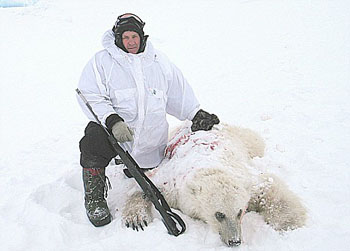
A marine biologist from Alaska says “pizzlies,” that is, crosses between polar and grizzly bears, like this bear shot on Banks Island in 2006, may become more common as the Arctic summer ice melts.
When the Arctic Ocean’s summer ice melts away for good — which some scientists predict will occur within 20 years — marine mammals like bowheads, walrus, seals, narwhals, and polar bears will encounter unfamiliar conditions.
And many predict these ice-dependent marine mammals will face extinction as a result.
But something else may also take place, suggests Brendan P. Kelly, a marine biologist with International Arctic Research Center at University of Alaska in Fairbanks.
It’s possible that we’ll see new hybrid animals or crosses result from the interbreeding of ice-dependent marine mammals, Kelly said in a recent interview.
Picture new breeds of polar animals, which will resemble polar bears and grizzly bears, harp and hooded seals, and narwhals and belugas.
Examples of this kind of interbreeding, which is more possible between marine mammals than among some other species, are already accumulating, said Kelly, who has been documenting the evidence.
Altogether, there are 28 mammal species found today in the Arctic that could potentially interbreed, he said.
These include bowheads and right whales and different populations of humpbacks, walrus and seals, which have been separated for 10,000 years due to the presence of ice in the Arctic.
“The sea ice is a continental-sized barrier to a lot of organisms that can’t penetrate sea ice,” Kelly said.
But as the summer ice retreats, marine mammals whose travels and interaction have been blocked by ice, will have more opportunities to come into contact, and they expand their distribution, he suggests.
Other marine mammals, like porpoises and killer whales, which are moving north and spreading out, may also mix with whale species in today’s Arctic.
Interbreeding between species used to happen mainly in zoos, where zookeepers experimented with breeding zebras and donkeys to make “zedonks” and lions and tigers to produce “tigons.” Most were dead-ends and could not reproduce.

Polar bears and grizzly bears were bred more than 100 years ago in German zoos— and unlike most other hybrids, the females were able to give birth to other beige-coloured bears.
Kelly said there’s “pretty strong evidence” that this is now happening in the wild.
Well-documented finds listed in scientific papers include:
• A pup in the hooded seal herd in the Gulf of St. Lawrence spotted in 1994, which bore a combination of hooded seal and harp seal features. Its mother was a hooded seal, its father a harp seal, although hooded seal females are approximately twice are large as male harp seals and a much more aggressive;
• The complete skull of a whale from Disko Bay in Greenland, in 1990, which had traits of a narwhal and beluga. According to the hunter who killed the whale, the whale looked like a combination of a narwhal and a beluga, with the tail of a narwhal and flippers of a beluga— and there were other similar whales swimming in the vicinity, he said; and,

• A “pizzly,” shot in 2006 on Banks Island, had the head and neck of a polar bear, but was the size of a grizzly. Genetic analysis showed the bear’s mother was a polar bear and its father was a grizzly. Both bears mate several times before the female can become fertile, so the two bears would been together for at least a week, biologists said.
Marine mammals are “infamous” for ability to hybridize, that to mate successfully with similar, but different, members of their species, Kelly said.
That’s because bears, seals and different kinds of whales have the same number of chromosomes, the unique packages of genetic information contained in every cell of living creatures.
Generally, the number of chromosomes varies from species to species, and once this changes it’s hard to hybridize back, Kelly said.
But there have been very little genetic changes in most marine mammals.
“Even species that are very different looking, like narwhal and beluga, have the same number of chromosomes, so there isn’t that chromosomal barrier to hybridization,” Kelly said.
But as the ice melts, some species may disappear through hybridization, Kelly predicts.
“We may hang on to a lot of polar bear genes, they’ll just be hidden in the grizzly bear population. They’ll still be bears— but they won’t be the polar bears we have known,” Kelly said.
The rate of environmental change makes it likely that the marine mammals seen now in the Arctic won’t have time to adapt.
Instead, some will meet and interbreed with similar species better equipped to survive, Kelly said.
(0) Comments