

No Inuit knowledge, no quota cuts, NTI says
“Hunters are on the land 12 months out of the year”
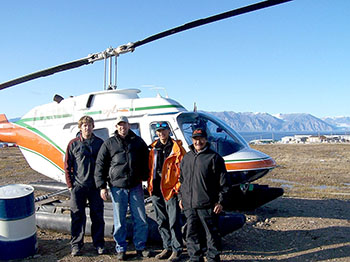
This team of scientists and hunters flew around Pond Inlet earlier this year by helicopter to survey polar bears. (PHOTO COURTESY OF WWF)
Nunavut Tunngavik Inc. says the Nunavut Wildlife Management Board should not cut the polar bear quota in Baffin Bay without first giving “full consideration” to traditional Inuit knowledge.
The wildlife board met Sept. 29 and Sept. 30 in Iqaluit to consider a request from the Government of Nunavut to decrease the number of polar bears that hunters from Pond Inlet, Clyde River and Qikiqtarjuaq are allowed catch.
To back up the request, the GN cited scientific models showing the current quota of 105 polar bears per year is too high to sustain the estimated population of 1,500 and should be lowered.
Raymond Ningeocheak, NTI’s vice-president of finance, said Inuit are concerned the population estimate used by the GN to justify a decrease resulted from a computer model, “with no verification,” noting the last population survey in Baffin Bay was completed in 1997.
“The fact that the data used by the government’s researchers is over 10 years old should raise red flags,” Ningeocheak said in an Oct. 1 news release.
Inuit also feel that the GN is ignoring the hunters, who say the polar bear population in Baffin Bay has actually increased, he said.
“Hunters are on the land 12 months out of the year and are constantly observing the land and animals on their travels. Over the last several years, hunters in the Baffin Bay region have observed an increase in polar bears,” Ningeocheak said.
“They can tell you which species are in decline and which are increasing,” said a speaker at the NWMB meeting.
Many others at the meeting criticized the mark and recapture survey method, which requires polar bears to be drugged.
Elijah Panipakoocho of the Mittimattilik hunters and trappers association said drugged polar bears later become dangerous animals, wrecking cabins and meat caches and scavenging communities for food.
Panipakoocho suggested a future survey could use methods like those recently used during a polar bear survey near Pond Inlet.
The helicopter survey, which received supported from the World Wildlife Fund, saw HTA members and polar bear scientists from the GN, Parks Canada and University of Minnesota working together.
The team observed a total 62 bears during 17 hours of flights, which covered nearly 2,500 kilometres of coastline.
Panipakoocho suggested good places to observe the polar bears and helped in determining the animals’ age and sex.
Panipakoocho said he was pleased researchers did not have to handle or tranquilize the polar bears during the survey.
This was the most accurate type of polar bear survey done that he’s seen to date, Panipakoocho said.
In his final comments to the NWMB special meeting, chairman Harry Flaherty tried to reassure the hunters who spoke against any reduction of the quota in Baffin Bay based on scientific data only, saying “we hear your concerns.”
A new survey of the polar bear population in Baffin Bay is “urgent,” Flaherty said.
This survey should involve more Inuit, rely on new methods and incorporate more Inuit traditional knowledge, he said.
The GN isn’t due to start a population survey in Baffin Bay until 2014, but this date could be pushed up to 2010 if the NWMB decides the survey is a priority.
(0) Comments