

Violent crime against young women, girls three times higher in the North
Young women in northern Saskatchewan, Manitoba experience highest rates; Nunavut is fourth
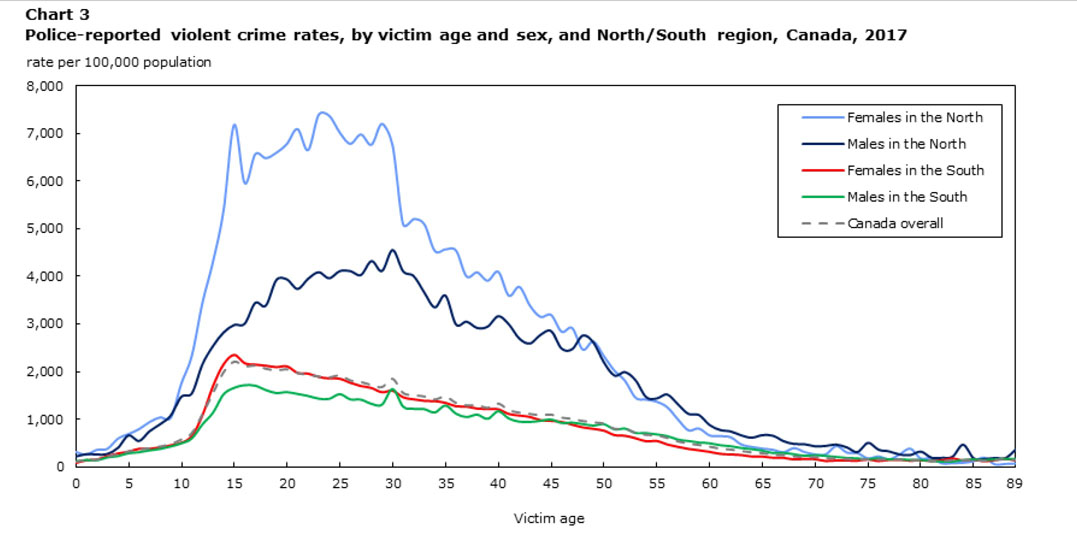
The light-blue line on this graph shows the dramatically higher rates of criminal violence that young women and girls experience in northern Canada. For the purposes of their study, Statistics Canada defines the “North” as the three territories, plus the northern regions of Ontario, Quebec, Newfoundland-Labrador and the four western provinces. (Statistics Canada image)
Though young women and girls in Nunavut experienced severe rates of violent crime in 2017, their counterparts in northern Saskatchewan and northern Manitoba fared much worse, Statistics Canada found in a report released earlier this month.
That finding is part of a big study that attempts to measure rates of violent crime against females aged 24 and younger in northern Canada and compare them with rates for the same group in southern Canada.
In their report, StatCan found that overall, young women in northern Canada are disproportionately victimized compared with young women in southern Canada.
“In the North, females accounted for just under half (48 per cent) of the population aged 24 and younger, but nearly two-thirds (62 per cent) of victims of violent crime in the North were female,” StatCan said.
“In fact, young women and girls in the North were over-represented as victims of violent crime whether they were compared with all females, all young Canadians, or all Canadians in the North.”
For the purposes of the study, Statistics Canada defines the “North” as the three territories plus the northern regions of Ontario, Quebec, Newfoundland-Labrador and the four western provinces.
Overall, 12,036 young women and girls aged 24 and younger in the North were victims of a police-reported violent crime in 2017.

That produced a rate of violent crime against young women and girls that’s about three times higher than the rate for young women and girls in southern Canada and nearly twice the rate for young men and boys in the North, StatCan said.
Violence rates highest in northern Saskatchewan
Of all the northern regions, StatCan found that northern Saskatchewan, by a wide margin, suffers from the highest rate of police-reported violent crime against women and girls aged 24 and younger in 2017: 13,886 per 100,000.
Northern Manitoba was second, with a rate of 9,015 per 100,000 and the Northwest Territories stood third at 8,909 per 100,000.
Nunavut was fourth, with a rate of 7,491 per 100,000.
In comparison, the rate in southern Canada in 2017 was 1,235 per 100,000.
Also, the raw police-reported numbers for Nunavut women and girls aged 24 and younger in 2017 reveal the following:

• Sexual offences: 144 young female victims.
• Physical assault offences: 451 young female victims.
• Criminal harassment and threat offences: 590 young female victims.

This bar graph shows the difference between the North and southern Canada in violent crime rates, by the age and gender of victims. (Statistics Canada image)
Dramatic difference in physical assault rate
The study also found northern Canada’s higher rates of physical assaults against young women account for much of the difference between northern and southern Canada.

“That said, by far the biggest discrepancy was for physical assault-related offences, for which rates were nearly four (3.9 x) times higher among young women and girls in the North than in the South (2,283 victims per 100,000 population versus 581).”
Also, 45 per cent of young women in the North who suffered from physical assaults suffered injuries, compared with only 32 per cent in southern Canada.
Homicide rate three times higher
As for homicides, the study found that between 2009 and 2017, 74 young women in the North were victims of homicide and that of those, 56 were Indigenous.
That produced a homicide rate for young women in the North for 2017 that was three times higher than the national average.
At the same time, the homicide rate for young men and boys in the North was even higher.
“However, when comparing the North with the South, the gap in homicide rate was widest among young women and girls (more than three times higher in the North for young females overall, compared with just over two times higher in the North for young males,)” StatCan said.

This table shows the raw numbers, and the rates per 100,000, for violent crimes committed against girls and young women in northern Canada. (Statistics Canada image)
Victims usually know their assailants
As for the perpetrators of violent crime against young women in the North, most are either intimate partners, casual acquaintances or family members of the victims, StatCan found.
And 95 per cent of victims knew their assailants before being attacked.
“In 2017, over two in five (44 per cent) young female victims of police-reported violent crimes in the North had been victimized by an intimate partner or spouse.”
“More than one in five (22 per cent) had been victimized by a casual acquaintance. Another 20 per cent experienced violence at the hands of a family member, which can include a parent, a grandparent, an aunt, an uncle, a cousin or a sibling.”
And the study also confirmed that younger victims were more likely to be abused by family members, while older victims were more likely to be victimized by intimate partners.
“As research has often found with young victims of violent crime, girls younger than age 12 in the North were most commonly victimized by a family member (54 per cent), while young women aged 18 to 24 in the North were most commonly victimized by an intimate partner (61 per cent,)” StatCan said.
Police more likely to identify northern perpetrators
One difference between northern and southern Canada is that in the North, the police are more likely to be able to identify the perpetrators of violent crimes against young women and girls: in 81 per cent of incidents in the North, but only 68 per cent of incidents in southern Canada.
“This may be attributable in part to the realities of smaller communities where residents are more likely to know each other, making it easier for police to identify an accused,” StatCan said.
At the same time, there was no significant difference in the proportion of criminal charges involving young female victims laid in the North (70 per cent) compared with those in southern Canada (70 per cent,) StatCan found.
Police-reported violent cri... by on Scribd
“That produced a homicide rate for young women in the North for 2017 that was three times higher than the national average.
At the same time, the homicide rate for young men and boys in the North was even higher.”
What was the national homicide rate in 2017?
What was the homicide rate for young women in the North inr 2017?
What was the homicide rate for young men and boys in the North in 2017?
An interesting observation. Following the Rwandan civil war, and genocide local politician Aloysia Inyumba made note that ““The genocide in Rwanda is a far-reaching tragedy that has taken a particularly hard toll on women. They now comprise 70 percent of the population, since the genocide chiefly exterminated the male population.” Similarly, Hilary Clinton made the observation that “Women have always been the primary victims of war. Women lose their husbands, their fathers, their sons in combat.” It’s a bit surreal to think that the death of men is still not enough to make them the primary victims of violence, it’s still women. This really plays to an ancient theme where men are considered more disposable than women.
Read more here:
https://quillette.com/2019/06/03/considering-the-male-disposability-hypothesis/
These are horrible statistics, yes, but if you look at levels of crime in general “in the north”, rates are sometimes 10X the national average. If violence against women is only 3X of that “down south”, that is 3X better than other crimes.
For example, in 2016 a Canadian resident had a 5.9% chance of being charged with a crime. In Nunavut, this figure was closer to 36% (or 43% in NWT).
Once again, due to the smaller sizes of communities in the north, there is a higher chance of these perpetrators being caught and charged.
Published studies conclude that in Canada, only around 1 in 20 sexual assaults are actually reported to the police. That suggests that in Nunavut instead of 144 sexual assaults against females in 2017, it could be closer to 2880 sexual assaults.
Further, males are 12 times less likely to report sexual assault than females, so whatever is reported in this category in other reports is barely the tip of the iceberg.
At that rate of crime, over a 7 year period, it would become a statistical certainty that an individual female will be sexually assaulted in Nunavut.
This is unless a significant portion of the female population is being victimized multiple times, or the rate of reporting to the police in Nunavut is much higher than other places.
I do not know if either of these thins would be true, but in any case this demonstrates the truly staggering scale of this problem.
We should therefore take no comfort in thinking that women in Nunavut are being victimized to a lesser degree than for example, bicycles are being stolen, or houses being broken into.
“This is unless a significant portion of the female population is being victimized multiple times… ”
That is the case. I know many women who have *not* been sexually assaulted in Nunavut although spending many years living there. I also know some who have been repeat victims.
It won’t get any better since rcmp’s and other social workers are against families in Nunavut especially men who they don’t like very much. Stop playing with families and it will lead to that woman fault and it will get not any better like democracy. You need to help the woman with counselling with elders with no connection to biase culture white systems.