

Nunavut Arctic College closed until fall, territory launches self-assessment tool for COVID-19
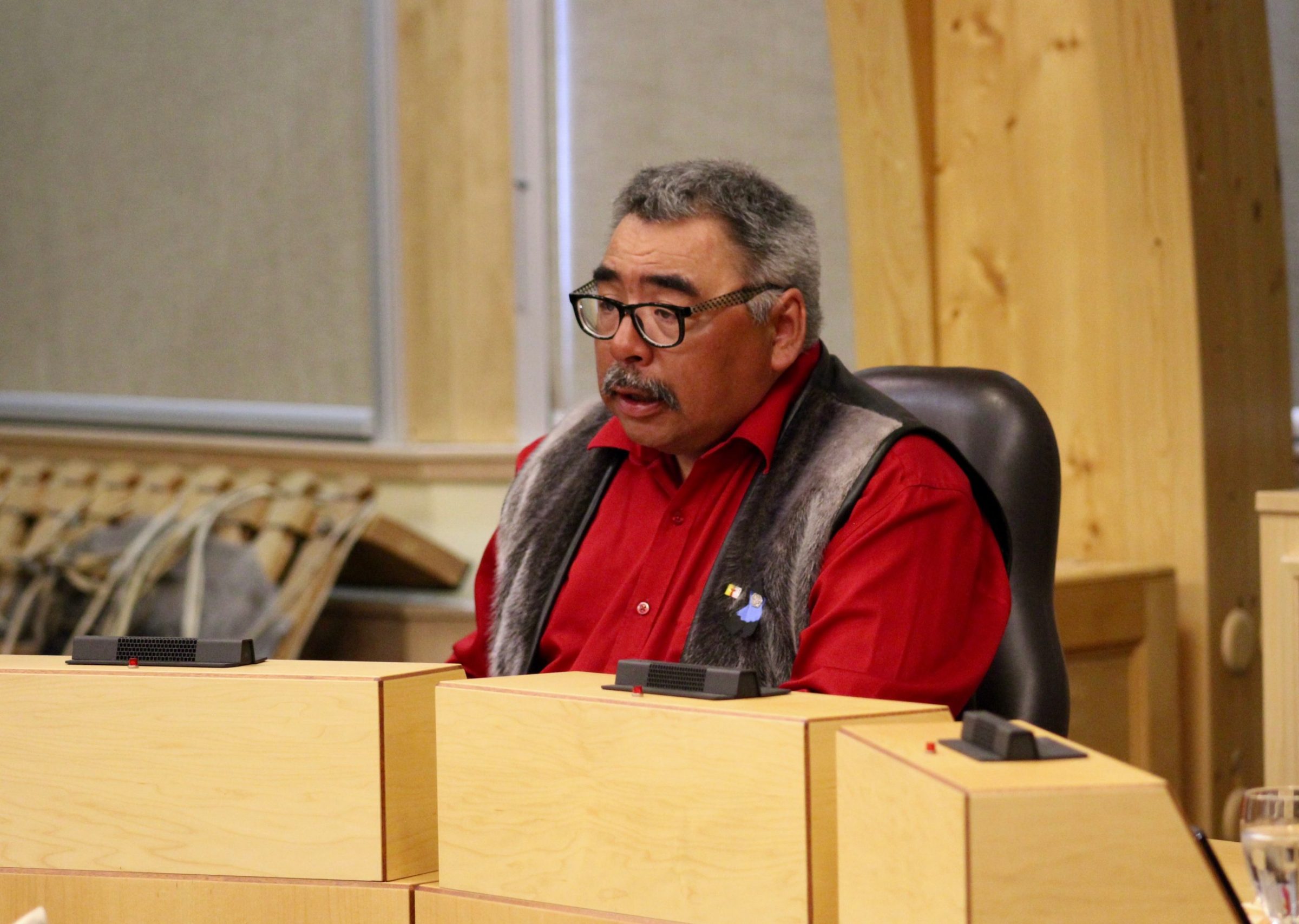
Speaking at a news conference earlier today, deputy premier David Akeeagok tells reporters that all Nunavut Arctic College campuses and facilities are closed until the fall. “Students with families can remain in Nunavut Arctic College’s family residence. The Nunavut Arctic College program heads and instructors will be in touch with their students directly about if and how their program will continue,” he said. The Government of Nunavut has also launched a new self-assessment tool for COVID-19 in Inuktitut, Inuinnaqtun, English and French. You can access the tool at nu.thrive.health/covid19. “The purpose of this self-assessment tool is to provide Nunavummiut with real-time information and recommendations based on self-reported symptoms or recent travel history,” said Dr. Michael Patterson, Nunavut’s chief public health officer. (Photo by Emma Tranter)
My piqatik asked to be tested at the Health Center in Rankin last week, as she was showing symptoms like a persistent cough and low fever. They refused to test her because she hadn’t traveled recently. Let that sink in for a minute. This was in early April, not March; totally unacceptable and out of touch with reality.
I agree with you #1 (Incompetence). You, your comment and your opinion are totally unacceptable and out of touch with reality.
The situation in Nunavut (zero reported cases of COVID-19) are due to the decisions being made by our leaders and the actions of our health team.
I for one go to the Health Centre when I need medical advice as I am not a doctor or a nurse. If commentor #1 (Incompetence) knows more about infectious disease, immunology, medical procedures and the protocols in place, they should avoid the health centre and manage any sickness, injury or illness yourself!
The professionals at the Health Centre are well trained and know what they are doing. They want to keep our community and Nunavut safe. You imply otherwise and that’s really out of touch with reality.
Thank you for this important and very instructive comment, Arnold. There is much to be learned from this and I hope you will follow along with my response.
.
First off, you don’t need to be an epidemiologist to have an informed opinion on testing or the recommendations and lines of reasoning followed by professionals. What you do need, however, is an ability to discern good information from bad.
.
A cursory glance at history or even a basic understanding of logic shows that an appeal to the rightness of authority, or experts can be problematic. Not because experts are often or always wrong, only that they can be and that they are not right by virtue of whatever title or position they might occupy, which seems to the be the thrust of your position.
.
Let me add that the testing criteria followed by our local health centers has probably been handed to down from our CPHO working with our Minister of Health. I am unsure if either of those men are actual experts in epidemiology either, though again I don’t think they have to be, either way they are not immune to mistakes and we should expect them to be current on best practices on testing from around the globe and on the opinion of global experts of infectious disease. It is incumbent on us, and on our local media, to ask questions like this.
.
Why is that?
.
Because science is a method that demands claims about what is true, or right, or in this case a “best practice” must be held up to a community of experts for scrutiny. So, in that spirit lets analyse some of your assumptions by look at the most successful countries in this crisis and what they have done to contain the virus.
.
I would argue that Hong Kong (4 deaths), Taiwan (6 deaths), and Singapore (2 deaths), New Zealand (43 deaths) are among the most successful to date, though there are a few others who rank well too including Germany and South Korea. The United States, by contrast, is probably the worst developed country to date. While the strategies of the top states are multifaceted they invariably follow the advice of the World Health Organization which is to test as widely as possible.
.
The restrictive criteria we use in Nunavut is artificial and not in line with the best practices around the world, so why are we using it? My hypothesis would be lack of capacity and availability of tests. The only thing that has kept us free from the virus so far is our stringent travel restrictions and our remote geography. This is good, but eventually it is a thin wall.
.
If covid 19 arrives by asymptomatic carrier and we are not practicing widespread testing of people who SHOW SYMPTOMS (note the original comment) because of some artificial and outdated criteria we will suffer for it. We have every right to be concerned.
.
Let me add, your belittling comment is delivered as a display of power, but what I see in it is fear. The need for things to be safe and authorities to be right because that brings comfort is often what motivates these kinds of quick and shallow reactions. Indeed, it is unnerving to think that what we are doing may be leading us to disaster, for some people it is preferable to ignore that reality, than to face it.