

Presence of mine: Nunavut leaders push mining potential at gathering
“Our vision is to have all of the employees Inuit, why not?”
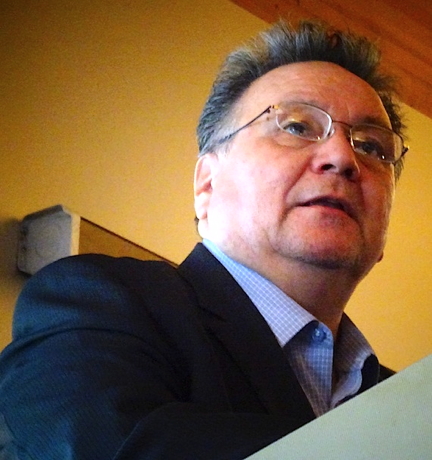
Nunavut Premier Peter Taptuna, speaking to an audience on day one of the Nunavut Mining Symposium in Iqaluit April 4, talks about the importance of the Grays Bay port and road in western Nunavut and an agreement-in-principle on the devolution of government powers from Ottawa to Nunavut, expected before Taptuna’s term ends in October. (PHOTO BY JANE GEORGE)
You might say that Nunavut’s economy has a lot of “untapped potential,” as Nunavut Premier Peter Taptuna said April 4 at the opening of the Nunavut Mining Symposium in Iqaluit.
And, while Canada’s economy has stalled, Nunavut’s future looks bright, Taptuna told an audience of several hundred gathered for the 20th annual mining conference.
But, true to this year’s theme of “Reflecting on the Past, Looking to the future,” there’s still much needed to move Nunavut’s resource industry ahead.
Chief among concerns was Nunavut’s lack of infrastructure, an issue raised by Taptuna and other speakers during the first session of the three-day event, which included the presidents of two of Nunavut’s three operating mines.
That deficiency, Taptuna said, could be remedied in part by the Grays Bay Port and road project.
Its promoters, the GN and the Kitikmeot Inuit Association, plan to file a proposal with the Nunavut Impact Review Board in the near future, Taptuna said.
The Grays Bay project, about 179 kilometres east of Kugluktuk and about 850 km north of Yellowknife, would include a deep water port and a road to service mines and link to the Northwest Territories.
The full development of that Coronation Gulf-Yellowknife transport corridor would require federal spending of $1.89 billion and could lead to an estimated $39.49 billion in resource development expenditures.
Despite the high price tag, Taptuna said it’s a “critical” piece of infrastructure to encourage mining, job creation and the economy in general, and he’s optimistic that Ottawa will one day commit money to Grays Bay—though none was earmarked in the recent budget.
“It’s what I’m hoping for,” Taptuna said.
To that end, the Premier said he’s been speaking directly to Prime Minister Justin Trudeau along with representatives from the KIA.
Taptuna said he’s also expecting to see an agreement in principle on devolution before his term is up—ahead of the three-year deadline raised last year.
Devolution—nammiminiqsurniq in Inuktitut—means the transfer of authority from the federal government to the territory.
In Nunavut, that would mean local power over areas such as education, health care, the administration of public lands and a larger share of resource wealth that those lands could generate.
Among the other challenges facing Nunavut, cited at the mining symposium: the need for more training of Inuit for jobs in the mining industry, an issue raised by Nunavut Tunngavik Inc. President Aluki Kotierk.
Baffinland Iron Mines Corp.’s President and CEO Brian Penney agreed, saying his operation in North Baffin, where only 12 per cent of the workforce is Inuit, has to work to bring to increase that figure to 30 per cent.
Ammar Al-Joundi, President of Agnico Eagle Mines Ltd., boasted of his company’s training efforts saying AEM plans to expand and double its Inuit workforce from 300 to 700 in the next two years, with the expansion of its Meadowbank gold mine and second operation at Meliadine.

“Our vision is to have all of the employees Inuit, why not?” Al-Joundi said.
But, “this is not an easy place to operate,” Al-Joundi admitted, pointing to northern costs that are two to 2.5 higher and, in particular, a carbon tax which adds to the expense.
Late last year, Trudeau confirmed that a Canada-wide carbon tax would start to phase in by 2018.
The tax initially places a $10 per tonne levy on carbon-based fuel, but that will slowly climb to $50 per tonne by 2022.
AEM has said it will lose about $20 million a year by 2023 for its carbon emissions in Nunavut.
That’s unfair, Al-Joundi said, because there’s no alternative to diesel, which is used in its open-pit fleet of heavy equipment.
The public will have a chance to learn more about mining in Nunavut April 5 at a trade show at the Frobisher Inn, scheduled to run from 1:30 p.m. to 3 p.m.
(0) Comments