

Dog-powered Danish patrol team travels Greenland four feet at a time
“Their gift will be to walk home”
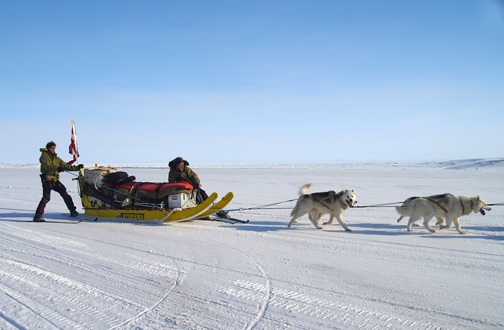
The Sirius patrol team arrives back in Alert after a week-long patrol with members of the Canadian Forces and Canadian Rangers. While soldiers from the two countries taught each other a few tricks, the dog-powered Danes did slow down the Canadians who were travelling by snowmobile. (PHOTO BY CHRIS WINDEYER)
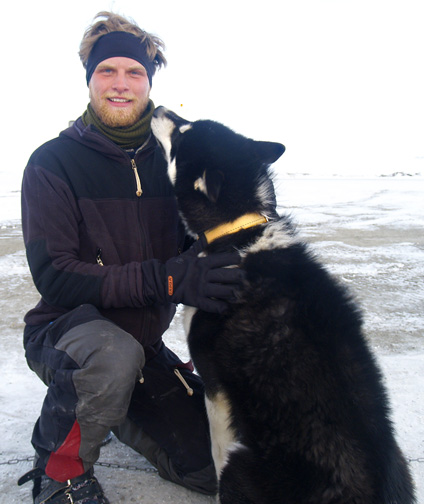
Jakob Nilesen, a member of the Sirius patrol team, gets some affection from one of the members of his dog team. The teams patrol a massive swath of Northern Greenland and are out on the land for as long as three months at a time. (PHOTO BY CHRIS WINDEYER)
ALERT — It might be tempting to complain about jet lag from the six-hour flight from Yellowknife to the most northern settlement in the world.
But meeting a member of Greenland’s Sirius sled dog patrol team puts any such talk to rest. The two-man, 13-dog team got to Alert to take part in Operation Nunalivut, Canada’s High Arctic military exercise, by Canadian Forces Twin Otter from western Greenland.
After a week on the land around the northern tip of Ellesmere Island, that same Twin Otter will drop Jakob Nilesen and his teammate, Morten Gormsen, back in Greenland, and then it’s 1,100 kilometres by dogsled back to their base in Kangilinnguit.
“Their gift,” says their commanding officer, Danish Rear Admiral Henrik Kudsk, “will be to walk home.”
Nilesen, from a town just south of Copenhagen, the Danish capital, is windburned and sports a scraggly beard on his face after months on the land. Nilesen’s been in Greenland for 10 months, nearly halfway through his two-year tour.
The Sirius teams are away from their base in Kanglinnguit for three months at a time. Nilesen says the first two weeks are the toughest, as the soldiers adjust to the tedium and physical strain of managing the dog team and a sledge laden with hundreds of pounds of gear.
“For the first two weeks you have to get used to it, but then it’s a normal day’s work,” Nilesen says. “You drive, put the tent up, you sleep, read books. You just get into a routine and just move along. You think a lot, but it’s a nice peace and you’re in the beautiful countryside.”
The dogs themselves are much bigger than Canadian Inuit dogs that sled owners in Nunavut use. That’s by design: the team breeds its own dogs and uses a computer program to manage the family trees, with the occasional introduction of new DNA into the line to control inbreeding, Nilesen says. Another difference from Nunavut is the dogs are fed pemmican, a dried mixture of meat protein and fat, which is high in energy and easy to carry in large amounts.
While the Danes have the dogs, the Canadian Forces, including the Canadian Rangers, travelled by snowmobile during Nunalivut, meaning patrols didn’t cover as much ground in a day as the Canadians are used to.
“We have to basically go with them and we had to travel a whole lot slower because they’re on a dog team,” says Abraham Qammaniq, a ranger from Hall Beach.

Qammaniq says he doesn’t know much about running dogs, but admits “it was different listening to Danish commands.”
Nilesen says the Sirius teams don’t usually work closely with Greenlandic Inuit, so Operation Nunalivut was a good chance to learn new tricks of the Arctic survival trade, including the best way to tie a knot with gloves on at -50 C.
“There’s a special way of doing that, trust me,” he says. “That was definitely something I learned from one of the elders in our patrol team, and it was just great seeing how much experience they’ve got from their ancestors. It was beautiful.”
Sirius teams act as both a military and police presence in the massive national park that comprises half of Greenland. The patrol was established during World War 2 to seek out and destroy weather stations built along the west coast of Greenland built by the Germans to support their naval activities in the North Atlantic.
Since then, their role has mostly been as hard-core park wardens, but Kudsk says that may change as oil drilling begins this summer near Disko Island, bringing massive amounts of equipment and hundreds of workers to the remote region.
The purpose of Operation Nunalivut is to get southern Canadian soldiers training in the Arctic and getting different segments of the Canadian Forces and the federal government working together to make it easier to respond to emergencies as the North continues to open up.
By extension, the purpose of including the Danes is so soliders from both sides of the strait that separates Greenland and Nunavut know who they’re working with if, or when, the two countries have to work together again.
“Obviously your Rangers know how to work and operate in the high regions and we believe our Sirius guys do too,” Kudsk says. “And it would be smart if they met because there might be things that either party may do better.”
Nilesen says a key difference is that Danes must make long meandering journeys from place to place in Greenland, while the Canadian Forces can come to a community and use it as a base of operations.
But Kudsk says despite the national and cultural differences, the Danes and Canadians had no trouble bonding.
“We find that our teams are extremely alike in their humour… They just click.”
(0) Comments