

Alberta university builds ties with Nunavut hamlet
“People were interested in another way of finding out what was going on around the community”
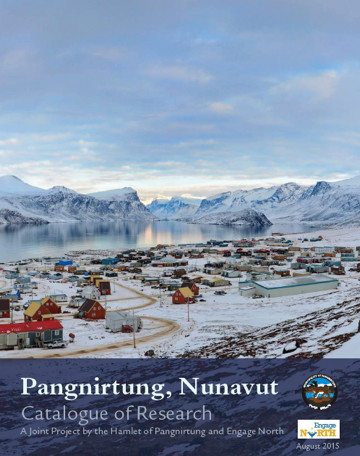
Photographer David Kilabuk’s spectacular photo of Pangnirtung graces the cover of a new catalogue of local research produced in partnership between the hamlet and the University of Alberta-based Engage North.
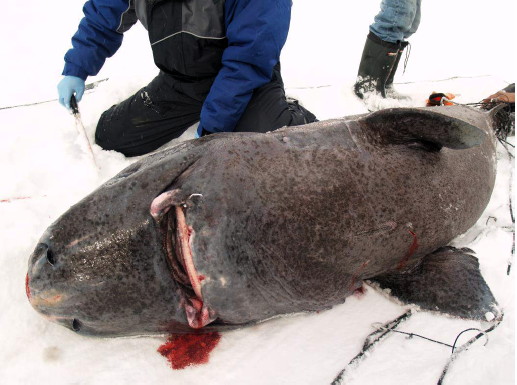
One of the many projects listed in a new catalogue of local research around Pangnirtung includes a masters thesis by C. Julián Idrobo of the University of Manitoba who studied Inuit knowledge of the Greenland shark: how it is considered a “thief” that steals fish and is a nuisance to the commercial fishery of Greenland halibut. (PHOTO CAPTURE FROM CATALOGUE OF RESEARCH)
An ongoing partnership between the community of Pangnirtung and an academic institute based out of the University of Alberta in Edmonton is producing more than just good relations between southern students and northern Inuit.
Matthew Miller, a research fellow with the U of A’s Engage North, has a specialty in water management and, as an engineer in training, has been working with the hamlet in Pangnirtung on community drainage issues.
But more than that, since he arrived in May, Miller has helped the community create a research catalogue containing summaries of 45 different projects that have recently been conducted in the area or which could be of interest to local people.
“The whole idea was just a sharing of knowledge — making research and information about research, who’s doing research — all these things available to people in the community and to other researchers,” said Miller, from his Pangnirtung hamlet office Sept. 1.
The idea for the catalogue was homegrown, Miller said. It was something local people said they wanted and although he doesn’t have any expertise in projects like this, he was more than happy to help work assemble a local team to get the job done.
“There is a fair amount of research that goes on in this area,” Miller said, “but it can be challenging sometimes. I think people were interested in another way of finding out what was going on around the community.”
That team, who were paid for their work through Engage North donors, included translators Mina Battye and Mary Etuangat, graphic artist Paulette Metuq, photographer David Kilabuk and Simeonie Akpalialuk Consulting.
“It was a hugely collaborative effort,” Miller said. “I was definitely helping to organize everything, but we had a great team putting it together.”
The catalogue, available online on the hamlet’s website, in both English and Inuktitut, was also printed in limited numbers and distributed to local schools, the library, government offices and other organizations, Miller said.

It covers a wide range of research under three basic categories: fisheries and wildlife, physical sciences and social sciences.
There is rich variety to this compilation. Topics cover everything from fish tracking to permafrost, wastewater impacts, the value of elder storytelling and growing the arts sector.
In each case, Miller contacted researchers and requested they write a plain language summary of their work and also to provide any photos or graphics to illustrate the project.
For the most part, researchers were more than happy to comply, Miller said.
Each research citation contains links to more information, if readers wish to explore further, and contact information so local people, or other researchers, can follow up at the source.
The biggest challenge for the project was just the volume of work, Miller said. Other than that, he said the project unfolded smoothly thanks to the collaborative spirit of the local team.
Miller has been working on other things for the hamlet as well including a preliminary drainage assessment, looking at culverts which run beneath roads and roadside drainage, continuing some work another Engage North fellow had begun two years ago.
Mariba Douglas, another Engage North fellow, was also in Pangnirtung this summer. She was at the Uqqurmiut Centre for Arts and Crafts to develop ways to showcase, feature and display the work of local artists, both physically and online.
Engage North was launched a few years ago by U of A academics and students who had an interest in the North, said Janelle Morin, the organization’s executive director, from her Edmonton office Sept. 2.
The goal of Engage North, Morin said, is to help build capacity in remote northern communities in various sectors — healthcare, engineering, administration, and the arts for example — and to build relationships between post-secondary institutions and northern towns.
Thanks to an existing connection between a student and the Hamlet of Pangnirtung, it made sense to continue building on those local relationships.
Engage North also works with Beaver and Dene Tha first nations communities in northern Alberta and the Northwest Territories, she said.
With an annual operating budget of about $150,000, cobbled together from various private, government and university sources, Engage North is able to fund a half dozen or so academic fellows annually who go to three different communities for three to four months at a time.
“It’s an important principle to not be a burden on the community. All the students we bring we do pay for their stipends and we also ensure that we’re supporting their travel as well so the community doesn’t pay for any of that,” Morin said.
They also try, when money allows, she said, to hire local people as language tutors and translators, for example.
(0) Comments