


As the mine goes, so does this Arctic town
Kiruna, Sweden: living on iron since the 1890s

Only a few historical buildings are being saved from the current town. Among them, the iconic clock tower atop the city hall, where the Arctic ministers met May 15. (PHOTO BY AEX BOYD)

The underground iron ore mine at Kiruna is the largest in the world, with 76,000 tonnes of ore produced every day. (PHOTO COURTESY OF LKAB)
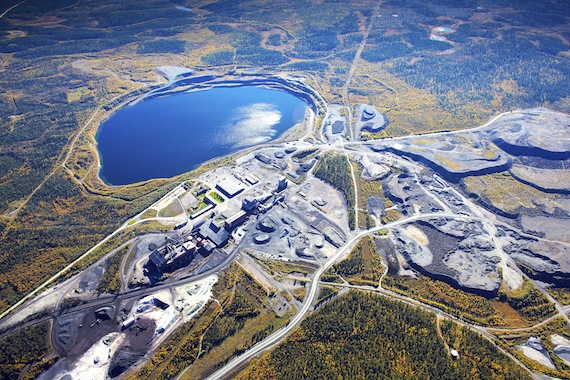
A mine — and a town. The town of Kiruna, Sweden grew up between the two mountains of Kirunavaara and Luossavaara, after the LKAB mining company was founded in 1890. Now the city centre is being relocated. (PHOTO COURTESY OF LKAB)
ALEX BOYD
KIRUNA, SWEDEN — Mining may have built the northern Swedish town of Kiruna, but mining is now making Kiruna move.
After wrapping up official business at the Arctic Council meeting there on May 15, the ministers — including Nunavut MP and new Arctic Council chair Leona Aglukkaq — were escorted to lunch at the region’s biggest industry and largest employer: the iron mine.
At 550 metres below the surface, everything looked good: the visitor centre was decked out for the high profile visit with big screen TVs and long tables covered with tablecloths and candles whose glow lit up the dark tunnels.
The picture of a modern mine: it was easy to forget that you were half a kilometre underground, except for all the hard hats.
Displays on the bumpy stone walls told the story of the mine that built Kiruna, a town of 18,000, located at the same latitude as Kugaaruk in Nunavut.
In many ways Kiruna is a success story; proof of the positive economic impact a mine can have on a northern community.
But at a time when more mining is being contemplated in the Arctic, local Saami people have raised serious concerns about the impact on their traditional lands.
Mining is “the worst predator we have right now,” Mats Berg, a member of the Saami community on the outskirts of Kiruna, said at the recent Peoples Arctic conference in Kiruna.
Kiruna has also become a testament to the power wielded by mining companies and the difficulty a town faces in branching out beyond it.
Because while there’s no question that Kiruna owes its economic prosperity to the mine, the mine is also the reason everyone in Kiruna will have to eventually pack their bags.
In 2004 the mine notified the municipality that its underground operations had expanded.
Slowly, the land underneath the town was shifting and would eventually crack. It’s estimated that over the next 20 years, more than 2,500 apartments and almost 200,000 square meters of retail, offices, schools and healthcare space will be on shaky ground.
So the town decided to pull up stakes and move the city centre three km to the east.

Kiruna’s mine, operated by state-owned Swedish company LKAB, is the biggest underground iron ore mine in the world, its grandeur usually described with numbers: the mine descends over a kilometre into the ground, produces 76,000 tonnes of ore every day and uses 400 km of underground tunnels that burrow, worm-like, through the ground.
Anders Lindberg, acting vice-president of communications with LKAB, says the relationship with Kiruna is important.
“We hope LKAB can be a good example of sustainable mining in the Arctic,” he said.
The mine emits one-seventh the carbon dioxide that its competitors do, he said, and they’ve worked to cut the amount of dust, sulphur and fluoride they contribute to the environment by half.
In addition, “we are sponsoring very heavily both cultural and natural activities,” he said.
In many ways the relationship between the mine and the town is natural. After all, they grew up together.
Iron was officially noted in the twin mountains of Kirunavaara and Luossavaara almost 300 years ago when the county governor paid a Saami man to show him which mountain contained deposits.
But it wasn’t until the end of the 19th century that a railway to transport ore was completed and LKAB was founded.
Kiruna spread out amongst the birch trees in the hollow between the two mountains, and is still dominated by the industrial areas and heavy duty equipment needed to service the massive mining operation visible from almost anywhere in town.
Recently the region has become known for things other than the ore it excavates.
It’s next door to the Esrange Space Centre and driving distance to Abkisko national park and the research station, and is home to a growing tourism industry.
Still, what the mine says goes.
Marianne Nordmark, a spokesperson for the municipality, said it’s hard to know the timeline of the move exactly.
But recent estimates say that the city hall for example — where the ministers met May 15 — will begin to feel the impact of the underground mining sometime in the next four years.
So a new city hall, at the new city centre in what has been dubbed the “new Kiruna,” will be completed by 2016.
LKAB is footing the bill, and 21 historic buildings — among them the iconic clock tower from the old city hall, the church, and some original houses — will be relocated, but most of the current town will be eventually demolished.
But Nordmark said that there was little opposition from people in town, noting that for many in Kiruna, there’s no question.
“The mining company offers jobs and a future to the area” she said.
(0) Comments