

Fishy Conservative claims about Nutrition North Canada
“It’s all designed to deceive the public and make ministers and officials look good”
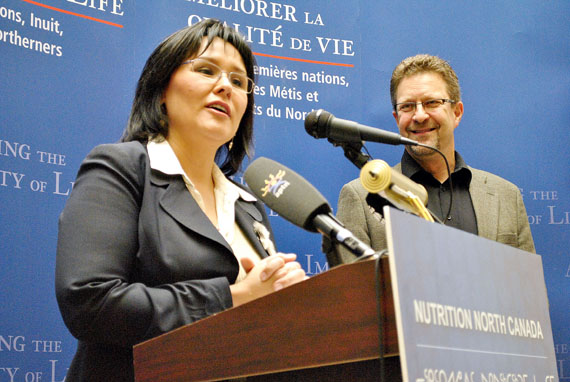
Leona Aglukkaq, the Nunavut MP and Chuck Strahl, then the AAND minister, announcing the Nutrition North Canada program in May 2010 at a press conference in Iqaluit. The program started up April 1, 2011 — which means its fourth anniversary occured this April 1. (FILE PHOTO)
FRED HILL AND MICHAEL FITZGERALD
Conservative candidates in this year’s election will no doubt try to convince voters that Nutrition North Canada has reduced food prices and increased the consumption of healthy foods in isolated northern communities.
Bernard Valcourt, the minister responsible for the program, has repeatedly made such claims in the House.
On Feb. 3, for example, he said “the transportation of nutritious perishable food has gone up by 25 per cent” and claimed that “the cost to a family of four has gone down by $110 a month.”
The Auditor General, on the other hand, found that the Aboriginal Affairs and Northern Development Canada lacks the data required to measure the success of the program.
Figures on the cost of a healthy diet and on consumption of foods eligible for the program — using shipments as a proxy for consumption — would be valuable evidence of success or failure if such figures were complete and accurate and if comparisons were made with an appropriate baseline.
Neither is the case.
Food Prices
Mr. Valcourt was undoubtedly comparing food prices from March 2011 — the last month of the Food Mail Program — with March 2013, as the same claim of a $110 per month saving between these two dates appears on the department’s website, which purports to demonstrate the success of the program.
The most recent figures available are for March 2013, now two years out of date.
The food price data behind this claim are unverified and supplied by the retailers themselves – and just a few of them at that, most notably the North West Co., the largest recipient of program funding at $32.4 million or 52 per cent of the total in 2013-14, according to the NNC website.
They do not include any useable data from Arctic Co operatives Ltd., the second largest recipient at $11.7 million or 19 per cent, for the stores owned by its member co-ops.

Similarly, no price data are included for independent stores supplied by southern wholesalers registered with the program, for a simple reason: such wholesalers would have no idea of food prices in the stores they supply.
Even if the March 2011 baseline figures are accurate, they represent prices six months after most non-perishable foods had been removed from the Food Mail Program in the first stage of NNC implementation.
This was also long after the department’s own on-site price surveys, which included all stores in each community surveyed, were foolishly and irresponsibly discontinued.
In 2010, the department also stopped monitoring the cost of the same food basket in supply centres in southern Canada – something it had done since 1990.
This has meant that the price gap between northern and southern Canada can no longer be measured.

Food Shipments
As far as volumes of shipments are concerned, the 25 per cent increase is based on a comparison between the last full year of Food Mail (2010-11) and 2013-14 — but not for the same set of communities, not necessarily for the same foods and certainly not for the same subsidy levels.
Retailers are actually reimbursed for their costs of preparing and submitting claims for this subsidy.
As soon as NNC came into effect, some retailers started using the program to claim the paltry, useless and, indeed, ridiculous 5¢ per kg subsidy in communities eligible for a “partial subsidy,” where they had not used Food Mail.
The volume of shipments to those communities has varied between 5 per cent and 7 cent of total program shipments, but this has only involved between 0.1 per cent and 0.2 per cent of the subsidy — good for the bottom line of the stores in those communities, perhaps, but insignificant in reducing the cost of nutritious food for community residents.
In addition, for 25 of the communities that are eligible for a “full” subsidy, shipments of foods in the “low subsidy rate” category also received only a 5¢ per kg subsidy.
The department does not provide data on shipments classified by subsidy level, but shipments of “low subsidy rate” foods to these communities would also represent a significant volume.
Consequently, the NNC volumes are undoubtedly higher than they were for the last year of Food Mail, although the latter figures have never been made public.
It’s all designed to deceive the public and make ministers and officials look good.
Blowing the Budget
None of Nutrition North Canada’s achievements — even if they were real — were possible within the approved subsidy budget of $53.9 million per year.
The program never operated within this budget. By 2013-14, the subsidy payments had reached $63.9 million – almost 20 per cent over budget. These figures exclude administration costs that appear to be between $2 million and $3 million per year.
As announced in November, the subsidy budget has been increased by $11.3 million in 2014-15, by $14.6 million in 2015-16 and by 5 per cent per year thereafter.
This money will avoid the politically embarrassing price shocks that would occur if the original spending intentions had been respected.
However, northern voters may still not believe the dubious claims of program success that will undoubtedly be trotted out during the election campaign.
Fred Hill managed the Food Mail Program in different capacities at Indian and Northern Affairs Canada from 1991 until 2010, and in collaboration with Michael Fitzgerald between 2008 and 2010.
(0) Comments