

Western Nunavut group finds dog frozen, others hurt, neglected
“If you don’t want your dog, don’t keep it. If you can’t feed your dog, ask for help”

A male husky named Rohkea was found in Cambridge Bay last week with a choke collar embedded in its neck. The dog was sent to the NWT SPCA, which sent the animal to a local veterinarian to have its collar removed from its neck. The dog survived and will be adopted out to a new family. (PHOTO COURTESY OF NWT SPCA)
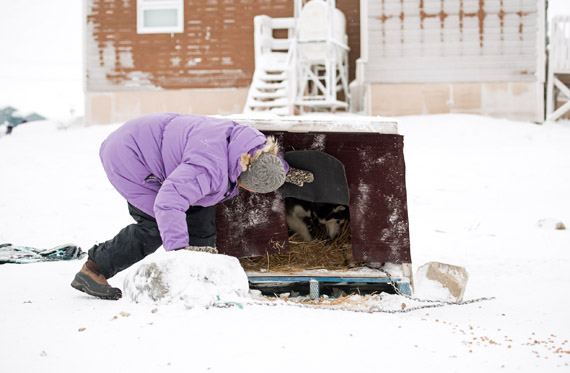
Bernie Thompson, who helps run the local animal rescue group Diamonds in the Ruff, distributes hay to dog shelters in Cambridge Bay Dec. 12. The hay was donated to the local animal rescue group Diamond in the Ruff by the NWT SPCA in Yellowknife. (PHOTO BY DENISE LEBLEU IMAGES)
A Cambridge Bay-based animal rescue group is calling for better enforcement and awareness to prevent animal neglect across the territory.
Over the past week, the local, volunteer-run organization Diamonds in the Ruff discovered a young dog frozen to death outside its owner’s home.
Days later, the group sent another dog south for surgery after finding its collar embedded into its neck.
“It’s a very difficult situation that we’re in, because there’s a lot of abuse of animals here,” said Bernie Thompson.
Thompson, along with her husband Al, have since 2010 run the local group Diamonds in the Ruff, which provides food and care for dogs in the Kitikmeot community.
“We wanted to go public with this because we want it to stop,” Thompson said. “If you don’t want your dog, don’t keep it. If you can’t feed your dog, ask for help. There are people here who will help.”
Although the couple regularly see and hear of instances of dog neglect, two recent cases have Thompson frustrated about the lack of support and enforcement in place in Nunavut.
The Thompsons often go around the community and feed dogs fish scraps from the local fish plant. As part of those rounds, the couple often checked in on a young male dog tied outside of a residence, who had recovered from a head wound earlier this year.
“So we’ve been going back to check on him from time to time, and my husband went back to check on him [Dec. 5] and he had frozen [to death] underneath the steps,” Thompson said.
The animal was probably about a year old, and didn’t have any obvious illness. The Thompsons sent the dog’s body out for an autopsy, and the report indicated the animal had starved to death.

Thompson said it appears that the dog’s original owner left the community before the animal died. It’s not clear how long he planned to be away, but the dog was under the care of the man’s partner when it died.
Thompson filed a complaint with the local RCMP detachment following the animals’ death; the hamlet’s by-law officer was also made aware.
But Thompson isn’t sure where the complaint will go, because the dog’s original owner is absent.
That’s the same problem the couple faces with another dog that was found with its collar embedded into its neck. The male husky, called Rohkea, is believed to have broken free from a summer cabin where he was tied up.
When he was discovered in the community Dec. 9, the Thompsons opted to fly the dog to the NWT SPCA in Yellowknife, where a local veterinarian performed surgery remove the choke chain from the dog’s neck.
Rohkea likely only survived because his collar was made of stainless steel, the shelter said; other dogs wearing leather or woven collars that become embedded usually die from infection.
Nicole Spencer, the manager of the NWT SPCA, said Rohkea is doing fine and will be adopted out to a new family once he’s recovered.
“We’d love to press charges, but we have no idea who the original owners are,” Spencer said.
Neither the RCMP nor the hamlet of Cambridge Bay responded to requests for information from Nunatsiaq News on criminal charges or fines related to animal abuse in the territory.
The Nunavut Dog Act prohibits owners from leaving their dogs “unfed or unwatered sufficiently long to amount to cruelty,” but does not specify a threshold.
The act sets a fine of $25 for anyone found guilty of an offence. It also gives power to the judge to order an animal destroyed “for humane reasons or for the safety of the general public.”
The act, written more than 25 years ago, in 1988, was inherited from the Northwest Territories when Nunavut became a territory in 1999.
The Criminal Code of Canada also makes it illegal to cause unnecessary suffering to an animal.
Many communities have their own local animal bylaws. In Cambridge Bay, bylaws require dog owners to provide their animals with food, water and tether that’s at least three-feet long.
To take it further, Thompson has asked the hamlet to update that by-law to include shelter — even if animals can withstand Arctic temperatures, it doesn’t mean the dogs are comfortable, she argues.
But with municipal elections on Dec. 14, the hamlet has yet to respond to that request.
Rules are only the first step, Thompson noted.
“Enforcement is a big thing,” she said. “Make bylaws, make rules, but have them enforced.”
Thompson said she knows that animal welfare is a sensitive issue in a territory where many people face poverty and food insecurity.
“If you can’t feed yourselves, you shouldn’t have a dog,” she said.
Each year, Diamonds in the Ruff raises money to bring up a team of veterinarians to Cambridge Bay to host a spay and neuter clinic.
Over the last three years, Thompson estimates the clinics have operated on between 300 and 400 animals. In that same period, Thompson said she’s helped send about 250 abandoned or surrendered dogs south for veterinarian care or adoption.
(0) Comments