

Nunavut plans more than $20M in airport fix-ups
Airports in Baker Lake, Cambridge Bay due for major work

If you want to fly into Rankin Inlet on Monday, Wednesday or Friday afternoon, watch where you park — this map from a recent Government of Nunavut presentation on Nunavut airports shows how aircraft are forced to park at the airport, the second busiest in Nunavut.
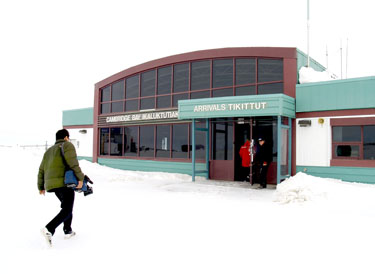
Help is on the way for Cambridge Bay’s airport, Nunavut’s third busiest airports. The Government of Nunavut plans to bring the airport up to national standards and make other improvements, starting in 2012-13. (FILE PHOTO)

It looks as if the Iqaluit airport’s badly-needed expansion will have to come through some private and public partnership, according to information from the Government of Nunavut’s capital plan for transportation in 2012-13. (FILE PHOTO)
With the promise of $27 million in upgrades slated for Rankin Inlet’s airport, the Kivalliq region’s hub airport can look forward to less congestion in the future.
But that’s just the start.
Rankin Inlet’s oft-overcrowded tarmac is only one of many overloaded and under-equipped airports in the territory, says a Nov. 9 presentation by Shawn Maley, the Government of Nunavut’s director of airports, at the Kivalliq Trade Show in Rankin Inlet.

The busiest Nunavut airports in 2010 were Iqaluit with 20,176 aircraft arrivals and departures, Rankin Inlet with 13,071 aircraft movements, and Cambridge Bay with 6,215.
To alleviate some of the chronic traffic logjams at Rankin Inlet, the GN is also eyeing a $7-million upgrade for Baker Lake’s airport, Maley said.
This will include an expansion to the airport’s apron, upgrades to its lighting system, and a new backup generator.
As for Cambridge Bay, its long-awaited airport revamp is inching closer.
That project will entail the construction of an expanded apron and new taxiway, widening of a runway shoulder and relocation of the road that running across the runway to the Department of National Defence facilities.
Cambridge Bay is also one of the last airports left in Nunavut with scheduled jet service that still uses a gravel runway.

And its cramped air terminal also needs more room. The airport hosts 19,000 passengers annually, a figure that is expected to rise to 25,000 by 2020.
To fix that, a 2010 report prepared for the GN recommended doubling the terminal’s current size over the next decade.
Overall, the cost of the short-term improvements needed in Cambridge Bay was pegged at $34.4 million.
But the report recommended putting the first chunk of money into shoring up the gravel sides of runway, which don’t conform to national standards.
The work on Cambridge Bay’s airport hasn’t officially been announced yet, but, according to the capital plan for the Department of Economic Development and Transportation, the GN earmarked $6 million for its contribution to Rankin Inlet’s upgrades and to Cambridge Bay in 2012-13

The balance of money — $18 million — to do work set for 2012-13 will come from the federal government.
Unfortunately, Nunavut doesn’t spend much money on airport infrastructure unless it can team up with a federal program, in this case, the Provincial-Territorial Base Fund.
However, another $3.5 million has been earmarked by the GN to advance the Iqaluit airport improvement project.
The money to deliver this project is expected to flow from a private-public partnership model — a model that Nunavut is looking at to pay for many of its costly infrastructure needs, such as a heritage and performing arts centre for Iqaluit and a mine training centre for Cambridge Bay.
The P3s offer cash-strapped governments, like the GN, leasing agreements with private developers as an alternative to traditional, capital-intensive methods of constructing public buildings
The GN also plans to spend $350,000 to conduct an engineering design for upgrades at the Hall Beach airport, $1.5 million for the design of a new airport for Pangnirtung and $50,000 to begin planning for a new airport terminal in Taloyoak.
Apart from their numerous infrastructure needs, Nunavut airports could also use more instrument landing systems.
An instrument landing system provides guidance to aircraft approaching and landing on a runway, using a combination of radio signals and high-intensity lighting, so aircraft can land in conditions such as low ceilings or reduced visibility due to fog, rain, or blowing snow.
Lack of an ILS in Rankin Inlet means more than one in 10 flights into its airport have missed approaches.
Right now, these systems are only found in Iqaluit and Resolute Bay.
(0) Comments