


Zen paintings reflect on 21st-century Iqaluit
Artist Ouellette puts on his second exhibit at Nunatta Sunakkutaangit

François Ouellette stands next to a display of his work at Iqaluit’s museum.

François Ouellette’s Iqaluit tundra shows images of the tundra, as well as of the housing and tank farm.
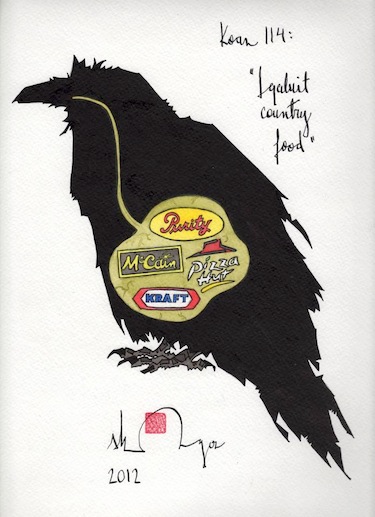
Iqaluit Country Food by François Ouellette depicts a bird with various brand names in its stomach, including the favourite brand of coffee and other major brands of cheese and fast food found in the supermarkets.
A view of 21st-century Iqaluit in watercolour sketches invites viewers to open their eyes and see Nunavut’s capital in a different light.
“Each drawing is kind of like a challenge to the people looking at them,” said François Ouellette, who welcomed visitors to his exhibit at the Nunatta Sunakkutaangit Museum on March 23.
His ink sketches painted with watercolours often reflect a sense of humour that draws smiles of understanding among those who know Iqaluit.

There are images of ravens, rocky landscapes, Tim Horton’s coffee cups, modular housing on struts abound in the simple, yet detailed drawings — which seem to resemble traditional art from Japan.
This is no coincidence, as Ouellette creates them as part of his practice of Zen Buddhism, a branch of Buddhism that which emphasizes the practice of meditation.
“I’ve been practicing Soto Zen for ten years,” said Ouellette, a husband and father who works as teacher at Ecole Trois-Soleils, who first experienced the practice of Zen when he taught in South Korea. “I was initiated as a disciple two summers ago, and I was given the name Shogun, which means Continuous Effort.”
“Each drawing is called a koan,” the artist said, referring to a statement, much like a riddle, that serves as a challenge between Zen monks. The effort to find a solution helps followers gain a better understanding of Buddhist teachings.
Ouellette’s work follows in the same vein — “to try to find a kind of deeper meaning to living in Iqaluit,” he said.
Living in the territorial capital “is in itself kind of like a lesson. But what’s the lesson to be learned, right?”

The city’s most abundant wildlife animal — the raven — stands watch in many sketches, and is the subject of some of them.
One painting, Iqaluit Country Food, depicts a bird with various brand names in its stomach, including the favourite brand of coffee and other major brands of cheese and fast food found in the supermarkets.
“That’s definitely what he eats more of here. The traditional foods here have changed a little bit,” Ouellette laughed.
In line with this, the artist uses his some less traditional ingredients in his watercolour paints, including coffee for the browns and greys, and Arctic cranberry juices for reds and other vivid colours.
Ouellette used such ingredients for a series of paintings of circular forms, done more in line with Zen tradition, called ensos. “These are a typical symbol of Zen, done with a singular brush stroke,” he said.

Typical of his more reflective work is a pair of paintings depicting the street sign for the Road to Nowhere. One sign, with a snow bunting bird perched on it, includes the statement “everywhere” in simple calligraphic writing.
The next one “somewhere,” as the snow bunting is shown flying off. As in most of his work, the painting’s statements are “a bit of a play on words,” Ouellette said, to draw the viewer in.
Other paintings include themes such as the modular aspect of living in the city, where images of boxlike forms and structures abound, the contrast of winter and summer, and the accumulation of waste packaging and other trash that litters the landscape.
Some reflect on more serious themes, such as Beyond Words, made in response to a triple murder-suicide that made headlines in Iqaluit three years ago. Such work is in line with the Buddhist philosophy of compassion for others, he said.
Proceeds from the sale of Beyond Words, along with three others, will go to charitable organizations devoted to helping others — such as the Qimaavik Women’s Centre and the Nunavut Kamatsiaqtut help line.
Ouellette’s exhibit is his second at the Nunatta Sunakkutangit museum.
“It’s something different and something individual to François,” said museum curator Brian Lunger. “We’ve had a variety of work [on exhibit] here, but this work is very unique and original. I can’t think of anything that would compare to it.”
Visitors at the opening March 23 agreed, many of them drawn back to see his work again.
“Each one tells an interesting story, for sure,” said Blake Wilson, who came to see the exhibit with a friend and fellow fan of the work.
“I like that there is no judgment, and everything tells a story,” agreed Rannva Simonsen, as she viewed some of the works with Ouellette’s wife Janelle. “It helps open your eyes, like a guide taking you by the hand to see new things.”
Ouellette’s exhibit Finding a Path: Zen Practice, Iqaluit Life, is on display at the Nunatta Sunakkutaangit Museum until May 26.
(0) Comments