

Global climate change deal won’t please everyone
Indigenous reps nervous about outcome of talks
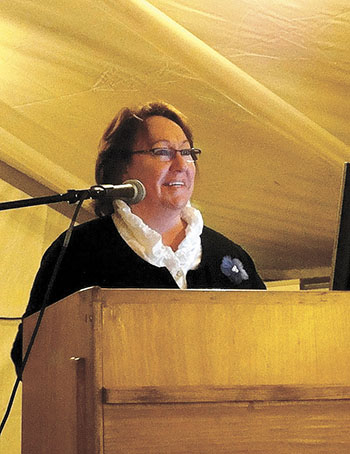
Sheila Watt-Cloutier, the former president of the Inuit Circumpolar Council, told a gathering in Copenhagen this week that any global plan on climate change should compensate indigenous people for damages caused by global warming. (PHOTO BY JANE GEORGE)

Expect nothing from the United Nations climate change conference in Copenhagen, Cletus Springer of St. Lucia, a small Caribbean island beset by increasing numbers of hurricanes and rising sea levels, said this week. In this picture, Springer stands beside the WWF’s ice carving of a polar bear, which is melting as the conference wears on. (PHOTO BY JANE GEORGE)
COPENHAGEN — When 110 world leaders descend on Denmark’s capital city Dec. 17 and 18 to sign a global climate change deal near the end of the COP15 gathering, it’s likely their agreement will disappoint many people from the Arctic and other regions who suffer the effects of climate change.
The agreement expected to emerge Dec. 18 from the United Nations climate change meeting in Copenhagen is nearly sure to disappoint former Inuit Circumpolar Council president Sheila Watt-Cloutier, who narrowly missed winning a Nobel peace prize for her efforts as a climate change activist.
Watt-Cloutier, who spoke to an audience at the WWF’s Arctic tent in downtown Copenhagen on Dec. 8, may not see the Dec. 18 deal recognize climate change as a human rights issue.
Watt-Cloutier also wants the deal to include an assistance fund for violations of the human rights of people in the Arctic, who have lost their livelihood as a result of warming linked to industrial development in the South.

But the amount of money set aside to lessen the impact of climate change and to help the poor of the world adjust is not expected to go to Inuit and other indigenous peoples of the Arctic.
The multi-billion-dollar mitigation and adaptation plan, which is supposed to be part of the Dec. 18 deal, would only see money going to the poor nations of the world.
Mary Simon, president of Inuit Tapiriit Kanatami, and an advisor to Canada’s delegation at the climate change meeting, is also urging world leaders to make money available to populations at risk in the richer countries of the world, such as Inuit.
The cuts to greenhouse gas emissions won’t meet the expectations of climate scientists either, who say that emission cuts must be much more severe than proposed to have an impact.
Scientists like Dr. Bob Corell, the chairman of the 2004 Arctic Climate Impact Assessment, says the world has to reduce its greenhouse gas emissions.
These have risen more since 1970 than they did in the 100 previous years and may double by 2050 if nothing is done, Corell said.

“There is an urgency, we have to slow that down dramatically,” he said at a Dec. 8 side event at the climate change conference.
But since Corell first spoke out about the need to lower emissions, emissions from industrial activity have actually risen every year.
The United States now says it will reduce its emissions by four per cent compared with 1990 levels, and the European Union promises emission cuts of 20 per cent from 1990 levels and to raise this target to 30 per cent if other nations also set similar targets.
But the two-degree rise in temperatures which these cuts aim to achieve globally has already been surpassed in the Arctic, where temperatures are now higher by about three degrees.
Even with higher-than-proposed emission cuts, it will take hundreds of years for the Arctic climate to stabilize, Corell said.

It will take at least 200 to 300 years for the temperature rises, which may go as high as six to 10 degrees, and 500 years for the ice or longer, he said, showing graphs which show that even if the world manages to cut emissions land and ocean temperatures won’t go down right away.
Overall, nothing meaningful will result from climate change meeting for vulnerable peoples like Inuit, who have already been affected by climate change, predicts Cletus Springer of the group called “Many Strong Voices,” which brings together people from the Arctic and small island nations to lobby on climate change.
Springer, who comes from the Caribbean island of St. Lucia, told the Arctic tent audience that the talks underway in Copenhagen are “nonsense” because they see governments dealing solely with government issues, not people-oriented issues.
And the proposed greenhouse gas emissions cuts are “ridiculous,” Springer said.
The money and time spent in talking in Copenhagen and other cities would much better be spent on finding ways to fight climate change at home, he said.
Gunn-Britt Retter, head of the Arctic and environmental unit of Saami Council, says she fears the Copenhagen deal will end up being almost as great a problem for Saami as climate change itself.
Fighting climate change by cutting emissions from oil, coal and gas power production will see more pressure to build wind farms, hydro-electric dams and nuclear power plants built on Saami lands.
Retter pointed to a company in Sweden, which recently received permission to start constructing the first of six windmill parks in the Jingevaerie Saami community, with 455 windmills, as tall as 80 metres, most of which will be on lands used by reindeer herders.
(0) Comments