


Advocates say Inuit no longer welcome to gather at Ottawa underpass; police say otherwise
Dedicated facility needed to help most vulnerable community members says group co-founder Nick Illauq
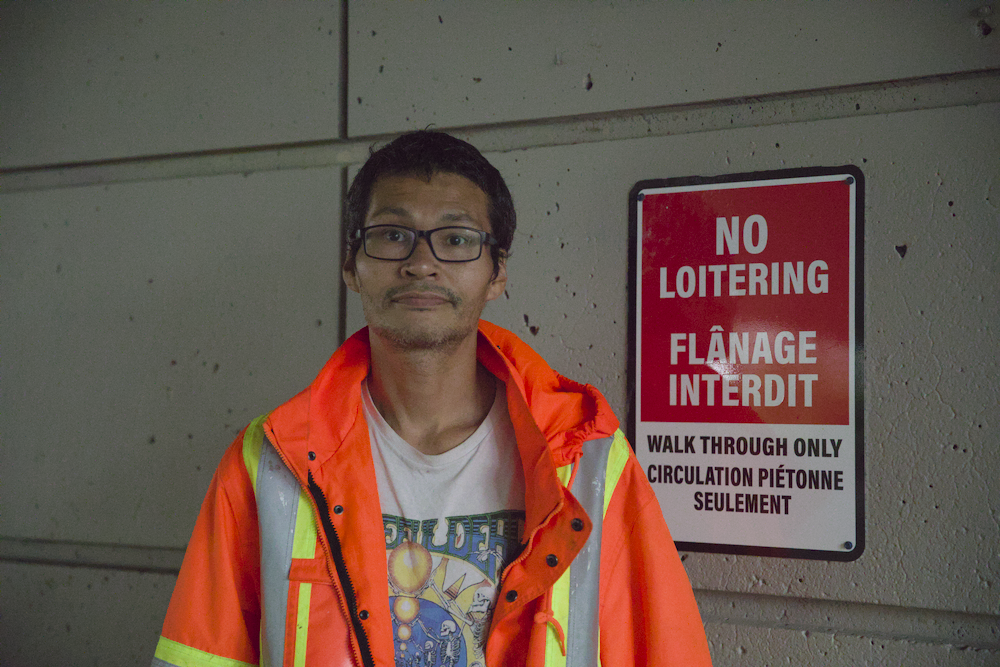
Nick Illauq stands next a No Loitering sign that he says was recently installed in the Rideau-Sussex pedestrian underpass. Inuit have used the underpass as a gathering space until recently, when they were cleared from the area, Illauq says. (Photo by Jorge Antunes)
For many in Ottawa, the Rideau-Sussex pedestrian underpass is a sidewalk. For a group of Inuit without homes, it’s the Circle — a place where they have gathered, supported each other and slept for more than 30 years.
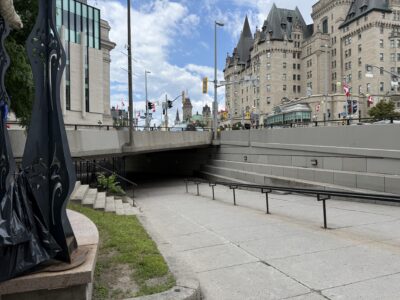
Ottawa Inuit Circle co-founder Nick Illauq says Inuit are no longer welcome at the Rideau-Sussex pedestrian underpass, known to many Inuit as the Circle. (Photo by Jorge Antunes)
“This place has history with us,” said Nick Illauq, co-founder of Ottawa Inuit Circle, in an interview. “It’s a mausoleum.”
The group met at the Circle June 30 to remember and share stories about their past members over plates of bannock and Arctic char.
In a way, the gathering was also a protest because, Illauq says, Inuit are no longer welcome in the area. During the last two months, police have increased patrols, issued tickets, erected a “no loitering” sign and removed unhoused Inuit from the underpass, he said.
The effect: Illauq says Inuit are less safe, as those who would typically be together at the underpass are scattered across the city. They now frequent locations such as Dundonald Park, a bus stop near the Odawa Native Friendship Centre and Rideau Street.
For example, Illauq recalls a recent incident outside the friendship centre where one man in a group of six yelled “drunk native” before punching an Inuk in the face.
The Ottawa Police Service says that it is not asking people to leave simply for gathering: they are enforcing laws regarding open alcohol consumption, drug use, threatening behaviour, public urination and other public safety concerns.
“Officers have been conducting proactive patrols in the area, with a focus on education, outreach, and public safety,” OPS spokesperson Julie Kavanagh wrote in an email, adding that the increase in policing is due to the “city’s broader revitalization and beautification work” under its Downtown Core Safety Strategy.
She also said that while sleeping in parks is prohibited, OPS recognizes there is a safety concern that comes with displacement and that police work to connect people with social services.
When asked if people are removed from the underpass for sleeping there, she did not clarify.
“Our focus is on working with municipal and community partners to offer safer alternatives where possible, while recognizing that the broader issues of homelessness, housing instability, and access to culturally appropriate supports cannot be solved by police enforcement,” Kavanagh wrote.
Illauq said that police have begun issuing tickets for public drinking. Some Inuit can’t pay them, and fear their inability to pay could result in jail time.

Four people in the city have received tickets since May 1, as part of the police service’s Downtown Core Safety Strategy — one ticket for trespassing, one for smoking and three for drinking in public, according to Kavanagh.
Three people who have received tickets were classified by the department as “white,” while one other was “Indigenous.”
Repeat offences, even with unpaid tickets, do not automatically result in jail time, Kavanagh said.
Meanwhile, Illauq says the underpass is a stop-gap measure. What he’d like to see is a permanent facility in Ottawa for Inuit in need to get cleaned up and have a safe place to sleep when necessary.
Some existing social services have turned Inuit away, Illauq said, deeming them “too dangerous.”

“These people are our friends, they are our family,” he said. “We are not afraid of them; they are humans just like everybody else and they’re Inuit. Everybody has forgotten them.”
Well, that’s one perspective at least. I also read in other media that this area has been neglected a long time, and that isn’t surprising as once an area has been taken over by the homeless, it’s going to go south.
I also read its a very sketchy pedestrian area that many people now avoid. That people routinely walk the more dangerous route on the roadway to avoid the circle, as you are assured to see open drug use and criminal activity. I also read it has no working lighting and that the lighting was likely vandalized over and over to make criminal activities easier.
Keep in mind, this was designed to be a major pedestrian hub, that is now seeing little use.
I also read the city has put aside $10 mill to improve the area and return it a proper entrance to the market for families and tourists.
And the complaint is
“Four people in the city have received tickets since May 1, as part of the police service’s Downtown Core Safety Strategy — one ticket for trespassing, one for smoking and three for drinking in public, according to Kavanagh.
Three people who have received tickets were classified by the department as “white,” while one other was “Indigenous.”
Wow, but that is a soft response from the city and they are still crying about it. Every city in Canada should be working to take downtown back from the homeless.
It has become too normal to stick a needle in your arm in front of families. It’s time to take all downtown areas back from the homeless. If it isn’t safe for Gramma or your teen to walk the area……. then it’s the homeless that have to go, not Gramma.
Let me guess Dave. You’re probably a NIMBY ( not in my backyard ) for a shelter for people whose people were here first in your area. If so where then? Or do the homeless don’t deserve a bed to sleep on.
Wrong again AJ.
I didn’t mention, so I will now…… there has also been a sharp rise in violence in the area too.
What does a shelter have to do any of this? You’re just making things up as you go.
Have you passed out cards to them with your address so they can can go to your house and sleep? Their situation is certainly distressing and I have no issues with my tax dollars going to help them since there are other areas where the money is wasted but theire are certain situations that can be dangerous when paths cross especially with alcohol involved race notwithstanding.
Pass out cards with YOUR name!
Each native community Elders need to do more for their own people! Step up and take responsibility!!!. Bring indigenous people back to their communities and put faith and prayer bak into them! Teach them so they can teach others.
Do , what Makivik does for the people that congregate at Cabot square , buy them , a one way ticket back home
Okay, they fly back to their home community. Then where do they go?
They go to the Northern porch then
Culture genocide still exist within Canada sadly
Cultural genocide exists everywhere. But by no means are true Canadians trying to delete the history of Canada. There are many lefties that are trying to delete Canadian history and many lefty politicians that boast Canada has no defined culture. I respect native culture for the ones that are true stewards of the land that trap, fish, hunt in traditional ways and teach traditional culture and values. Too often though I see different Canadian natives that abuse resources Both natural resources and social resources. If these people were white they would be arrested and processed no different than any other race. No other culture in Canada gets as much special treatment as indigenous people. Over 30 billion dollars of tax revenue is distributed to first Nations annualy in Canada, yet there is a rampant suicidal rate, crime rate, homelessness rate among that community. I don’t know why this continues to happen given the spending. Either the money isn’t getting to where it needs to go by corrupt government or the money dependency is the problem. I believe both and I do not know what more can be done. I certainly know that allowing people to get drunk and do drugs openly in public and shutting your eyes to it will not solve the problem either.
I remember this underpass being a great place on Canada Day. Vendors would set up there, and it was a vibrant, welcoming space for everyone.
Are those memories somehow less valid because I’m not a visible minority?
Why not make better use of the space for everyone? Here’s a novel idea: create a safe, walkable path.
How does turning a public space into a lawless area for any group benefit society?
Je me souviens que ce passage souterrain était un endroit formidable lors de la fête du Canada. Des commerçants y installaient leurs kiosques, et c’était un lieu animé et accueillant pour tout le monde.
Mes souvenirs auraient-ils moins de valeur parce que je ne fais pas partie d’une minorité visible?
Pourquoi ne pas aménager cet espace de manière à ce qu’il profite à tous? Voici une idée toute simple : créer un passage piétonnier sécuritaire.
En quoi le fait de transformer un espace public en une zone de non-droit, pour quelque groupe que ce soit, est-il bénéfique pour la société?
i do hope sincerely that more is done for the inuit homeless in the city however both things can be true, they need support but that also they cant take over public areas with drinking, and other behaviors. people of the city shouldnt have to walk around drugs needles, and open bottles and hurry through areas for safety risk
The city has decided to clean the area up. So pedestrians can safely use the area. If the people hanging out there’s. Are doing drugs, and alcohol
. Defecating and urinating in public. Then they should be removed. No matter if these people are Inuit, white or any race. It’s against the law. So don’t try to pull the race card. It’s wrong
The government of Nunavut is partly responsible for Inuit homelessness in Ottawa. Many Inuit go to Ottawa because they cannot get housing in their own territory. It’s pathetic and the lack of housing for Inuit in Nunavut continues to the ongoing devastation of MMIW.
The City is not just banning Inuit folks..come on, stop playing the rascist card. It is everyone under there. Unfortunately, the majority are Inuit. I have lived in Ottawa for 60 years…every shape, colour,nationality, have lived under that bridge when it opened.
The decade is the Inuit as majority…next could be anyone’s guess.
PS I am a landed immigrant, so my folks/countrymen could be next
Nunatsiaq spins the wheel in whatever way will ‘engage’ readers. It’s vile at times, honestly.
Being homeless isnt ‘using a gathering space’
An underpass filled with carbon monoxide isnt ‘a sacred place’
Move on…
I hate using the tunnel but as a wheelchair user sometimes I am forced to or risk the cars on ground level. Every time I read that the police have cleaned it out of drug and alcohol users and dealers, I think it is safe, I try it again only to find them back. I never see anyone sitting or standing having talks to encourage one another. Almost always there are bodies passed out on the ground and drug paraphernalia scattered over the ground. If there is a group that really wants to claim a safe space, then they need a presence there to make it happen.
One can see inebriated, drugged, or sleeping bodies on the ground throughout the market area, and many places smell of urine. The city keeps spending money on “improvements”, but all it has succeeded in doing is furthering its decline. A few decades ago, the market was a great place to visit but now it’s a disagreeable place and best avoided. It used to have a large number of fruit and vegetable stalls, just like a real market, and there was a healthy mix of small shops and book stores. The city banged up the taxes, which drove them away, and its ever-increasing rules and regulations recently caused the produce stalls to pack up and leave. The places they occupied have turned into parking spots, interesting shops became bars, and the market is now no longer a market but a trinketfest instead. Panhandlers are everywhere. Buskers, Ecuadorian panpipers, Morris dancers, etc., who turned streets into real public spaces, have largely disappeared, probably “moved on” because they had failed to acquire a permit. The city has removed or blocked off places where people used to be able to sit for a while, and replaced them with organised (controlled) seating areas blasted with piped music. As for urine, why not solve the problem by having public toilets each with an attendant, just as one finds in cities across Europe?
I lived in Ottawa most of my life and used that underpass almost every day. I have never seen illegal activity there. People use it as cover from the extreme weather, as a place to sleep, and a place to congregate.
There was a time I was hesitant about using it, but that was more out of being young and naive. Yes, sometimes it smells of alcohol or urine, but so does most of Rideau street and Sparks Street – places where the real illegal activity occurs.
What Ottawa needs is to bring back safe injection sites, to fund Inuit initiatives and housing initiatives, and to educate their police force on working with vulnerable populations and mental health. For the underpass itself, they could afford to put lighting, yes, and maybe an actual garbage can. Oh, and to fix those broken stairs.
Never once huh?
Weren’t some Ottawa safe injection sites accused of turning a blind eye when drug dealers set up inside the tents and actively sold illegal drugs inside the tent stalls?
Safe injection sites are and have always been a terrible idea.
Do you even know what a safe injection site was? or do you just generalize? I’ve never seen tents inside of Community health centres that hosted these programs.
My Inuit brothers and sisters certainly need more respect. If your going to take there meeting places away from them then give them a replacement location which connects as a community.
Yes, there issues with drugs and drug use in the area. You’re only displaced the problem somewhere else in the city.
This issue is not only for the all cultures and indigenous people and shutting down public injection sites is the wrong approach.
There have been too many times that I found drug parafanelia in the washrooms at rideau center, or the ground. The problem has only moved them to the somerset ward area.
There needs to be a better approach to the problem
The homeless needs to realize that it is an underpass for pedestrians not for loitering. I want to feel safe enough to walk the underpass and not be harrased for cigarettes, money and other things. Lets make Ottawa great again!
So they’re seriously trying to argue not being allowed to bum around in the underpass is racism. What a grift. Your ancestors would be ashamed of this behaviour
8 street drugs are a result, not a cause but none the less it’s found in places in cities and the unfortunate who got no where to call home. More resources should be directed to those in need in those locations.
on June 14, 2006, 35-year-old Steven “Cactus” Beriault was fatally stabbed in the pedestrian underpass near Rideau Street and Sussex Drive by someone who was living in the underpass