

Agnico Eagle’s $3.3B Hope Bay mine moving ahead
Wind turbine, paid for by Ottawa, to cover half of the mine’s future energy consumption
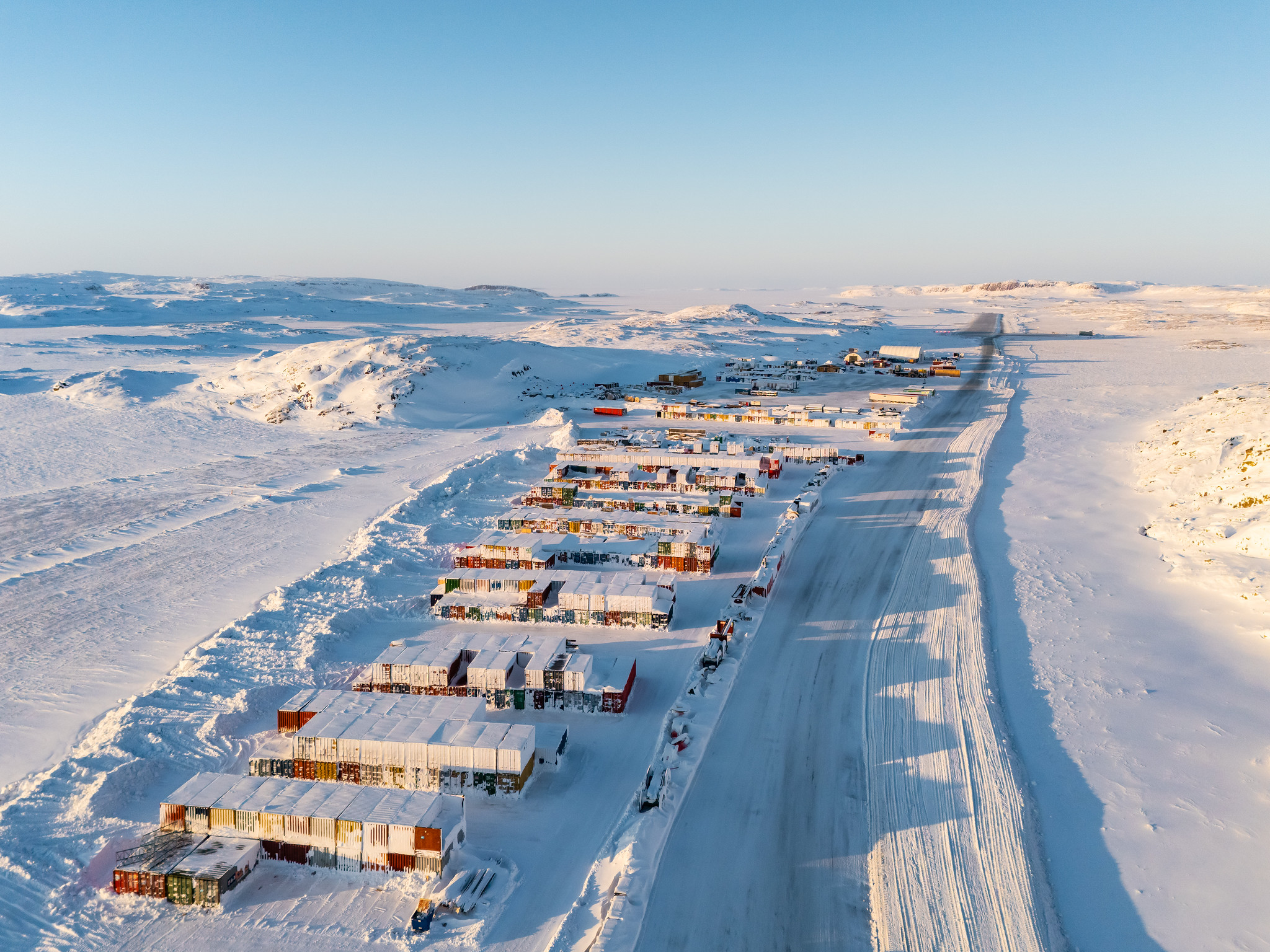
Agnico Eagle Mines Ltd.’s Hope Bay mine, 150 kilometres southwest of Cambridge Bay, could be running by 2030. (Photo courtesy of Agnico Eagle)

Agnico Eagle Mines Ltd. is moving ahead with its third gold mine in Nunavut — the Hope Bay gold complex, located 150 kilometres southwest of Cambridge Bay.
The board has approved a $3.3-billion investment to develop the site, with “initial production” starting as early as 2030, according to a company news release.
“This includes the core infrastructure needed to build and operate safely and reliably in Nunavut,” said CEO Ammar Al-Joundi during Tuesday’s ceremony at the Hope Bay site.
Among other upgrades, the work may include building a high capacity processing facility, a 37-megawatt power plant with heat recovery, water management infrastructure and fuel and logistics systems, he said.
Once finished, Hope Bay could produce 400,000 to 435,000 ounces of gold annually. The company expects it to create some 2,000 jobs and to have an 11-year lifespan, Al-Joundi said, but it has the potential to go “long beyond the initial plan.”
Agnico Eagle, headquartered in Toronto, acquired the site from TMAC Resources Inc. for approximately $260.7 million in January 2021. Initially, it was Chinese, state-owned firm Shandong Gold Mining Co. that wanted to buy the site, but the federal government rejected that deal in December 2020 after a national security review.
Agnico Eagle also owns the Meliadine and Meadowbank mines in the Kivalliq. Hope Bay will be Nunavut’s fifth mine along with B2Gold’s Goose Mine and Baffinland’s Mary River iron ore mine.

During the same Tuesday event, the federal government announced that it has earmarked $25 million for a wind project in Hope Bay.
“Building new clean energy will enable responsible resource development, enhance our energy security, improve affordability for northerners, while supporting local jobs and economic development,” said energy and natural resources minister Tim Hodgson.
The project will include a single turbine built by Inuit-owned Kitikmeot Tugliq Limited Partnership. It will bring 4.2 megawatts of wind power and four megawatts of battery storage to the mine.
It is set to reduce the mine’s annual diesel consumption by three million litres and greenhouse gas emissions by over 8,000 tonnes per year.
The turbine will account for about half of the mine’s future energy consumption, Al-Joundi said.
Both Agnico Eagle and the Department of National Defence signed a memorandum of understanding, in which the company committed to “sharing knowledge and information” on how to deliver large infrastructure projects in the North, said Hodgson, who signed the document.
“This knowledge will be critical as the Canadian Armed Forces expands their presence and readiness in the North in order to defend and strengthen our sovereignty,” he said.
What is glaringly missing from this article is insight into what this mine will bring in terms of royalties to Nunavut in particular. After all, Agnico-Eagle will be mining out a finite natural resource, leaving behind tailings that will need to be managed in perpetuity (a topic of concern that is common to all metal mines worldwide).
I note that mine tailings are effectively a hyperfine dusty grit that tends to be rich in a variety of heavy metals. These are mobilized by the fact that the mining process entails converting solid rock into ultrafine sand so that the metals of interest (gold in this case) can be extracted chemically. Once the gold is out, the ultrafine sand needs to be impounded somewhere, and although there are various ways of storing these tailings (either behind dams or in some cases by returning them to the mine excavation itself in a phased approach), the end result is the lingering concern of toxic heavy metals leaching out forever. (Making matters worse is the fact that metal ores tend to be rich in sulphur. This then gives sulphuric acid in the presence of moisture and oxygen, and acids mobilize metals.)
As I write this, the price of gold per ounce is $4480 USD, which works out to $6171 CAD. And, we are told that the mine will be able to produce between 400,000 to 435,000 ounces a year. Doing the calculations means a raw revenue of $2,468,400,000 to $2,684,385,000 per year. That is a hell of a lot of money leaving Nunavut and flowing into the pockets of outside investors! I imagine that the vast majority of these investors have probably never set foot in Nunavut or Canada.
So, although it sounds great that Agnico-Eagle is investing $3.3 billion dollars in setup infrastructure (including a 37-Megawatt diesel power plant, powered by big reciprocating engines; leaving the wind turbine, at rated output of just over 4 Megawatts, to somehow power provide half of the mine’s energy consumption, a calculation that raises a lot of interesting questions), it is clear that this clever company will be able to recoup its initial investment in a real hurry.
Granted, of course there will be ongoing costs to pay for: diesel fuel to ship in, machinery to maintain, workers to pay and house and feed, and so on. And yes, those costs are elevated in remote areas like Nunavut.
But still, the question needs to be asked: Is Nunavut really getting a fair deal on the one-time resource boom that we are hurrying to cash in on?
Also, we need to be careful not to give away our resources for peanuts because of mining companies cunningly arguing that “hey, it’s so costly to do business in Nunavut, so we expect discounts on the royalties and we want tax writeoffs and rebates on roadbuilding and so on”.
As an example of responsible long-term resource investment, we can look at Norway, a country of about 5.6 million people which has invested its North Sea oil revenue into a Sovereign Wealth Fund that today is worth over $2 trillion dollars (and that is in US dollars). That is $2,000,000,000,000 dollars (yes, twelve zeros) in USD, or $2,750,000,000,000 Canadian dollars. That works out to 491,071 dollars for every man, woman, and child in Norway. And, because the Sovereign Wealth Fund is invested, it keeps growing via the magic of compound interest.
Norway therefore provides an excellent case of genuinely responsible resource management: converting a one-time windfall (as collected by the government-owned oil company StatOil, today known as Equinor) into lifetime benefits for future generations. (Norway wisely gets its day-to-day energy needs heavily from hydropower, and has intelligent, progressive taxation to ensure that everyday civil-infrastructure needs are being met in such a way as to not whittle away the one-time oil boom.)
Compared to Norway, Canada’s province of Alberta provides a stark example. Alberta has harvested $500 Billion dollars more in oil (as total of both conventional oil and as tar sands, also known as oil sands) than Norway has. But somehow, Alberta has a huge cleanup bill. One study I read from the University of Calgary, which quoted the Alberta Energy Regulator, cited a figure of $260 Billion dollars, with half being for conventional oil (symbolized by the iconic pumpjacks often shown in photos, also known as grasshopper pumps) and the other half being for the tar/oil sands. Here is the reference (it is from 2023, with the figures taken from a publication released a few years before that):
https://www.policyschool.ca/wp-content/uploads/2023/10/EFL-49A-AB-ConvenOGLiabilityRegime.YewchukFluker.pdf
Meanwhile, a December 2025 CTV article quoted the estimated cleanup cost being between $100 Billion to $300 Billion. Here is the reference:
https://www.ctvnews.ca/calgary/article/alberta-passing-the-bill-for-orphan-well-cleanup-to-the-public-new-report/
I think these examples, as taken from the oil industry, are really instructive as to how we should be managing the metal-mining industry, which now sees a literal gold rush (in all sorts of minerals, not just gold), all under the rubric of Donald Trump’s push for monopolizing the world in “critical minerals”.
Also, we need to remember that Canada has a sad history of mining-company messes. Time and time again, we fail to collect enough money to cover the true cost of mine closure, thereby leaving the taxpayer to foot the staggeringly huge bill of cleanup. Many examples can be found. Mount Polley (a gold-and-copper mine in central BC made famous by its tailings-dam failure and damage to Quesnel Lake, the aftereffects of which continue to linger now over a decade afterwards) and the Giant Mine (a former gold mine near Yellowknife NWT that released major arsenic contamination) are just two examples. Thousands more can be found, some dating back many decades.
And of course, we need genuinely fair value in return for the finite resources that we are literally giving away. The endless trumpeting of “jobs, jobs, jobs” might sound nice on paper, but with mines becoming increasingly automated, the number of actual employees will continue to dwindle (as measured on a per-unit-revenue of the mine). And, how many of the workers are actual Inuit?
So, it is particularly important to resist being dazzled by numbers like the “3.3 billion dollars invested” figure. Of course, for ordinary citizens, such figures are astronomical. And, Nunavut is home to a lot of impoverished people who are eager for job opportunities and for whom any amount of money seems like a lot of money. But the mining companies know this too. And, this is precisely why they are so good at mesmerizing the general public (and also politicians) with their new mining projects.
The recent Mining Symposium here in Nunavut was chock-full of mining-industry lobbyists eager to sell their project both to investors and to the general public. These lobbyists come across as if their companies are doing us a favour by mining out our precious metals, all while the topic of royalties receives little or no ink.
What is a fair proportion of the revenue that we should be drawing in and keeping here in Canada (and ideally in Nunavut, for which devolution is less than a year away)? I would say at least 50% of profits, and I would demand a full accounting of where all the money is going. Also, companies should not be allowed to write off exorbitant salaries for executives as a “business expense”.
Actually, I would argue that, because these outside companies are taking away literally a part of Nunavut’s mineral heritage (so once it is gone, it will be gone forever), we should have an ironclad rule that the top-paid executives are not allowed to take home any more than (say) 5 times the money (in terms of total compensation, thus including salary, pensions, benefits, stock options, and so on) than the lowest-paid worker onsite (including contract workers). Such a rule, if combined with the collection of serious royalties, would reduce the risk of “greedsterism” or profiteering.
Also, we need to make strong agreements to ensure that foreign meddling in our natural resources is not allowed. For example, the secretive investor-state dispute settlement (ISDS) mechanism (which enables mining firms to sue governments and thereby literally steal money secretively from the public purse) was created by the United States under its “World Bank”) should not be allowed.
Also, we should be free to tax the revenues of mining companies as we see fit (not as outside investors see fit). For too long, Canada has been selling out its natural heritage to outsiders, who in turn reap a huge profit. In this way, profits are privatized, and losses are subsidized.
So, when will these topics be part of the public discourse? These are issues that matter to all of us. We cannot afford to be further plundered by superrich foreign investors whose sole interest is to further enrich themselves.
Since you have researched this so carefully, clearly you are aware that as the mine is on Inuit Owned Land, NTI receives 100% of the royalties, and they have had for years a resource revenue policy explaining how those royalties will be used, right?
Agnico Eagle very clearly lays out the information in their announcement. The NTI Royalty will be up to 13% of net revenue. The Kitikmeot Inuit Association is receiving a 1.4% Net Smelter Return on top of that (that’s what they sell the gold for minus transportation and refining costs. On top of that, their federal and territorial income tax will be around 27% (although they will, just like everyone, try to find the deductions they can).
So I find it somewhat entertaining when you list all of the concerns without noting that people have already thought about them.
“13% of net revenue”
You are going to be very let down when you learn its up to 13% on a sliding scale of NET PROFIT, not revenue.
There is a massive, colossal, incredible difference between revenue and net profit.
Yes, mistake in terminology, my error. That said, an NPR was what I meant.
In any case, and looking beyond the exact numbers of the “sliding scale of net profit” as pertaining to this particular Agnico-Eagle gold mine, my point is that the vast majority of the profits from this mine will be leaving Nunavut (and probably fleeing Canada as well).
And, I am sure that this same general theme applies to all the other mines here in Canada.
This topic of “profits being heavily privatized” (i.e. the mining company invests a few billion in infrastructure but makes billions each year, thereby demonstrating that they can clearly contribute much more to the public purse) is a topic that should be on the table at every political meeting in any jurisdiction where mining occurs. This includes NTI meetings, other indigenous-group meetings, Nunavut Legislature meetings, and Federal Government meetings.
The need for serious discussion on this topic also applies to all other provinces and territories. Notable examples include Yukon, NWT, BC and Ontario, where mining is also ramping up and the mining-company lobbyists are also salivating at huge profits with only relative pittance going to the public purse.
We also need to remember that Canada loses $15 Billion dollars a year to foreign tax havens. A good overview can be found here:
https://breachmedia.ca/canadas-hidden-tax-crisis-is-stripping-15-billion-from-the-economy-every-year/
These are all topics that are of interest to all of us, everywhere in Canada, right across Canada, in every city, every town, every hamlet, in rural areas, and in every Indigenous community. And, the time to discuss these topics is now, before mines and other resource-extraction projects are approved and permitted.
Very clearly, taking a big-picture view is important. We need to get our approach to mining revenue-generation right, before the mining-industry lobbyists get too far ahead of us. These suit-and-tie people know all too well how to dazzle us with millions of dollars while quietly spiriting away billions of dollars in revenue.
Remember that, when the gold is gone, it is gone forever. Because all mines are “one-shot deals”, we really only have one shot at getting the revenue-generation part (and therefore the long-term wealth aspect) right.
By the way, as a land-use planner myself, I strongly feel that the Nunavut Planning Commission (NPC) and the Nunavut Impact Review Board (NIRB) should have, as part of their mandate, a serious cost-benefit analysis that includes a review of royalties and long-term benefits as well.
Earlier I gave the example of Norway, whose mining (for North Sea Oil) resulted in 100% of the profits flowing into the public purse. With this in mind, even a full 50% of profits going to the public purse from mines here in Canada would be modest. Think of the size of a Sovereign Wealth Fund (either Nunavut-based, NTI-based, or Canada-based, or even multiple such funds) that could be created with such serious royalties from mining. Also, think about the serious infrastructure improvements that could be built.