


‘Awesome’ opportunity: Iqaluit hydroelectric project reportedly on Carney’s to-do list
Prime minister to announce 5 more projects for fast-track approval on Thursday
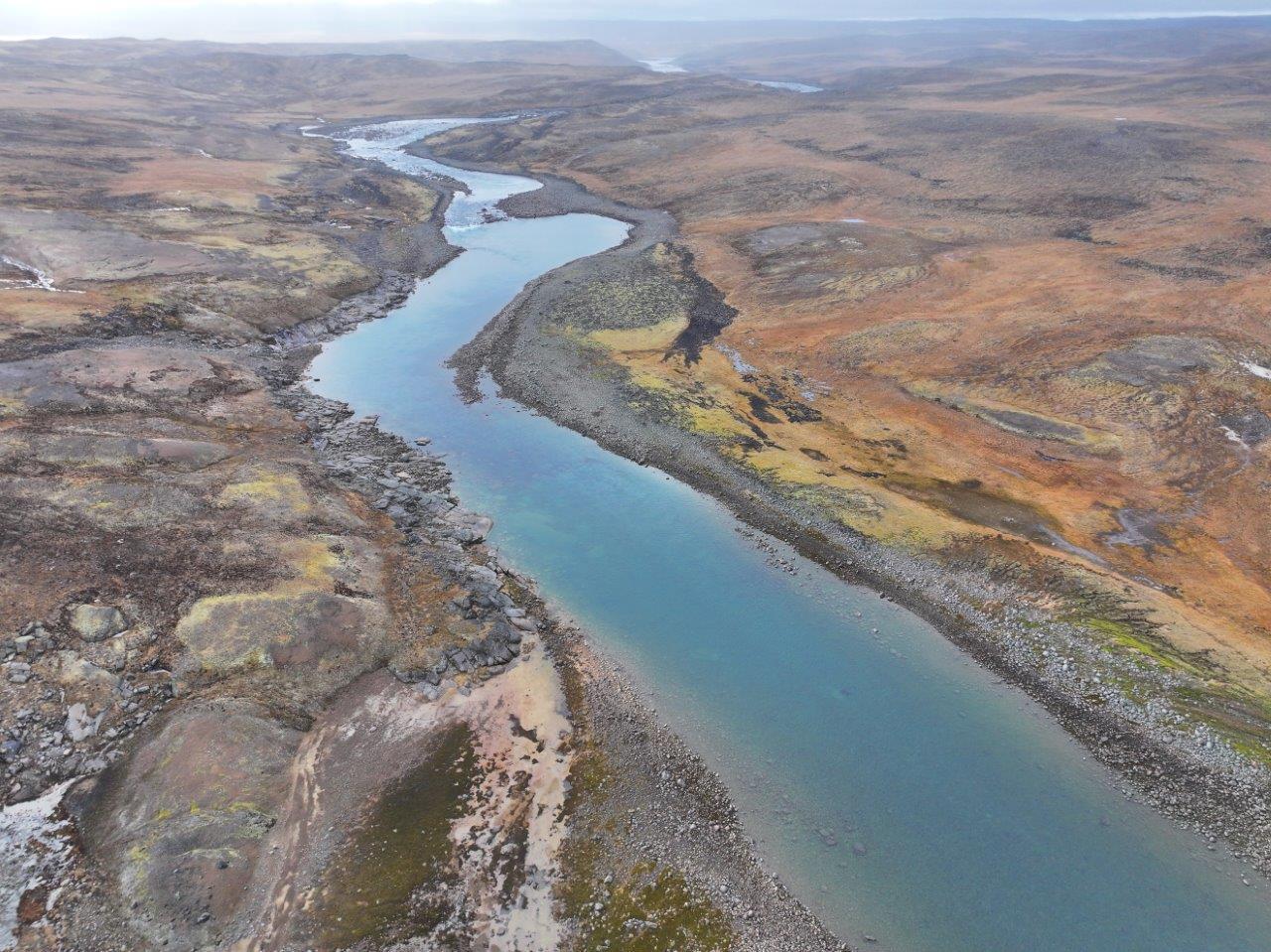
The proposed Iqaluit hydroelectric project, with a 50-metre-high dam and a powerhouse, could be built along the Kuugaluk River. (Photo courtesy of Nunavut Nukkiksautiit Corp.)

It will be a “big deal” if the proposed Iqaluit hydroelectricity project is included on the list of federal nation-building projects to be revealed Thursday, says the executive director of the Federation of Canadian Municipalities.

Matt Gemmel, executive director of the Federation of Canadian Municipalities, says the Iqaluit hydroelectric project could help enable local resilience and sustainability. (Photo by Arty Sarkisian)
“It seems like the kind of project that enables local resilience and sustainability,” Matt Gemmel said in an interview at the Nunavut Association of Municipalities annual general meeting in Iqaluit Wednesday.
The hydroelectric power plant proposed to be built along the Kuugaluk River, about 60 kilometres northeast of Iqaluit, is expected to make Prime Minister Mark Carney’s list of projects slated for fast-tracked approval, both the CBC and Globe and Mail reported Wednesday, citing anonymous sources.
This week, Carney said he will reveal the six projects on his list Thursday in British Columbia. Along with the Iqaluit hydroelectric plant, the other projects are believed to include mining and gas exporting, CBC’s sources said.
This summer, Carney announced the creation of the Major Projects Office to review projects recommended for fast-track approval, and in September he revealed the first five.
“I’m definitely happy about that,” Nunavut MP Lori Idlout said of the potential addition of the Iqaluit hydroelectric project to the list.

“It’s Inuit-led and it’s been something that the city has been exploring for a long time.”
Iqaluit Mayor Solomon Awa called the prospect “awesome,” but wouldn’t comment further.
The hydroelectric project is led by Nunavut Nukkiksautiit Corp., a subsidiary of Qikiqtani Inuit Association, the entity mandated to promote the rights of Qikiqtani Inuit.
The project would include an approximately 50-metre-high dam and a powerhouse and could be operational by 2033, generating 15 megawatts of electricity for about 100 years.
That would be enough power to replace all of Iqaluit’s diesel-generated electricity, which requires burning about 15 million litres of diesel fuel per year.
That would help make Iqaluit a “modern Arctic capital,” Heather Shilton, the corporation’s executive director, told delegates at the Travel Nunavut annual general meeting last week in Iqaluit.

There is no exact price tag available for the project, but in 2017 the cost was estimated to be approaching $500 million.
The federal government is expected to be the project’s main funder and has already allocated $26 million for studies. Also, the corporation is working to get a loan from the Canada Infrastructure Bank, a Crown corporation that funds Canadian revenue-generating infrastructure projects that are in the public interest.
On Wednesday, Shilton declined to comment until Carney’s announcement is made.
The consideration of Nunavut infrastructure for the nation-building projects list is a positive development, but there is a lot of “ambiguity” about what it will mean in practice for the projects and for Nunavummiut, Idlout said.
“It would mean in reality that it would still take a long time for any of those benefits to be seen in Nunavut,” she said, adding smaller projects like the paving of airport runways still lack funding.

“We need to see a balance between meeting the immediate needs of Nunavummiut, as well as investing in those strategic longer-term projects that will keep maintaining our goal toward self-determination,” Idlout said.
Iqaluit hits 11 Megawatts in the winter these days + it’s never ending construction growth.
Your 15 megawatts won’t be able to compete with Iqaluit’s power demands by the time you open up the dam.
Definitely, the benefit of having “made-in-Nunavut” electricity, without dependency on foreign-to-Nunavut diesel fuel, is a huge benefit in its own right. Iqaluit will finally be free of the geopolitical tensions of the global oil market.
And, let us look at other big-picture aspects.
Although this project might end up costing $1 billion (or maybe even more) by the time of completion (including all the supporting infrastructure like access roads and powerlines), and although the timelines could shift (for various reasons), and although 1 billion would work out to $100K per person (if we assume that Iqaluit’s population by completion time will be 10K people, albeit I am sure it will be much more), and although $1 billion would give more “bang for the buck” if spent on renewables down south, this hydropower plant still offers much more value than the Lockheed Martin F35 fighter jet (a contract which has become infeasible to cancel).
For perspective, Prime Minister Carney has allocated $80 billion in military spending, including the $10 billion that he has already announced this past summer. Although our national defences definitely need some amount of beefing up, including icebreaker ships and for expansions of Arctic military capabilities (which will also have valuable roles in search-and-rescue and environmental response, given the rise in Northwest Passage ship-transits), I feel that allocating $80 billion on military stuff is excessive. (Imagine how much permanently affordable public housing we could build, Canada-wide, with, say, $40 billion.) By the way, that $80 billion figure does not even touch President Trump’s Golden Dome, which would weaponize space and would be an outrageous boondoggle and alarming waste of money.
Because hydropower dams can last for centuries or more, the Iqaluit hydropower project will be able to provide reasonable long-term value. Consider that if diesel fuel were to remain at 1 dollar a litre forever (and ignoring inflation), then this 15 million dollars of fuel a year would work out to 1.5 billion dollars over a century. (This is a simplified illustrative example. If we wanted to take inflation into account over that 100-year timeframe, then that would address the time-value-of-money aspects of the plant and its operational-cost savings, given that the $1 billion hydropower plant cost would theoretically be paid in full at the start of year 1, yet the equivalent energy as diesel fuel burned would be an annual expenditure. For simplicity, I am also not delving into details such as using electricity to partially or even fully replace diesel fuel for heating. However, Québec provides many examples of both resistive electric heating and heat-pump usage.)
Also, remember that hydropower plants can be rehabilitated and can easily last longer than a century. And, the electricity is effectively free, as long as the hydropower dam is maintained. (Because hydroelectric turbines rotate at much lower speeds than typical diesel gensets, and because hydro turbines do not have the high internal temperatures inherent to combustion engines, and because turbines do not have reciprocating parts, therefore hydropower plants typically have much longer lifespans and can easily be rebuilt repeatedly over long timeframes.)
Also, hydropower is the only renewable source that does not require batteries to ensure reliable power under varying demand. (To be clear: the existing diesel plant will still be needed as a backup in case the 65-kilometre-long transmission line gets knocked out, but it will be just that: a backup, not a continuously running prime-power diesel plant.)
Hydropower also has other advantages, including averting the particulates and gases (including carbon dioxide) that diesel-fuel burning inevitably releases. (I am fully aware that, on a Canada-wide scale, our diesel plant is insignificant as a source of emissions.)
In any case, the fundamental benefits of the hydropower plant are very much valid, especially considering that fuel prices could easily grow faster than inflation (remember that oil prices are set globally and can fluctuate wildly), and also considering that Iqaluit as a city is growing rapidly and might continue to do so for some time (for example, a full-scale military base has been announced). The more Iqaluit grows, the more valuable the hydropower plant’s fuel savings will become.
The cost of electricity in Iqaluit (to be paid by someone!) could increase by 2 to 3 times.
Assume 1. a completed construction cost of $1 billion in 2029 dollars; 2. labour’s operating cost similar to the cost of diesel generation; and 3. a bond rate of 5% to pay for the project.
Amortization over 30 years then requires an annual payment of $65 million compared with today’s annual cost of some $24 million for 16 million liters of diesel used by the current power plant.
An additional cost of some $40 million has to come from somewhere just to break even with the cost of electricity from the existing diesel generation in Iqaluit.
Also, it will still be necessary to have back-up in Iqaluit in case of outage, Hydro is not 100 percent reliable because of risk both to the generating plant and to the transmission line. For example, some years ago Yellowknife lost the electricity generated by the Cominco mine’s hydro plant. Fortunately this was just one source of electricity for the city.
Couple contextual items
Fuel is not going to get cheaper so I would expect that $24 million to increase, a lot, over the next thirty years.
This absolutely won’t happen without a massive pot of free money from the feds. The diesel plants built across Nunavut in the last 10 years were financed, in large part, through funds provided by the federal government’s Arctic Energy Fund. There’s no way a hydro project starts without a MASSIVE investment from the feds.
In Nunavut we use postage-stamp electrical rates. That means that costs, in excess of federal funding, for all new plants and infrastructure are amortized and spread across all consumers in the territory, so Iqaluit would not solely be on the hook for costs.
It’s unfortunate that SMRs aren’t little further down the development and regulatory pipeline. I think that tech has the potential to meaningfully displace diesel plants across the territory….but that’s also a whole other kettle of fish for people to get upset about!
you think the only cost Timorese the diesel plant is the fuel? Plant operators, diesel maintenance, maintenance crews, building maintenance……,just to list a few things.
A well built hydro electric installation requires very little maintenance or manpower to operate.
Diesel is not getting any cheaper ….
Not great news for fish.
Re: ‘Goodbye Char’: The Sylvia Grinnell River, with its miles of shallow, gravel spawning grounds is an ideal habitat to embellish our precious char fishery. The hydro project will feature fish ladders which will enhance the fishery not destroy it. This technology is well known and well established. This will be an asset not a threat. The Inuit proponents of this project will make sure our rich char potential is not only saved but enhanced for everyone.
That river will disappear under a HUGE lake. No more spawning grounds.
Because people over fishing and using nets in the winter for profit isn’t an issue?!?
Awesome, indeed.
The powerline project to be announced for northern BC is a bail-out for Alcan. They have a massive hydro-electric plant there. They use most of that electricity to convert low-cost bauxite ore into high-priced aluminium. Aluminium is, essentially, bottled electricity.
With the powerline, Alcan will be able to sell electricity to all the small towns between Terrace and Prince Rupert. All the small plants now providing electricity to those communities will be shut down, putting people out of work, but the capacity to produce aluminium will be maintained and used at reduced capacity.
As for a nation-building electricity project in Nunavut… I don’t think so.
I would be leaning toward micro- nuclear reactors for several communities instead of mega millions for one community. It would cost additional millions to connect another community/ies.
No one knows there’s other communities other than Iqaluit in Ottawa. Don’t blow their mind and show them a map.
This is just a con job by the Liberals to keep Nunavut happy, this will never happen, the uproar of a few Oceans North, NGOs don’t care about this and will pat themselves on the back when they derail this over the fish.
Carney mentions 100% inuit doing the business built,
Now if any conflicts can be not hired and many other Inuit who can work would be great,
We already seen Polar Outfittig already been hired as his Uncle is the president of this business ,
Guess you can hire anyone involved in family ties as not seen as Conflicts ,
Watch more will go in Conflicts as years go by .
That Iqaluit hydroelectric project would be a glacier most of the time no?
The need for energy security in such a smaller grid seems like a perfect match for an SMR or two …