


Canada becoming ‘energy superpower’ as 4 Nunavut projects get federal funding, Idlout says
Federal government will spend $17.2 million on renewable energy projects in Nunavut
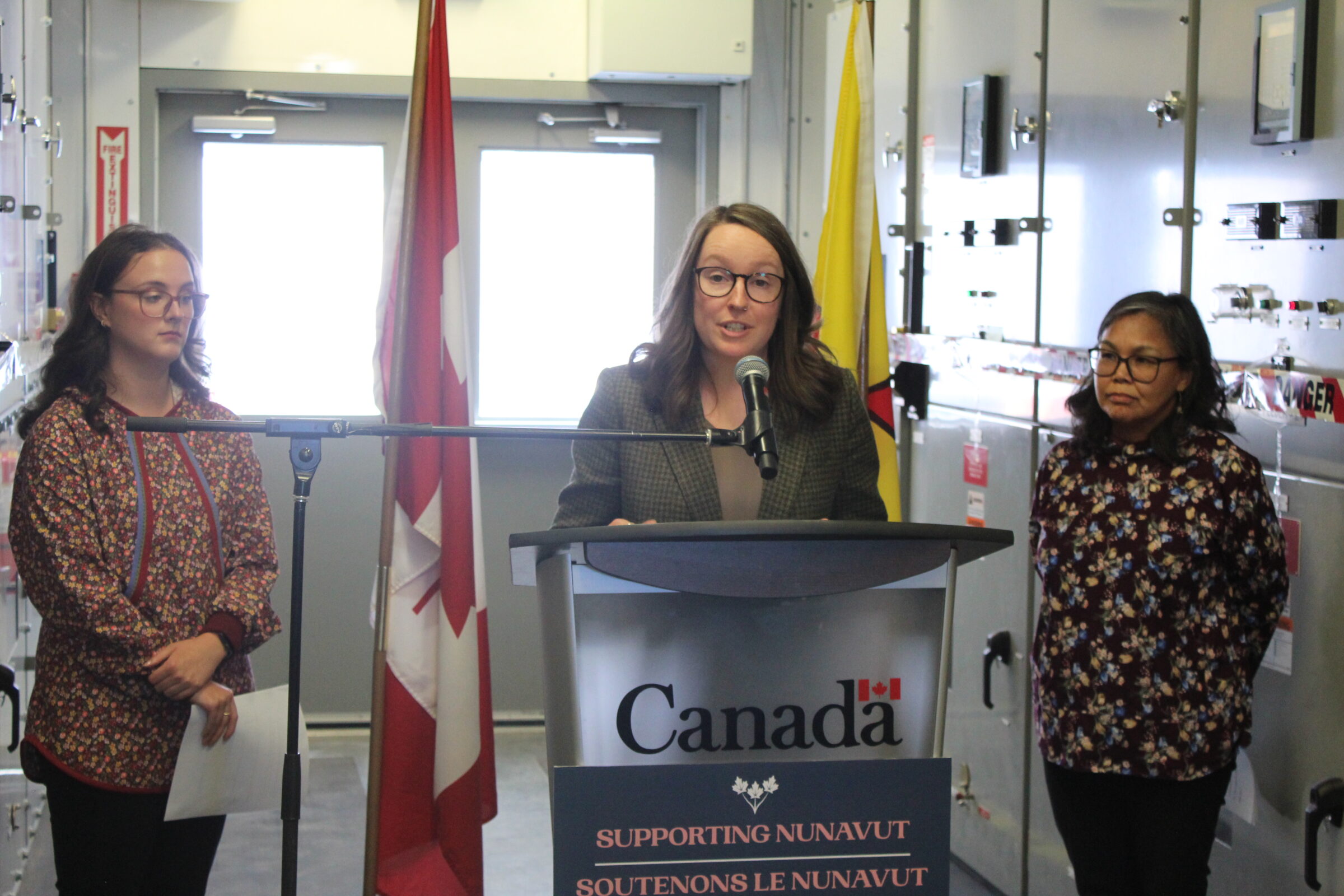
From left, Nunavut Nukkiksautiit Corp. project manager Clara Phillips, Nukkiksautiit COO Heather Shilton and Nunavut MP Lori Idlout announce federal funding for four clean energy projects on Monday. (Photo by Arty Sarkisian)

Nunavut will get $17.2 million in federal funding for four clean energy projects that will be part of the country’s Arctic sovereignty push, Nunavut MP Lori Idlout says.
“It clearly shows that we are on the road to becoming an energy superpower,” the Liberal politician said at a funding announcement on Monday at the Iqaluit power plant. “Inuit and Indigenous peoples are leading the way.”
The money, which comes from the federal departments of Natural Resources and Crown–Indigenous Relations and Northern Affairs, will help fund wind turbines and solar energy projects.
Nunavut Nukkiksautiit Corp., which is owned by the Qikiqtani Inuit Association, will get $4.8 million for feasibility and engineering design studies of solar and wind projects in Sanirajak, Kinngait and Resolute Bay.
Those studies should be “wrapped up” in a couple of months and, once completed, the projects should offset future diesel fuel consumption in the communities by more than 50 percent, said the company’s chief operating officer Heather Shilton.
Nukkiksautiit will also get $8.5 million toward the construction of a clean energy system that will power the Aqsarniit Hotel and Conference Centre. That should start operating in August, Shilton said.
Qulliq Energy Corp., Nunavut’s government-owned electricity provider, will also get funding: $1.3 million for “renewable energy studies,” Idlout said.

Sakku Investments Corp., the business development arm of the Kivalliq Inuit Association, will get $2.5 million for its solar and battery projects in the Kivalliq Region.
Nunavut burns more than 54 million litres of diesel fuel annually to generate electricity and the “demand is growing,” Idlout said, adding that the renewable energy projects will help battle climate change and make Canada more “independent.”
“Canada will no longer depend on any one international partner,” she said. “Instead, we will have a stronger, more independent country.”
Pretenders working hard now. Can you guys look at the Inuit complaints and work on it. Pretenders that are working in each community have to be investigated. They say police serve and protect the community not in arviat. Investigate the health professionals and you will see how they have been working. Especially to Lori that she already knows about this and still nothing happened.
These are great projects for Nunavut! The RDC’s for the Kivalliq and Qikiqtani constantly making progress. Too bad the Kitikmeot Region is always lacking any drive to provide economic development for it’s residents.
Canada should have been a “energy superpower” , if , it had not been for Justin trudel and Steven guilbeault screwing the energy sector in the name of climate change . by the way , i m pro oil !!!!
do you even care to make any sense!
What a sad LOL, that Canada is becoming an energy superpower with windmills and solar in the Arctic. And of course, said with the standard, believe-me climate change fear look.
Yup, yup, three cheers for intermittent electricity, to strain the current power plants to produce higher electricity costs for money in the Inuit Orgs’ short-term pockets.
Seems as if the MLA didn’t get the memo? The United Nations Intergovernmental Panel on Climate Change (IPCC) has dropped the idea that the temperature is racing upwards to the world’s ending doom. Climate change is over, well for now..
No surprise when massive amounts of electricity and water are must-haves for data centers now building across Canada without formal environmental impact assessments.
So plop them on prime food and animal farmland, without worrying if built on large aquifer systems. Though gives a nice fear phrase to pull out of the back pocket to say the future food and water shortages are because of climate change.
Wonder why Nunavut’s floor crosser MP didn’t announce… Keystone pipeline and new pipelines are a go. The west coast oil tanker ban lifted with an oil refinery to be built in Alberta. Of course, they would say this if the Liberals truly wanted Canada to be an energy superpower.
“The United Nations Intergovernmental Panel on Climate Change (IPCC) has dropped the idea that the temperature is racing upwards to the world’s ending doom. Climate change is over, well for now.”
That is a lie. The 2023 report, the latest one, discussed increasing average temperatures. The 7th report is currently due to come out early in 2027. The topics to be covered were drafted in 2024 and are available on the IPCC website, with the upcoming report focusing on the effect of climate change on urban areas, since that it where most of the world’s populations live.
So the obvious question: where did you hear the lie you that someone told you, and why didn’t you bother to check and see if it was true?
Look to Geoscientific Model Development by Dr. Detlef van Vuuren and ScenarioMIP team. Published May. IPCC released their own formal statement acknowledging the scientific shift.
The elimination of past decades of climate fear… RCP8.5, SSP5-8.5, and SSP3-7.0.
RCP8.5 Is officially dead.
Yes, they eliminated RCP8.5, which was, “the worst-case scenario in that framework, representing a world in which fossil fuels are widely exploited and more of the world adopts energy-intensive lifestyles”.
Why have they dropped it? “The authors of the new paper wrote that “trends in the costs of renewables, the emergence of climate policy and recent emissions trends” justify the implausibility of the highest-emissions scenarios such as RCP8.5”.
Sooooo… Policy regarding reducing carbon emissions and reducing the costs of renewable energy have now made the worst-case scenario implausible? Interesting how you use that in your argument against renewable energy.
Can Idlout, or someone, explain how either solar or wind can generate electricity in winter when the temp is minus 40 and there’s no sun and no wind?