


Canadian North sale is not gonna fly
Letters | Igloolik man weighs in on pending airline sale
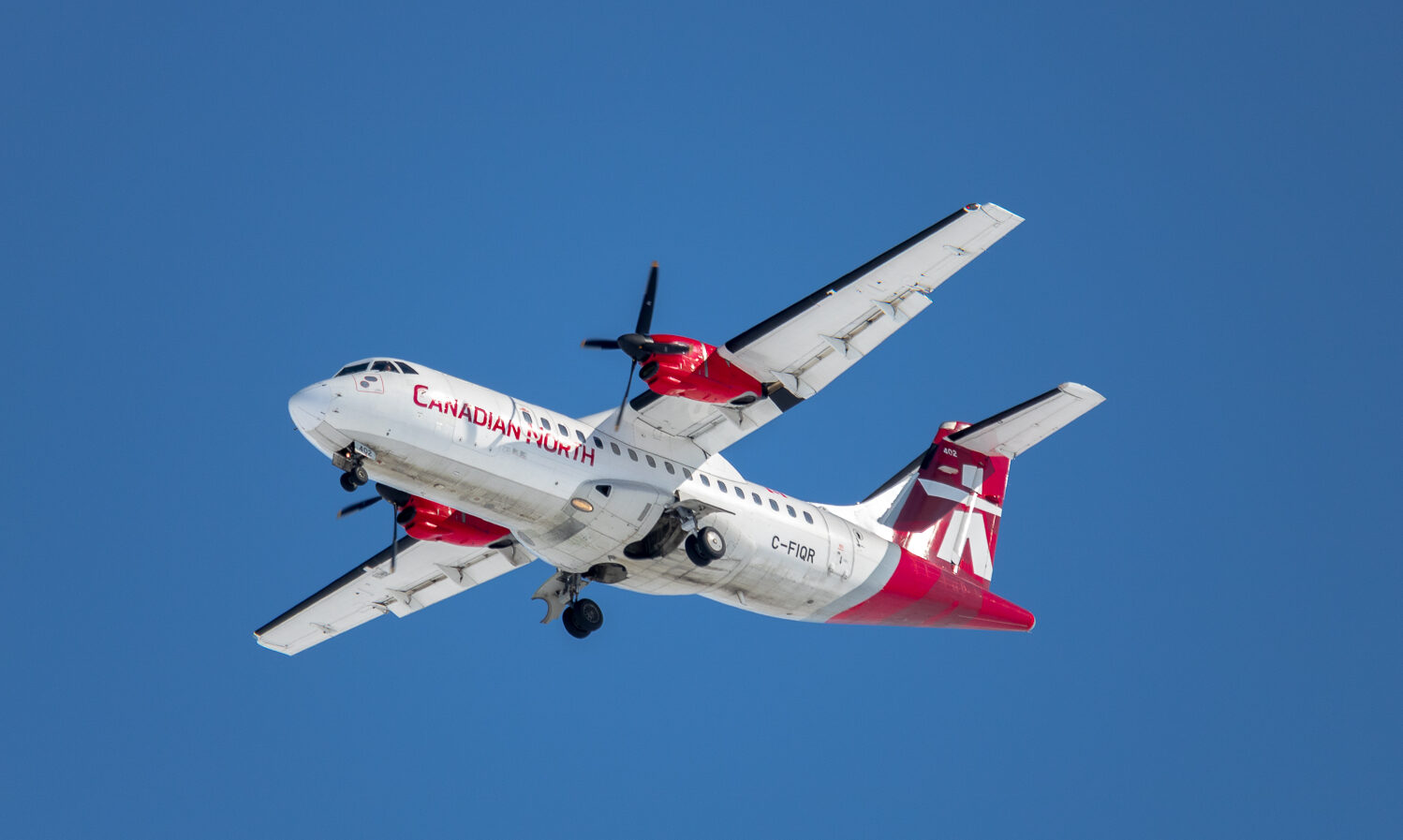
A Canadian North plane approaches Iqaluit in this file photo. Winnipeg-based Exchange Income Corp. is in the process of buying the airline from Makivvik Corp. and Inuvialuit Development Corp. for $205 million. (File photo by Jeff Pelletier)

Stephen Frampton (Submitted photo)
Imagine Northern bought Co-op.
Just one store in all communities with limited to no competition, and a legal responsibility to shareholders, not to communities. Nunavummiut would be rightly upset.
A similar development is underway for Nunavut aviation, as Canadian North announced it is being sold to Exchange Income Corporation, subject to regulatory approvals and other closing conditions.
It already owns Calm Air in the Kivalliq and has the medevac contract in the territory. If Exchange Income Corp. were to buy Canadian North, it would nearly monopolize commercial, cargo, and medical flights in a territory where there are no travel alternatives.
The company knows this, mentioning multiple times in the deal’s press release “the essential nature of the service,” and acknowledging it will become “the pre-eminent provider of this valuable service throughout the entire region.”
Read to the bottom and we’ll also see it is also looking to achieve its “target return on capital by the end of the second year of ownership.”

In short, while the company asserts that it is responsible and will provide stable or even enhanced service, it is also communicating that to meet profitability targets, there will be changes coming.
Moreover, Makivvik, a Nunavik-based co-owner of Canadian North, intends to retain the route from Kuujjuaq to Montreal, rather than sell it to Exchange Income Corp. Why is Makivvik retaining the route that impacts it the most? Not a good sign.
It is possible that Exchange Income Corp. is a good, ethical operator that can faithfully steward a monopoly business to improve service for customers, while upholding its fiduciary duty to investors.
However, anti-monopoly laws exist because of how rarely this is the case.
Odds are the losers in this transaction will be Nunavummiut.
I’m not arguing that Canadian North is better off as it is.

There are obviously changes that need to be made and more transparency required. The point is: best-case scenario, the status quo is maintained. More likely, things get worse.
How do we know this?
Other airlines operated by Exchange Income Corp., like Calm Air, receive similarly inconsistent reviews to Canadian North.
Makivvik (one of the sellers) chose not to give Exchange Income Corp. control over the route most critical to itself.
Exchange Income Corp.’s only legal obligation is to provide its shareholders with a return. The corporation will be able to use its monopoly on Nunavut’s aviation infrastructure to take actions with few consequences.
As of yet there is no mechanism to assure accountability to the people who use and need these services, and, if the lack of enforcement of the conditions of the 2019 Canadian North and First Air merger is any indication, the government is unlikely to enforce one, if such a mechanism were to exist.
The phrase proudly adorning the Exchange Income Corp.’s website tells us all we need to know: “Essential services, reliable dividends.”
Should Nunavummiut’s reliance on air travel for essential services be exploited to pay and grow the dividend of Exchange Income Corp.’s shareholders?
My answer, is no thanks.
Nunavummiut need to put up a fuss, so politicians and regulators feel compelled to give this transaction the scrutiny it deserves.
Stephen Frampton lives in Igloolik, has published business-related articles on the stock research platform SeekingAlpha, and has a finance blog called “FrampFiles.”
Nunatsiaq News invites readers to submit letters to the editor for publication. They must be less than 500 words and signed by the writer. Please send them to editors@nunatsiaq.com.
I respectfully disagree. Of course EIC has a responsibility to its shareholders to provide reliable dividends. That’s the only reason people invest in a stock. It achieves that by providing reliable service to its customers. The present owners obviously want out, and EIC is a willing buyer. No-one else seems to have been interested. As to why Maikivik is choosing to keep the Kuujjuaq-Montreal route, there are probably two reasons – to integrate it with Air Inuit’s regional services in Nunavik, and (I’m guessing) because it was not an important route for EIC to acquire because they have no other footprint in Quebec. EIC is a well-managed company with a history of rewarding its shareholders with consistent dividends. It’s a public company. Nunavummiut with spare cash should consider investing, for a current return just in excess of 5%.
You don’t need to provide reliable service to customers when you’re a monopoly. Look at the Kitikmeot. We have no other passanger transport options after the last merger.
There’s almost never make-up flights resulting in people being bumped often for multiple days. Cargo has suffered terribly, bags routinely never make it resulting in additional trips to the airport and there’s no consequence for any of this.
Good reliable customer service is valuable in a competitive market. A single passanger airline is not a competitive market. You can make your returns of exploiting being a single airline repercussion. Travel isn’t going to stop, most of it is work or medical related.
But you need to provide a viable business. Granted, that might not conform to current expectations around service. Maybe we need to acknowledge limits here. Are we taking for granted what ‘reliability” means?
Hi, I hope EIF remains ethical and maintains routes and safe planes. I too do suggest that you all buy a few shares each to retain some pressure on the company. EIF seems to be ethical compared to say Brookfield income fund. Stocks should go a bit lower this year.
It’s very odd for Inuit to divest from the very thing that controls 99% of access to the territory they live on.
There is not much transparency over why Makivvik is making this move. Are they running out of money? Is the airline not profitable?
We only have to look at Nunavik to see the effect of a monopoly: tickets well over 3000$ from Montreal to Puvirnituq, a short 2h30 flight. The Kuujjuaq route is on the path now to be around the same price, with Canadian North gone.
Ken, your a smart business guy and author, you just nailed it about EIC returning consistent returns of 5 percent, you never had to deal with calmair, you lived in Iqaluit, and always had the best of air travel jet service, all their business is government guaranteed business, and the travelling public is in for a wake-up call if this buyout continues, nobody else will invest in the airline business. And if another company try’s to operate the GN, will not use it, so in a year after this happens, I expect to see a comment from you about your investments in EIC and your dividends, and the travelling public public comments,
Sure wrote a lot about his story, all the while some other real stories never get more than a paragraph. Just writing for a friend.
The article was kind of thin on details.
In my opinion, the airline is already around as low as it is likely to go, so at least there’s a lot of room for improvement. My metrics being on-time performance, customer satisfaction, and price.
Its previous First Air/Canadian North merger already went through, which is where the huge overlap was; so imagining this as a Northern buying Co-op is a strawman argument.
If I were guessing, I would say there won’t be a lot major changes on the consumer-side until the next Medical/Duty contract is awarded. On paper, there should be synergies that could be realized, but whether or not they materialize is still an open question.
EIC probably knows that they might have bought a white elephant if, which is itself a big if, another airline enters the territory in any capacity. But looking at the airlines EIC already owns, they seem to know how to balance aircraft utilization with reliability.
As for Makivvik and the Kuujjuaq route – realistically, that should have been moved over to Air Inuit decades ago, so that was inevitable.
The three things that I think could fix 90% of the complaints would be:
1) bringing back overnight bases in Resolute and Cambridge, which would improve connectivity and save hours of flying ‘dead’ legs each day
2) being much more strategic with connections through Iqaluit, notably tightening up the multiple 6-hour layovers north and south
3) take a long, hard look at the specifics of the fleet and play off of that strength
To elaborate on point 3, Canadian North has four 737 combis. For now, one is tied-up on Calm Air’s Winnipeg-Rankin route. These excel on the Inuvik run in the west, and I guess the trans-arctic. There’s not a lot of point in wasting hours and cycles on long sectors like Iqaluit-Ottawa, where Cargojet can pick-up the slack, especially if the 300 combis are payload restricted anyway.
As for the ATRs, as much as I could, I would move freight on freighters and move passengers on scheduled flights. Freight does bring in revenue, but the losses in labour required, aircraft utilization with long turnaround times, compensating customers for things they flattened or froze, etc; just focus on moving them efficiently on their respective aircraft.
Depending on EIC’s appetite for change, some future outcomes I could see are combining Calm Air and Canadian North entirely, splitting them to be an all-ATR and an all-737 operator (especially with the Alberta charter network), or even an all-passenger and all-freight operation.
Lots of opportunities, which is why I said I think there’s a lot of room for improvement. I might be wrong, but we’ll see.
Firstly, the article isn’t a business one and it wasn’t written by someone woth business expertise
Secondly, CO-OP and Northern are competitors in most Arctic hamlets. I’m okay with that. That isn’t an analogy for airlines. Besides what is Candian North Airlines’ competitor in each hamlet?
I have to laugh at your rationale about “why do Makivvik don’t want to give the YUL-Kujjuaq route to EIC”. Just be real or get inform about Nunavik- Makivvik are not affraid of EIC – they are playing the same game – now Air Inuit will complete their monopole in Nunavik – and truly, this was already the case given that Makivvik partly own Canadian North. Same same story of no competition, no option…in Nunavik and now across the board in Nunavut.
All hearsay. You didn’t even interview the.
I would question if the author is even qualified to comment. Maybe I will come out of retirement and become a “blogger” instead of just commenting on NN stories.
Makivik invested millions into First Air, and no doubt IDC did as well to Canadian North. Will either recoup, or profit from their investment? Hopefully they both at least break even, but I imagine that they would have done better just buying an ETF.
Makivik’s Air Inuit has grown and matured and it makes sense for them to serve Kuujjuaq as well as all of Nunavik. That’s where Makivik’s shareholders live, and that is who they have to keep happy. Keeping the Kuujjuaq route is a no brainer.
As for EIC’s purchase, who else would buy it? The GN and the 3 Nunavut RIAs were offered a stake in First Air, Canadian North, and the merged company many times. They declined.
Aviation, and especially northern aviation is a capital intensive undertaking with a very poor rate of return – especially as you are constrained by federal rules.
EIC has proven that they can run airlines in the north, and do it profitably. If the GN does not want to run an airline as a quasi utility then there really is little choice but to have a company like EIC run it.
And for those that want competition, the towns and hamlets are just too small to have two airlines trying to compete. Decades of Canadian North vs First Air proved this.
Ok all you professors, do any of you spend your own money on an airline ticket or pay for any cargo, I doubt it, and if course you know very little about EIC, google perimeter air owned by EIC, northern Manitoba chiefs fed up with the terrible service, EIC is profit motivated, and it has to be, but EIC has taken on Canadian North/first air and if you think service and costs are going to get better forget it, they buy up every airline to have all the business, wait and see, thank god the journalist that wrote this is right, stop hiding behind the rational that it will get better, it will not Calmair does not have the capacity or people, or corporate background to run this large business, and the GN, federal go, nutrition north, and you the travelling public will find out soon, it’s easy to run a few ATRs from wpg into the kivalliq, and they will clean out the fat at Canadian North and try to pay staff minimum wage, but their incompetence in this venture will be paid by you, I am still living it, and these posts are buy people that have no stake in Nunavut or nwt or Ontario or Alberta.
“Calmair does not have the capacity or people, or corporate background to run this large business.”
Uh… Canadian North sold for $205M. EIC is worth $2.47B. They own 6 airlines (not including CN) and a pilot training school. I think they’ve got the capacity and corporate background.
Anyway, this author doesn’t know what he’s talking about. Calm Air serves Kivalliq. Arviat, Rankin, Whale Cove, Chester, Baker, Naujaat, Coral. The only overlapping community with Canadian North is Rankin. So the Northern/Coop analogy really doesn’t apply. And people have already explained why Makivvik kept the Kuujjuaq route, I think it was even in a previous article, so I don’t think the author has really done much homework on this one.
I’m not saying that service or fares will definitely get better, but I do think there is opportunity for certain improvements. Having a provider that serves the entire territory (combining Kivalliq with the Qikiqtaaluk and Kitikmeot) provides an opportunity for improved scheduling. A larger fleet provides better opportunity for make-up flights. Provides better economies of scale for maintenance and repairs. A company with more capital available can make investments in the right aircraft. There are efficiencies to be had. That being said, I wouldn’t bank on fares decreasing. And some actual competition would be nice.
I’ve occasionally wondered if there’s room in the market for small aircraft operators. Could somebody fly a few twin otters in the Kivalliq between Baker/Chester/Rankin/Arviat/Whale Cove? Or along the East cost of Baffin Island? Maybe in the central area encompassed between Gjoa/Naujaat/Igloolik?
I don’t know if there’s truly opportunity and viability there. But it would be cool.
Assuming that this deal proceeds to completion, it will be interesting to see how EIC runs Canadian North. Given that the aviation industry is federally regulated insofar as safety requirements are concerned, I have a feeling that the most likely scenario is a continuation of the existing service frequency (at least on the more popular routes) but a rise in airfares that outpaces the Consumer Price Index (CPI). Also, I would not be surprised to see a decline in service frequency in the smaller hamlets.
Given that reliable civil aviation is a crucial aspect of Nunavut’s national-level transportation (i.e. many flights to or from Nunavut communities are done in order to access southern cities), I think the most logical solution would be to have a federal-government-owned airline that services the Canadian Arctic.
It is not hard to find federal-government-owned transportation systems. One example is Via Rail, a Crown corporation that is fully owned by the Government of Canada.
In my opinion, the Government of Nunavut is simply too small to be able to handle the capital-intensive nature of running an Arctic airline. (Incidentally, because the GN does not have the “heft” to run an airline, it is not very meaningful to use BC Ferries as an analogy. The BC Government is simply much bigger because BC is demographically much bigger than Nunavut.)
Furthermore, because the Canadian Arctic extends beyond Nunavut, the only logical government entity for running an airline covering Northern Canada would be the Canadian federal government.
We also need to remember that the federal government has invested many billions of dollars in Nunavut (and in the Arctic in general). All of the following examples of essential services were made possible by significant infusions of cash from the Canadian federal government:
– Healthcare facilities (primary, acute, and long-term care)
– Schools (primary, secondary, NAC college)
– Airports
– Power Plants (including infrastructure and also renewable energy)
– PPD Tank farms and infrastructure
– Seaports
– First response (e.g. policing and emergency medicine)
– Defence
– Coast Guard, Search and Rescue
– Fisheries protection
– Environmental remediation
– Scientific research (e.g. climate change and resilience)
– Social services (e.g. income support, public housing).
(Although some of the above services are nominally provided by or through the GN, and although not everything is completely paid for by the feds, the fundamental reality is that the long-term sustainability of nearly everything in Nunavut depends heavily on financial support from the Government of Canada.)
And, the long-term viability of all of these essential services depends heavily on reliable civil aviation, simply because people (e.g. schoolteachers, nurses, doctors, pilots, electricians, diesel mechanics, airplane technicians, powerline workers, military staff, support workers for all of the foregoing, etc.) need an efficient, timely way to get around in order to do their jobs. In fact, the same applies to everyone here in Nunavut.
So, if EIC is genuinely committed to providing reliable, cost-effective civil aviation, then an EIC-owned Canadian North will be viable. But if the reliability and cost-effectiveness decline, then the need for a federal-government-owned Arctic-wide airline should become abundantly clear to everyone.
I broadly agree.
I’m not sure how to shield this theoretical airline from the whims of political blustery. Trying to appease constituents by micro-managing an airline into oblivion is not helpful, and any individual changes to flight schedules would have to make sense in the bigger picture of the airline.
But it should be noted that there are a fair number of government-owned airlines that are profitable and popular with the travelling public. Atlantic Airways, for example, is 67% owned by the Faroese Government, face other airlines with direct and indirect competition, and are profitable; feel free to read their annual financial reports on their website.
I think the public fears of ‘oh, it will only be a sink-hole for money’ are largely unfounded. I also think ‘oh, only the private sector knows best’ are way too simplistic.
Federal government crippled the airlines when they introduced Nutrition North. Airlines were able to compete with food mail program as part of offsetting lack of numbers travelling.