


‘Hope today, hope for the future’: Mary Simon urges ongoing reconciliation
Governor General emphasizes Inuit-led education and dialogue with government, Crown in reconciliation efforts
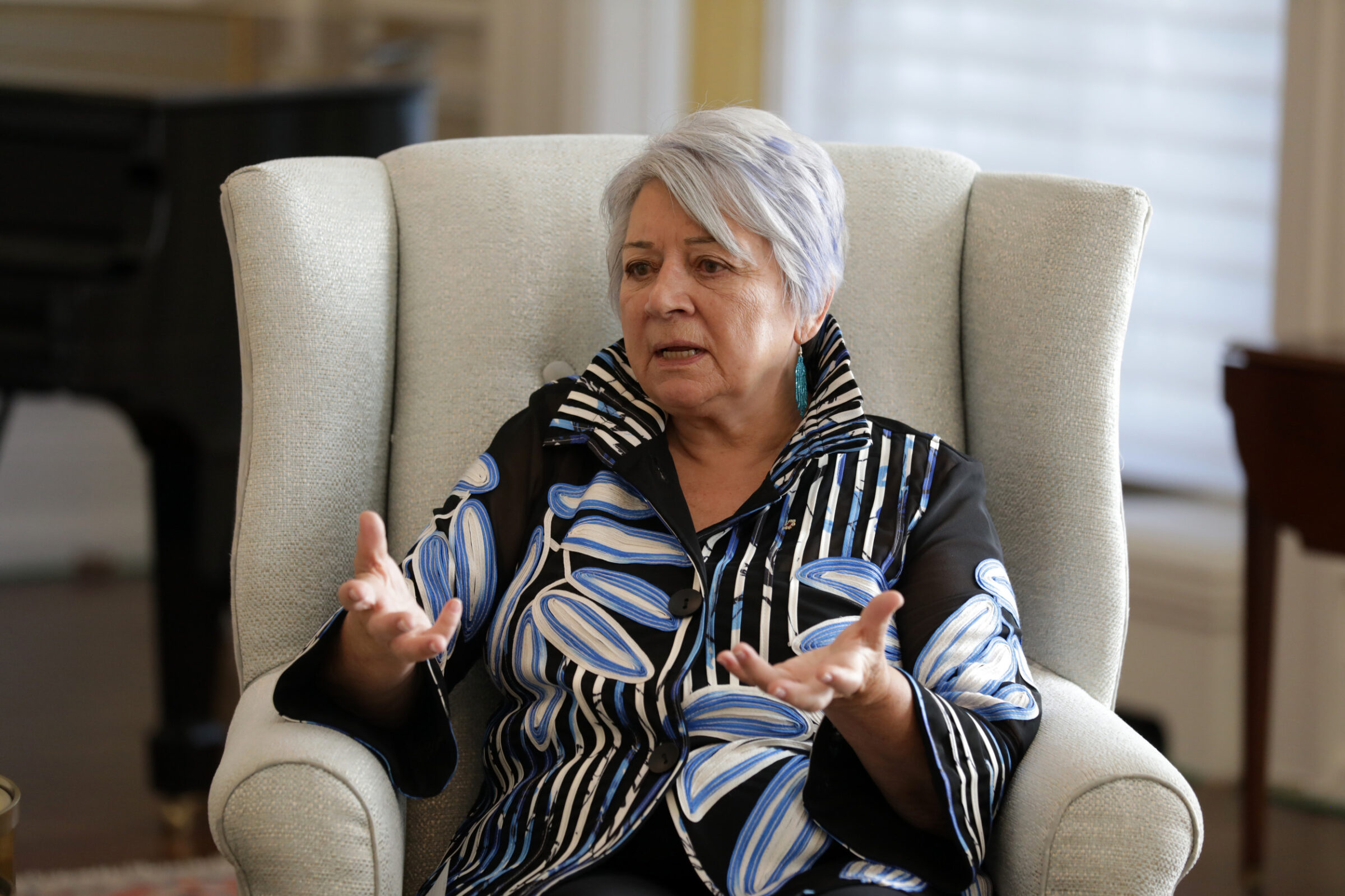
Gov. Gen. Mary Simon talks about reconciliation at Rideau Hall on Monday, one day before the 2025 National Day for Truth and Reconciliation. (Photo by Mike Carroccetto, Special to Nunatsiaq News)

The National Day for Truth and Reconciliation isn’t just about looking at the wrongs of the past, says Gov. Gen. Mary Simon.
“It’s about remembering what happened in the past but also looking at how we can move forward … so that we remember, and so that we never do it again,” she said in an interview Monday, about the meaning of the national day for reflection that falls on Sept. 30 each year.
An Inuk from Nunavik, Simon is the first Indigenous person appointed to be Canada’s Governor General.

Gov. Gen. Mary Simon poses for a photo at Rideau Hall on Monday, one day before the 2025 National Day for Truth and Reconciliation. (Photo by Mike Carroccetto, Special to Nunatsiaq News)
She will take part in several commemorative events around the National Day for Truth and Reconciliation in Ottawa.
On Monday, she hosted a gathering of residential school survivors and others at Rideau Hall. On Tuesday, she will be at a commemorative gathering on Parliament Hill to honour the thousands of lives lost or traumatically affected by the residential school system.
Then on Wednesday, there is a re-raising the Survivors’ Flag ceremony on Parliament Hill.
“This day brings everything together, to acknowledge that we are now in a place where we are dealing with colonization and residential schools,” Simon said in an interview Monday at Rideau Hall.
“It provides us an opportunity to continue our dialogue on not just the history, but also the future — of building a new relationship with Indigenous people and Canadians,” she said.
The gathering she hosted Monday marked 10 years since the Truth and Reconciliation Commission released its final report.
Simon said her role as Governor General gives her “convening power,” or the ability to facilitate discussions between Canadians.
In that job, Simon represents the King in Canada, serving as a symbolic bridge between Indigenous Peoples and the Crown.
“When I talk to other Indigenous people, they want to change their relationship with the government. They don’t want to give up their relationship with the Crown, because that’s paramount,” she said.
“They want to revisit their treaties and bring them up to date with today’s way of life and the standards that we, as Canadians, take for granted.”
Asked about a timeline for reconciliation, Simon said there isn’t one.
“Reconciliation is an ongoing process that we carry. We may see progress when life becomes easier and there’s more equality in the country, but there’s still a long way to go.”
Simon said there has been noticeable progress in raising public awareness of Indigenous issues and the legacy of residential schools.
She emphasized the importance of Indigenous language and education for cultural continuity, such as through Inuit Tapiriit Kanatami’s Inuit Nunangat University, which received a $1 million grant from the Rideau Hall Foundation to develop an Inuit-led teacher training faculty in July.

“Other cultures have it, so why not us?” she said.
“I was fortunate to grow up speaking Inuktitut. Many people didn’t, because of residential schools. Families, schools, educators must work together to raise children in their language.”
She said she draws strength from her own history being born in Kangiqsualujjuaq in Nunavik, where Inuit communities were impacted by residential schools and federal relocation policies.
“I don’t let [that history] weigh me down,” she said. “It’s really important for Canadians to understand why people are still so affected by those traumatic events.”
For Simon, ajuinnata — never give up — has become a guiding principle.
“It’s a call to continue what we’re doing, to move ahead,” she said. “We have come this far in our reconciliation process, and we have a lot more to do. So we must keep going. So, ajuinnata.”
“Asked about a timeline for reconciliation, Simon said there isn’t one.”
Of course there is no timeline. Why would you stamp an expiry date on a cash cow?
What an ignorant POS thing to say!! Reconciliation will be an ongoing process until Indigenous People in Canada are, at the very minimum, at par with the rest of Canadians when it comes to food security, education, child care and welfare, health care, reduced incarceration rates, reduced homelessness and overcrowding, job opportunities all of which had been taken away during colonization and cessation from the land and its resources! Just based on your comment it is proof that reconciliation will take awhile…if it doesn’t start with you hopefully your children will be enlightened. Now, go rage somewhere else.
Who’s raging here?
You can’t impose prosperity, eventually indigenous people need to create their own wealth. That’s the only way to get ‘on par’ (whatever that means).
Wow! It really is sad that your brain is so closed and that your ignorance and denial is so rampant. Reconciliation has nothing to do with money! It is about acknowledging all the disgusting harm done to Indigenous people by colonizers and non-indigenous settlers; and then it is allowing Indigenous people to heal, become strong and create the proper relationships they expected they were going to have when they were happy to invite the colonizers onto their land when they first arrived here. This includes being provided with compensation for the hundreds of years harm they went through (there were probably millions of Indigenous people over the last hundred years or so that have been harmed and need to be compensated for). Also, there needs to be compensation for all the hundreds of years where Indigenous people lost benefits from their land. The Canadian legal system, our Canadian government and our Canadian Constitution provide Indigenous people with rights that says colonial systems must make ammends and reconcile with Indigenous people and those systems believe that money is the proper way to do that. It is in no way Indigenous peoples fault that reconciliation costs so much. Indigenous people never expected to be overpowered and have their land, their children or their cultures stolen from them. They never would have agreed to that. Reconciliation will take a long time because there are hundreds of years of harm done to Indigenous people and lots of healing to do. It’s not just been done to people. It has been done to cultures and land and those things take a lot of time to heal. Please take some time to learn about things.
So….. it is not about money. It is about compensation and making amends, with said compensation and amends measured by monetary payments. Thanks for clarifying that.
How long does society have to say sorry? It just becomes meaningless rhetoric spouted by those who would benefit from it: politicians and activists among others. To say this is ignorant is ridiculous. This is an affront to all Canadians who pay enormous sums of money to FN much of which is squandered on bureaucrats and indigenous internal politics so it never finds its way to the people that deserve and need it. Looks like there will never be an honest discussion about residential schools either because it doesn’t support the message of continued abuse by a post colonial white privilege society. How racist is that? In the end it has become an endless cash grab. All people deserve to be respected but that’s not what is happening in our divided society. I
It’s reconsililation for their experience but to their kids it’s still a struggle. Health care, mental health, meds for health care. It’s still in effective to Inuit and their children struggling with jobs,
Reconciliation (edit) it is but another top heavy approach again as admin soaks up resources. Talk of the importance of the Inutituut language, but no teachers hired, no courses offered, Yada Yada. Sad to say.
What’s with all these ridiculous and wasted arguments?
Both Mary Simon and the position of GG are so outdated. It’s beyond me why we, as Canadians, continue to pay for this! And for all you anti-colonialists (haha), abolition of this position should be a big cause. Unless you have a double standard.