


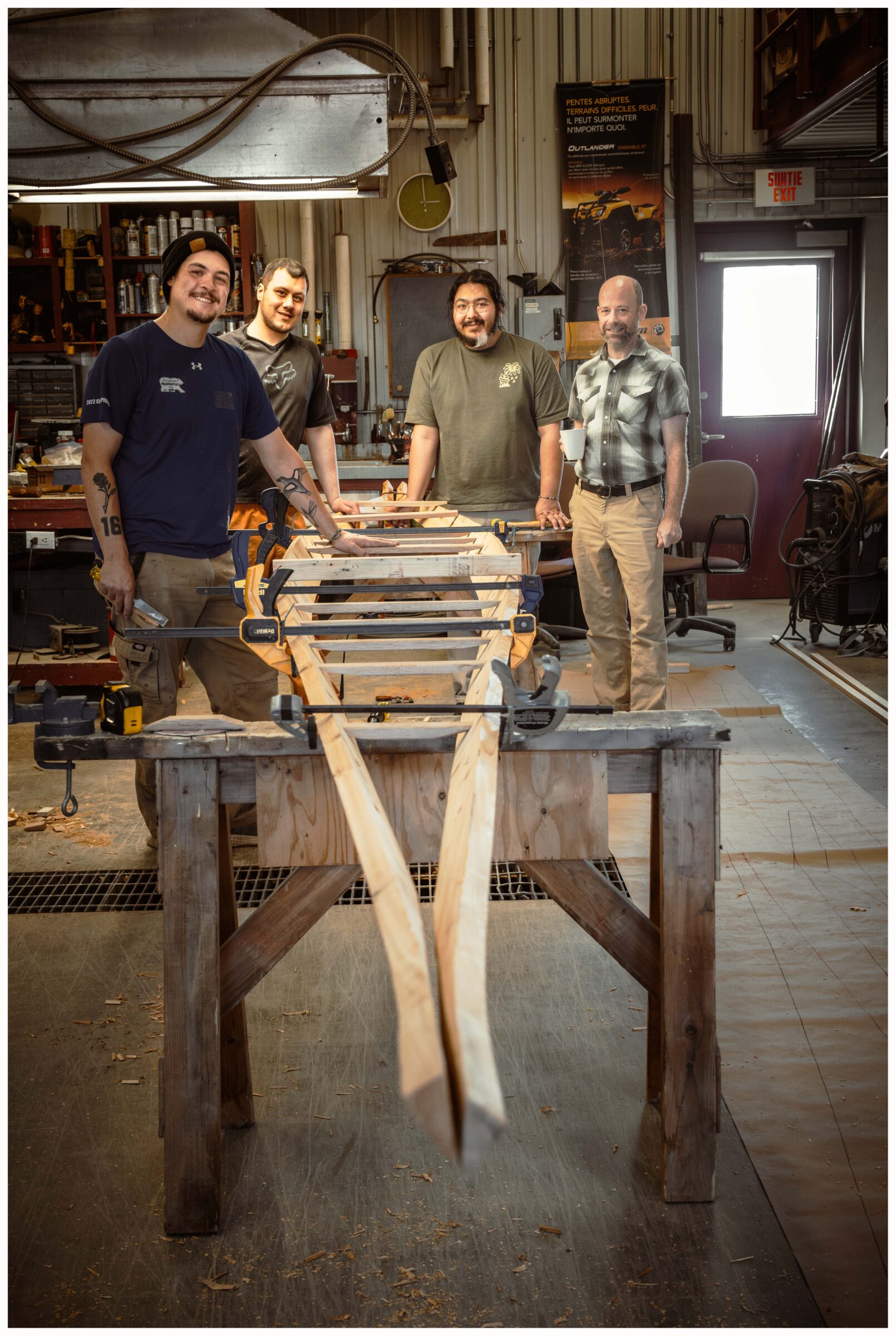
Qajakkut Society members Robert Comeau, left, Izaac Wilman, and Aasivak Arnaquq-Baril participate in a workshop alongside Oregon author and kayak researcher Harvey Golden. (Photo courtesy of Corentin Chaillon, KRG/Parks Nunavik)
Iqaluit kayak builders invited to work at Canadian Canoe Museum
Qajakkut Society members to build on site at Canadian Canoe Museum this fall

Updated May 5 at 4:45 p.m. ET
Members of the Iqaluit-based Qajakkut Society are planning to take part in a builder-in-residence program hosted by The Canadian Canoe Museum in Peterborough, Ont., in October.
Society members Robert Comeau, Izaac Wilman, Aasivak Arnaquq-Baril and a fourth participant yet to be confirmed will build two south-Baffin-style qajaak, the Inuktut term for kayaks.
They’ll also share their knowledge and paddling skills through lessons and programs at the museum, which opened at its new location on the shore of Little Lake in May 2024.
These kayaks will also be used in the museum’s on-water program fleet, which teaches kayaking skills to people young and old.
“One of the things that we’ve been dreaming about is that we showcase contemporary builders,” said Carolyn Hyslop, the museum’s executive director.
“We’ve dedicated a space called the Living Tradition Studio to do just that, to bring builders and makers from across the country and actually from around the world into the canoe museum.”
The museum will produce a series of mini-documentaries highlighting each builder’s process, stories, and their approach to the work. These videos will be available online, allowing enthusiasts worldwide to learn and be inspired by the builders and makers featured in the program.
Surrounded by glass windows and doors, the studio is designed to encourage visitors to engage with the builders. A fully stocked carpentry shop is adjacent to the studio.
“If they need to cut timber or mill some wood, then that’s all right there,” Hyslop said.
A Qajakkut Society kayak is already on display at the museum. It was presented in 2024 to mark the opening of the new 65,000-square-foot museum building.
“They produced a kayak that is on display with content they developed in videos, photos and even audio recordings, which accompanies the kayak that they made for the exhibit,” said Hyslop.
“That kayak is a real keynote feature in our exhibition hall on the second floor. We loved working with them so much.”

Other builders-in-residence scheduled to visit the museum from May through September include craftspeople representing Kitigan Zibi First Nation in Quebec and Fort William First Nation in Ontario.
The museum expects to welcome about 85,000 visitors annually, said curator Jeremy Ward.
“(The builders in residence program) offers a powerful way to honour the cultural histories and technical achievements held within the collection by bringing them to life through hands-on learning and storytelling,” he said.
Back in Iqaluit, Qajakkut Society members are finishing up two kayak frames for students who have attended weekly drop-in sessions held since December. There’s no date set yet for when the next drop-in sessions will begin.
Other upcoming or ongoing projects include some builds planned for Rankin Inlet and Coral Harbour, as well as a frame commissioned by a cruise ship operator.

The society will also host a kayak-builder gathering in Iqaluit in August.
“We’ll invite builders from across the Arctic to join us,” Arnaquq-Baril said.
Established in 2016 to revive the art of building kayaks and paddling and hunting using kayaks, the Qajakkut Society is headquartered in the Inuit Heritage Trust’s garage and workshop in Iqaluit.
To date, the society has produced 25 kayak frames “and counting,” Arnaquq-Baril said.
Note: This story was updated to correct the location where the Qajakkut Society is based.
So great to see younger people learning this important art. I wish them every success. Btw, Harvey Golden has built dozens of replica qajaq/kayak-related boats and their paddles as they were used from (… what-are-today-named-as …) the Russian Far East/Siberia, Alaska, Canada, and all of Greenland. Harvey is an international treasure in terms of hands-on knowledge in how these craft were made for he has flown the world in order to document their construction and then come to home to build replicas. Many are in such disrepair in museums that they may not last many more decades.
You can see these kayaks and other skin boats that he built by searching:
Harvey Golden kayaks [or] http://www.traditionalkayaks.com
The sheer beauty of even one kayak warms the heart. To see the dozens that Harvey has built all together on one site shows the vast depth of Inuit marine engineering and creativity.