


Iqaluit’s Apex, Plateau roads to be paved in $83M spending plan
Capital budget approved by finance committee Thursday; operation and maintenance budget to come
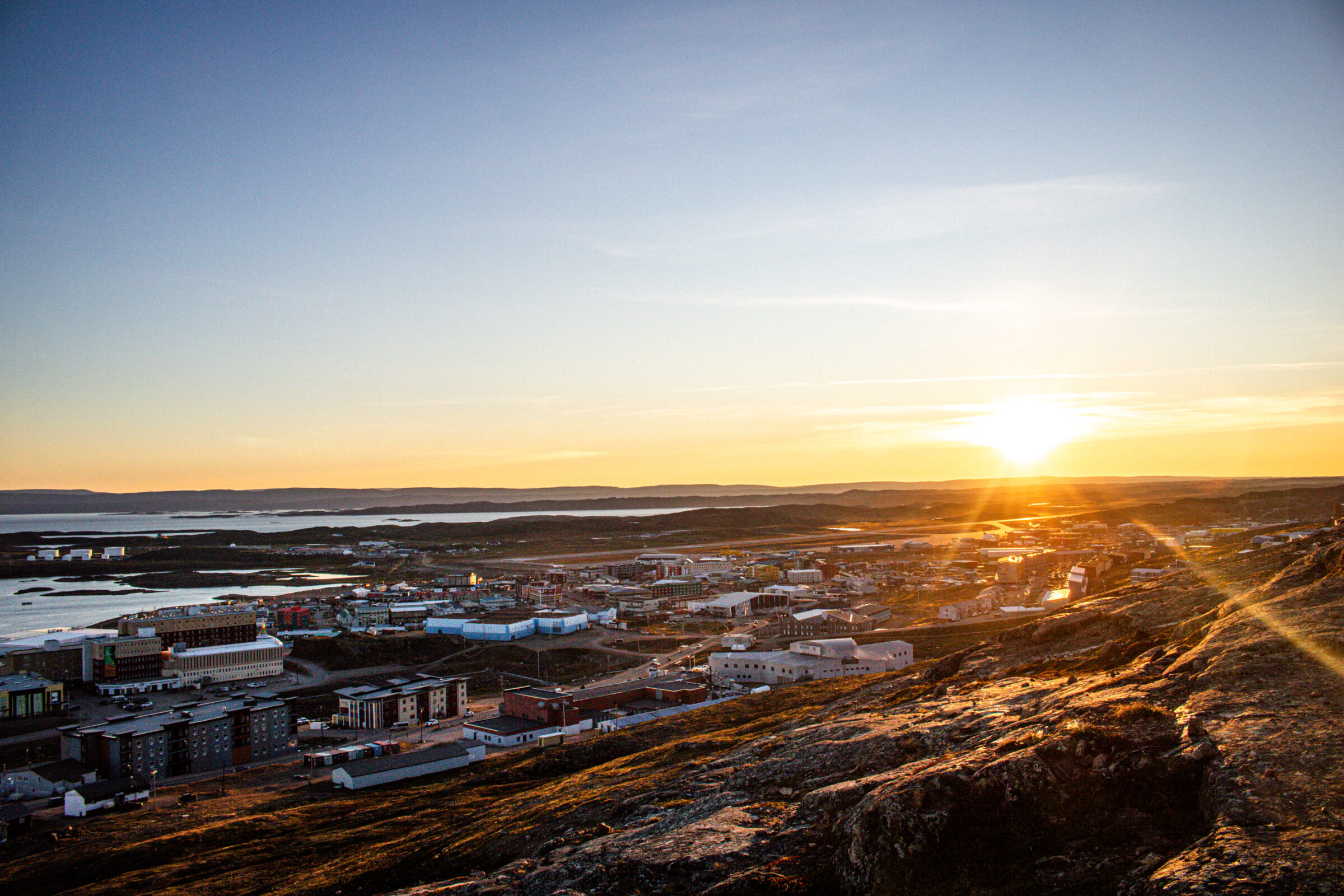
The City of Iqaluit’s $83.4-million capital budget plans to pave roads and put money into the city’s water supply upgrades. (Photo by Jeff Pelletier)

Paving roads and pouring millions of dollars into water upgrades are some of the major items included in the City of Iqaluit’s proposed 2026 capital budget.
The capital plan — which outlines how the city plans to spend money on equipment purchases, construction and other projects — was reviewed Thursday by the finance committee.
At $83.4 million, next year’s plan comes in higher than this year’s $71.5-million capital budget.
Peter Tumilty, the city’s finance director, told councillors he presented the plan “a few months earlier than normal” this year so the city can begin the tendering process ahead of the next construction season.
Two busy Iqaluit roads — the road to the Plateau areas and the road to Apex — are set to be paved, each at a cost of $2 million.
“The paving is probably going to make a lot of people happy that live on the Plateau, that have to drive through there three, four times a day,” said Coun. Amber Aglukark.
Similar to other recent capital budgets, upgrades to the city’s water supply infrastructure will take the biggest chunk of spending at a total cost of $43 million. That money comes from $214 million the city received in 2022 from the federal government to pay for those upgrades.

An additional $15.2 million will go toward sewer and wastewater upgrades.
The city is also set to spend $5.8 million to upgrade other facilities, including a $500,000 improvement to the fire hall located inside Arnaitok Arena.
Just over half of the capital budget, 56 per cent, is paid for with money from the federal government, Tumilty said. City funds cover about 36 per cent, and the Government of Nunavut is paying for approximately seven per cent.
Committee members unanimously approved the capital budget, sending it to city council for final approval.
“You look at the number of projects that were undertaken in 2025, it was a lot,” said Coun. Kyle Sheppard, who chairs the committee.
“To have accomplished as much as we did this year, looking at a smaller number of projects with few larger ones, with the water project advancing in 2026 I’m excited about some of the progress.”

The City of Iqaluit’s operations and maintenance budget for 2026 — which covers day-to-day expenses such as salaries and lists revenue from property taxes — was not presented Thursday.
Tumilty said it will be unveiled either in October or November.
Great! perhaps the City should also look into paving 2 small roads, the one by the arnaitok arena and the pool. Both are roads to city properties and they are in a terrible state. It is especially bad in the pool parking lot where its like a small pond in the spring.
The City should consider the steep road right beside the Arctic College and the main Apex hill as spots they should avoid paving because of the winter ice. It’s due to the fact that in the past, the student buses and the Caribou Cabs crown vic’s cannot climb those hills without gravel, and there were more issues for both classes of vehicles on the steep pavement rather than the gravel roads that provided friction for the wheels to turn.
However, maybe they can apply a textured finish akin to smart pavement to ensure traction during the icy months of the year
perfect for the reckless drivers who love to speed.
It blows my mind how expensive it is to pave such a small part of road, would it not make more sense for the city to purchase the equipment and train their road crew to pave the roads?
Instead of an over priced tender process?
Why does it have to cost over 80 million to pave a couple kilometres of road?
Build up the capacity in Nunavut, it’s much cheaper in the long run.
On the roads topic, the article states:
“Two busy Iqaluit roads — the road to the Plateau areas and the road to Apex — are set to be paved, each at a cost of $2 million.”
So, $4M for the roads-paving, with the remaining going for other tasks. But yes, that is still a lot of money. And yes, the tendering process is expensive, and yes, it would make far more sense to have the City of Iqaluit do this kind of work in-house (instead of paying through the nose to outside contractors who love to overcharge the public sector just because it is the public purse).
And yes, that paving is going to encourage people to speed. And yes, we have already had deaths from people forgetting that kinetic energy (which is the key determinant in accident severity) increases with the square of speed (e.g. tripling the speed means the accident worsens nine-fold).
That being said, Coun. Aglukark’s comment that “The paving is probably going to make a lot of people happy that live on the Plateau, that have to drive through there three, four times a day” points to a fundamental problem that seems universal in cities in North America: way too many people driving huge vehicles, each with only one person in them!
Seriously, why would someone (other than certain specialized vehicles like the water trucks and sewage trucks to Apex) “have” to drive any specific road so many times every day?
I think the root problem here is that car-based commuting has become far too normalized in our culture (all across Canada). Huge numbers of people have planned their entire lives around their cars. Lured by the soft sell and the hidden persuader, they buy houses in the suburbs, all while forgetting the price tags associated with the upkeep of all those roads. (Each time a vehicle passes over a road, the road flexes a bit and incurs more wear. Heavier vehicles exert more wear. And then there are all the environmental and other costs, too numerous to discuss here.)
In terms of getting around town (and Iqaluit is not a big city), it is fair to say that the vast majority of one-person-per-car drivers really could be using their own two feet nearly 100% of the time. (Yes, there will always be exceptions, such as people with special needs, people with orthopedic issues, people carrying cargo, people with several young children, and so on. But it is still true that the vast majority of vehicle trips and vehicle-kilometres are being done by vehicles that are completely empty except for the driver. And these are all vehicles capable of carrying five or more people each!)
As a pedestrian who has always felt like a second-class citizen, I really wish we had actual year-round-maintained, dedicated pathways for walking. For actual people. Not just focusing on fancy roads that see hordes of huge pickup trucks and monster SUVs. We already have way too many of these huge gas-guzzlers here in town as it is!
Do you live in Apex?
And arguing against paving because it will encourage speeding is the most backward, caveman reasoning I’ve ever heard.
I live in Iqaluit (the main portion) because I deeply value the freedom of simply being able to walk everywhere I need to go. I have a driving licence but I have zero desire to sink heaps of money into owning and maintaining a huge machine that weighs 30 times as much as I do, all just to carry my body one or two kilometres from Point A to Point B.
The relationship between road-surface conditions and the speed at which people drive is easily observable, and it has been extensively documented in highway-engineering literature. This goes in tandem with other aspects like road width and road layout design, all of which are standard fare for civil engineers engaged in highway engineering. (Ralph Haas, an engineer who passed away in 2020, is famous in this field, and he authored 12 textbooks on the subject.)
And, on Palaugaa Drive (the gravel road that I live on), I can actually observe first-hand how people speed up after the road has been regraded and the new gravel has been packed down. But when potholes start to appear, then people start slowing down. I have also seen this same effect with paved roads: all it takes is some deterioration in the pavement and people magically slow down. (Yes, I am fully aware that much depends on individual drivers: some drive recklessly and some drive very carefully.)
With regards to people living in Apex: I would expect that someone who consciously chooses to live there does at least some of their work from home, or has some sort of business there, and makes no more than one round trip a day to downtown Iqaluit (and then not on every day). I note that Apex is not purely residential.
But we also need to keep in mind the big picture. Because Apex accounts for a very small fraction of Iqaluit’s population, Apex’s contribution to Iqaluit’s overall traffic problem is proportionally small. My comments on habitual solo one-person-per-car drivers are intended to focus more on the people who live in Iqaluit but excluding the Apex portion (which is markedly separated from the main part of Iqaluit by topography).
To respond to your question about why people have to drive several times a day: if you have children, they are bussed home every lunch time. Young children cannot be left alone at home. They need to be fed and supervised. So yes, parents have to run home every lunch, –timing fits not allow for walking,– that’s an entirely different debate we can have.
Pave the rest of Iqaluit: side streets, parking lots, build sidewalks instead. The dirt road to Apex is fine. Paving it = MASSIVE WASTE OF TAXPAYER MONEY.
such a waste of money and misallocated resources. the economy is in the town, not the boonies. duh, #city.mgmt.101