


Judge to consider motion to dismiss lawsuit by Igloolik Inuit alleging harmful medical experiments
Five Inuit filed a 2019 lawsuit against the federal government after allegedly receiving skin grafts and other experiments in the 1960s and 1970s
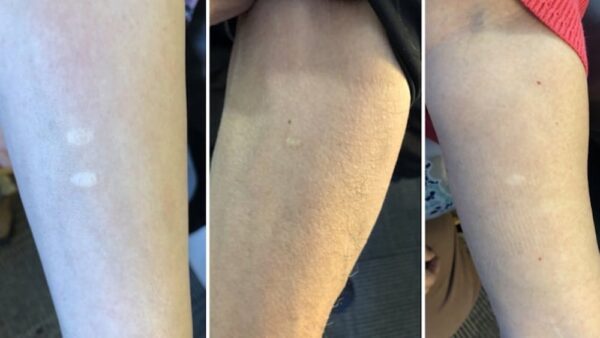
Some of the scars from alleged skin graft procedures conducted on Igloolik Inuit between 1967 and 1973. Five Inuit are seeking damages and an apology from the federal government, which asked a judge in August to dismiss the lawsuit. (Photo courtesy of Steven Cooper)
A Nunavut judge will have to decide whether to hear or dismiss the claims of five Inuit who allege the federal government subjected them to medical experiments in Igloolik in the 1960s and 1970s.
Former Nunavut premier Paul Quassa, filmmaker Zacharias Kunuk, Lazarie Uttak, Lydia Inooya and the late artist Madeline Ivalu, who died in May, are suing the federal government for more than $1 million each in damages.
But lawyers representing the federal government and three universities appeared in the Nunavut Court of Justice before Justice Mark Mossey this week to argue the 2019 lawsuit should be dismissed because it was brought too late.
“Applicable limitations periods under the limitations legislation in effect at the time have long since expired,” Chris Bernier, the federal government’s lawyer, wrote in a motion to the court in August 2025.
The federal government, University of Toronto, University of Manitoba, and University of Alberta are requesting a summary judgement, which if granted would prevent the case from going to trial.
Steven Cooper, the plaintiffs’ lawyer, said Mossey is expected to decide by the end of the year. He said if his clients’ lawsuit is dismissed, it would set a harmful precedent.
“If this case is allowed … to be dismissed in this fashion, this will have an impact across the country, especially in the North,” he said in an interview Tuesday.

The five plaintiffs are among approximately 30 Inuit who say they underwent harmful experiments, including ones that included skin-grafting and ones that were aimed at evaluating their tolerance to extreme cold.
Court documents filed by the federal government’s lawyer note the universities were among the partners involved in the experiments, conducted under a research program called the International Biological Program.
“Our position to the court was simply that the conditions in the North, the knowledge of the plaintiffs, and the law as it stands all suggest that this has to go to trial,” Cooper said. “The world of Igloolik in the ’60s and ’70s was very different than it is now, we have to be careful about applying southern case law to northern realities.”
A spokesperson for the federal Justice Department said it couldn’t comment on the government’s motion for dismissal, saying the Crown-Indigenous Relations and Northern Affairs departments would be better suited. Spokespeople for the departments were not immediately available to comment. The representative for Crown-Indigenous Relations mentioned the Remembrance Day holiday.
The three universities involved are not targeted by his clients’ 2019 lawsuit, Cooper noted. They came in as third parties, and filed motions alongside the federal government last August to dismiss the case.
Cooper said he believes lawyers for the federal government persuaded the universities to join the legal dispute as a delay tactic.
Nunatsiaq News asked the three universities and the lawyers representing them for comment but did not receive a response as of Thursday.
Cooper said the federal government’s actions go against the spirit of a 2021 civil litigation directive by the former Attorney General of Canada Jody Wilson-Raybould, which noted limitations should be pleaded only in exceptional cases when dealing with historical abuses brought forward by Indigenous Peoples.
(0) Comments