


Military marches on with Iqaluit forward operating location
Site to be last of 4 projects across Canada; tenders to be issued in early 2028
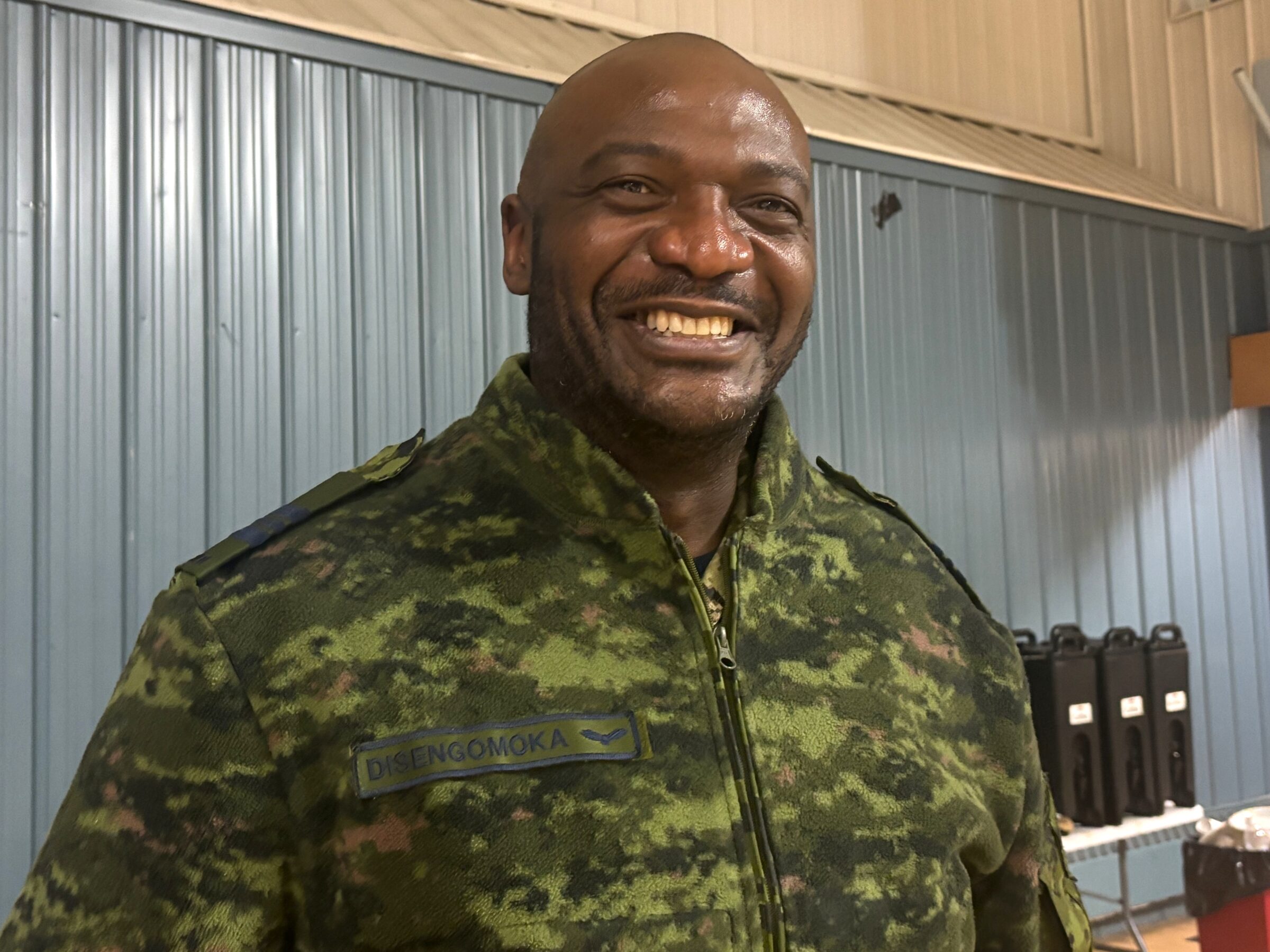
Maj. Jorim Disengomoka, pictured here at the military’s first public engagement in Iqaluit into its forward operation location, says he is always open to listen to residents. (Photo by Daron Letts)

Contracts for the $5-billion forward operating location planned for Iqaluit by 2040 are scheduled to be out for tender by early 2028, according to the Department of Defence.
“I don’t think it’s wishful thinking. I think it could happen in 2028,” said project director Mike Speiser during an interview Thursday. “I’m confident.”
Iqaluit will be the last of four future forward operating locations to be built. Work in Whitehorse, Inuvik, and Happy Valley-Goose Bay, N.L., are scheduled to be tendered throughout 2027.
Delays at any of the other locations could push back Iqaluit’s tender date, Speiser added, but not by much.
“Instead of January-February, it could be spring of 2028,” he said.
The construction phase is set to begin in 2031, with site preparation beginning in 2029.
Iqaluit is last on the list because Canada’s strategic threat comes from Russia and China to the west, said Air Force Col. Patrick Dubé during an interview.

To the east, Happy Valley-Goose Bay already has more infrastructure in place, leaving Iqaluit with the most development and logistics planning needs, he added.
The Defence Department posted an advance procurement notice in April to inform industry that contract bids will soon be accepted across all four locations.
The successful companies will be responsible for overseeing subcontracts to carry out the work. Bidding in Nunavut requires adherence to article 24 in the Nunavut Agreement, which requires the federal government to provide support to Inuit firms to enable them to compete effectively for government contracts.
Iqaluit’s facility will be designed to host a fleet of visiting southern aircraft ranging from fighter jets and transport planes to marine patrol and search-and-rescue aircraft.
It will serve as the staging point for southern-based aircraft to reach remote locations across the Arctic, as part of the federal government’s North American Aerospace Defence Command modernization plans.
The proposed site, north of the city’s existing runway, will feature warehouses, maintenance buildings, barracks for 600 soldiers, munitions storage, and airstrips, among other structures.

The project will include some dual-use infrastructure, which the municipality will build with federal funding, use and maintain, Dubé said.
Although plans are fluid, dual-use developments may include an enhanced fire hall, increased wastewater capacity, and a multi-use building with a classroom, garage, and space to house an emergency preparedness control centre.
So far, an archeological study is complete and will soon be shared with the Inuit Heritage Trust, said project manager Chris Middleton during a public engagement session Thursday at the cadet hall.
A traditional use study will soon follow, guided by wisdom from elders, he said.
An environmental site assessment and species-at-risk study are also on deck.
Members of the public with questions or concerns have somewhere to turn in the city, said Maj. Jorim Disengomoka, head of the Canadian Forces’ presence in Iqaluit, during Thursday’s public engagement.
Disengomoka moved to Iqaluit on Nov. 5 and is scheduled to remain for three years.
“I’m not going anywhere,” he said. “You can come to me and talk to me and I will relay your concerns. I will make myself available.”
He invited residents to visit his office at building 2050 on Hubbard Lane, near the port.
(0) Comments